Archive | October, 2025

Christian Nationalists and Texas Public Schools

26 Oct

By Thomas Ultican 10/26/2025

In September, the fifth largest school district in Texas, Fort Worth Independent School District (FWISD), adopted Bluebonnet Learning’s program of instruction. Three of the nine board trustees voted against the adoption, calling it “state-sanctioned indoctrination.”  Their concerns were well founded.

Bluebonnet uses Biblical passages in its lessons. The Texas Education Agency (TEA) contracted with Public Consulting Group in Boston to create the new curriculum. Public Consulting Group subcontracted with curriculum writers including Texas Public Policy Foundation, with radical Christian nationalist billionaire Tim Dunn serving as vice president on its board, and Hillsdale College, a rightwing Christian college and charter school organization from Michigan.  TEA also hired a conservative educational publishing company co-founded by former Arkansas Gov. Mike Huckabee to provide content for the state’s proposed program. But so far, the state has refused to identify the authors who transformed Amplify’s program into the Bible infused Bluebonnet curriculum.

TEA has made adopting Bluebonnet attractive. FWISD estimates that implementing Bluebonnet will cost nearly $2.4 million, however, TEA is providing $60 for every enrolled student so the districts expects to receive $4 million from the state. In addition, the Amplify reading lessons required staff to create content, but Bluebonnet creates the content for them.

Many people believe the real reason FWISD adopted Bluebonnet’s lessons is an attempt to placate Mike Morath, TEA commissioner of education. One of FWISD’s schools, Leadership Academy at Forest Oak Sixth Grade, failed the Texas Starr Testing for a fifth straight year. This triggered a state law requiring Morath to take some form of action. His options include taking over the district and replacing its elected leaders.

Reverend Mary Spradlin of Pastors for Texas Children said the adoption of Bluebonnet looked like a move by the district to placate TEA Commissioner Mike Morath. She added, “If you feel like you must adopt it to avoid a takeover, we’ve already lost control.” Reed Biltz, governance chair of the League of Women Voters of Tarrant County, also opposed the adoption saying it looks like taking a bribe from TEA. Bilz noted, “The league opposes threats to basic constitutional rights.”

TEA Strips Democratic Rights in Fort Worth

Today’s (10/23/2025) Fort Worth Report announced, “Fort Worth ISD’s nine locally elected trustees are out as Texas officials stepped in Thursday after years of poor student outcomes.” Whether you believe FWISD Superintendent Karen Molinar’s claim that adopting Bluebonnet had nothing to do with a threatened state takeover or believe the opposite claims, it makes little difference now. The Report headline reads, “Texas takes control of FWISD in state’s second-largest public school intervention.”

Morath wrote, “Since the campus earned its fifth consecutive unacceptable academic rating in that year, the school’s subsequent closure has no bearing on, and does not abrogate, the compulsory action the statute requires the commissioner to take.” The commissioner was not required to get rid of the elected school board; that was his choice.

This is the same reason that the Houston ISD was taken over. One school in a high poverty community did not reach the designated cut scores on Texas Starr testing five years in a row.

Like all standardized testing, the Starr results only correlate strongly with family wealth. In FWISD, 85% of the students are either Black or Hispanic with 83% listed as economically disadvantaged. In Texas, this kind of data means a community’s democratic right to elect their school leaders will likely be stripped. Now the state’s largest and fifth largest school districts, which are in heavily democratic communities, have been taken over by the Christian nationalist running TEA.

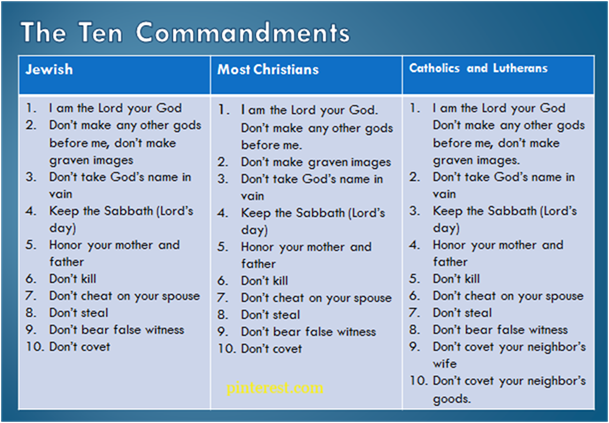
Besides creating Bluebonnet, Texas political leaders are taking other measures to force Christianity into public schools. New state laws require displaying the Protestant version of the Ten Commandments in all classrooms. Gov. Greg Abbott also signed legislation in June that allows districts to offer a daily, voluntary period of time to pray and read the Bible or other religious texts. A 2023 law allows districts to hire chaplains as counselors.

Why has driving Protestantism into public schools become a state agenda?

Billionaire Dollars Driving Christian Nationalism

A year ago, Propublica published “A Pair of Billionaire Preachers Built the Most Powerful Political Machine in Texas. That’s Just the Start.” The article begins by telling the story of former Texas state representative Glenn Rogers. It would be hard to imagine a more conservative legislator, but he got crosswise with Billionaire oilmen and hardcore Christian nationalists Tim Dunn and Farris Wilks. Rogers believes two of his votes caused the problem. He voted against vouchers and voted to impeach Attorney General Ken Paxton, one of their most powerful allies.

In 2023, Hours before the Texas House overwhelmingly voted to impeach Ken Paxton in May, a well-funded supporter of the attorney general issued a threat to his fellow Republicans. A vote to impeach Paxton, Jonathan Stickland wrote on Twitter, “is a decision to have a primary.”

Stickland was the leader of Defend Texas Liberty, a political action committee that has donated millions of dollars to far-right candidates in the state. It is a key part of the constellation of political campaigns, institutions and dark-money groups that West Texas oil tycoons, Tim Dunn and Farris Wilks, have lavishly financed in their long-term crusade to push Texas to the extreme right. KSAT in San Antonio claims, “Over the past 20 years, Dunn and the Wilks brothers have sunk nearly $100 million into a sprawling mix of nonprofits, political campaigns, think tanks, fundraising committees and websites to advance their far-right religious, economic and anti-LGBTQ+ views.”

In October 2023, the Texas Tribune wrote, “Nick Fuentes is just the latest white supremacist embraced by Defend Texas Liberty.” The meeting between Defend Texas Liberty’s Jonathan Strickland and the pro-Nazi Fuentes caused such a backlash that Strickland was removed from his post. The political foes of Dunn and Wilks believed this issue would finally undermine their political juggernaut.

Instead, in 2024, Dunn and Wilks materialized large victories everywhere and grew stronger than ever. They defeated long time political foes and set their allies up to take over the state Legislature. According to KSAT, they left no doubt “as to who is winning a vicious civil war to control the state party.”

Too Much Money in Too Few Hands

This year, Texas Republicans finally forced vouchers onto a public that did not want them. In addition to the Christian nationalist money, Jeff Yass, the richest man in Pennsylvania, spent heavily to make vouchers a reality in Texas. Yass is a Jewish boy from the Bronx who co-founded Susquehanna, now a giant options trading and market making company. In the last year, according to Forbes, his net value has more than doubled from $27.6 billion to $59 billion.

Yass and his wife believe in school choice and that is their right. However, their unbelievably large fortune makes their opinion so much more important than those of the rest of us. It is the same with politics in Texas. Dunn and Wilks have such large fortunes they swamp the public’s will. Their lavish spending for Christian nationalism and Jesus in politics is overwhelming the majority of Texans.

This article provides one more piece of evidence making it clear something must be done about the growing menace of oligarchs in America. We need some sort of redistribution of assets in the United States and much higher taxes on the wealthy. The state of economic inequity is a major outcome of the Reagan revolution and it is destroying our democracy.
Beyond Resilience Katrina at 20

14 Oct

By Thomas Ultican 10/14/2025

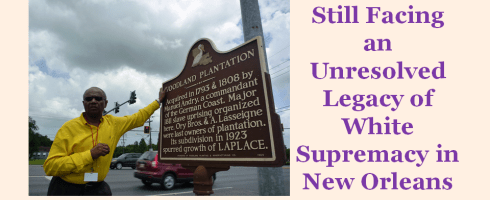
The book William Franz Public School is a well documented work that shines a light on the deep racism in New Orleans and especially in its public schools. The title is the school where 6-years-old Ruby Bridges accompanied by federal officers desegregated New Orleans’ schools to the chagrin of the 1,000 plus protesters out front. “The message rang clear; Louisiana’s strong commitment to the education of its White, wealthier children paralleled an equally strong commitment to keep its Black, poor residents uneducated and isolated, and thus economically and politically powerless.” (WFPS 11) That ugly racism still permeates New Orleans which made me question what are their Black residents thinking and feeling. Ashana Bigard’s book, “Beyond Resilience Katrina 20, brilliantly provides some answers.

Bigard and her family have been in New Orleans forever; she is at least fifth generation. Her large family is a big part of the soul of New Orleans. Ashana takes her readers into the Black community that has refused to be beaten down and defeated by wealthy White supremacists.

After Katrina, the people in power stole the public community schools, fired the mostly Black teaching force and brought in predominantly white kids from Teach for America (TFA) to teach. Ashana shares that story beginning with running from the storm and then fighting against injustice for the last 20-years.

Katrina Arrived

Hurricane Katrina arrived about a week before payday for much of the New Orleans community. Like many others, Ashana and her family had experienced hurricanes before. They really could not afford to travel so they chose to wait it out at home. The storm came through and made a direct hit on the city, it was loud and intense but the next morning things seemed OK.

It was a tough night, but they had successfully ridden out the storm and it was beautiful outside. Ashana decided to walk to the old New Orleans community of Carrollton to check on a friend. Downed trees were everywhere. On the way an old man informed her that if she did not “have a boat in your pocket” she better get out of there because the levees had failed and the water was coming. (Bigard Page 11)

Some people in the community believed the levees had been purposefully blown up. Ashana and her family quickly got it together to load up and head out for Houston where they stayed until New Orleans opened again.

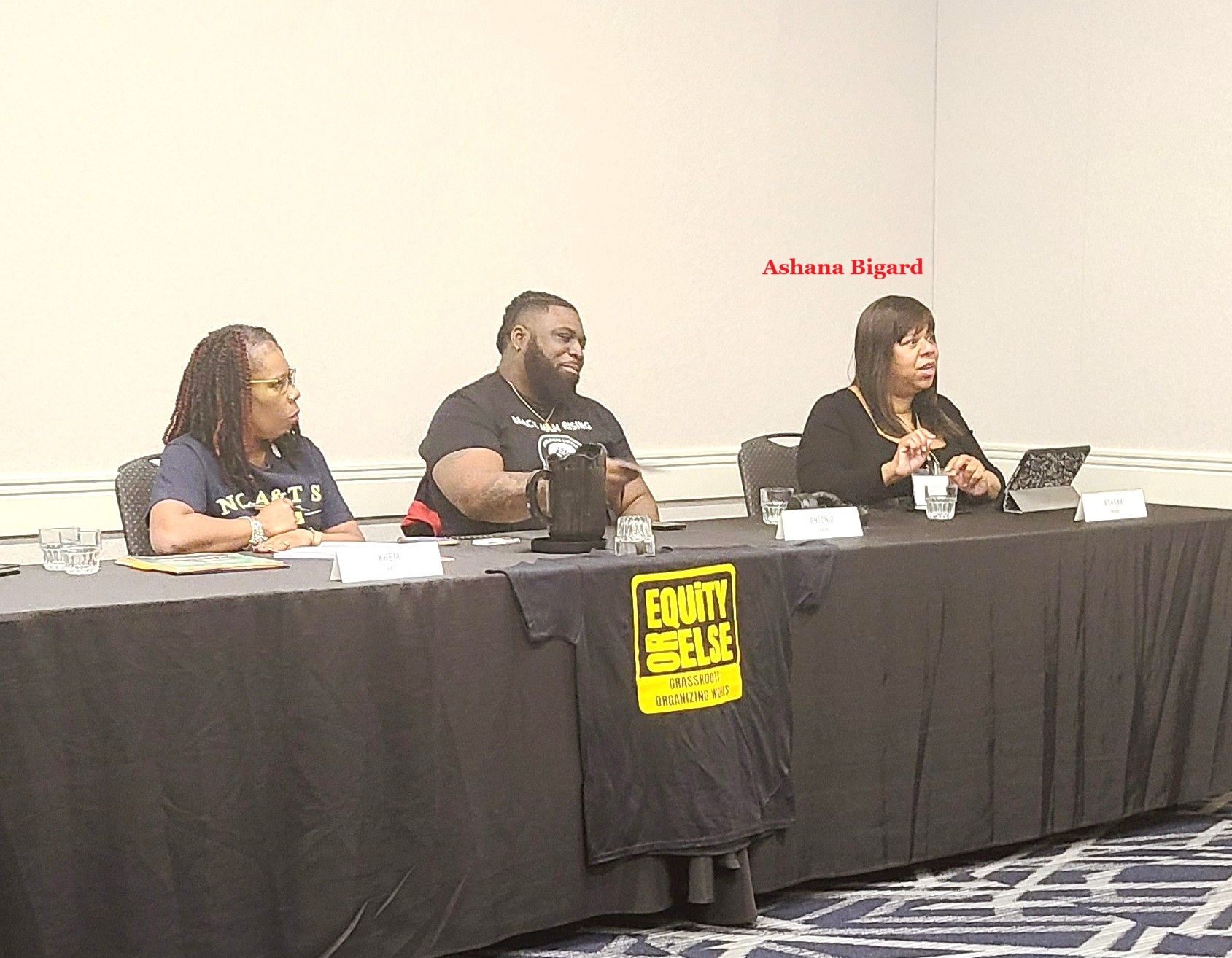
NPE 2025 Photo by Ultican

Back in New Orleans “the fraud was staggering” and media racism was appalling. Ashana noted:

“It seemed like every opportunity afforded to them, the media disparaged us calling us refugees and calling us looters. … White people getting food from stores to help each other … were described as ‘finding food.’ Black people doing the exact same thing were ‘looters’ and criminals who should be shot on sight, despite the fact that they had been left to die with no water, no food for days on end.” (Bigard Pages 32 and 33)

Rebuilding New Orleans

The work force in New Orleans is dominated by the Black community. However, when the rebuild started, local unions were frozen out. Wealthy carpetbaggers were running the show. Ashana sarcastically asks, “how could everybody get their money off the top if they were actually paying people real wages?”

There were no longer community schools that welcomed children or a city that was welcoming to its people. They soon began referring to their children’s schools as “test prep factories” and the kids called them “preparatory prison practice.” The youths of New Orleans named the new Knowledge is Power Program (KIPP) schools “kids in prison practice.” (Bigard Page 34)

Ashana worked at various non-profits as a student, parent and community counselor and advocate. She worked for families and friends of Louisiana’s incarcerated children where family members wanted to understand how their children first came into contact with the legal system.

Where were the arrests happening? Where were the summons coming from?” (Bigard Page 44)

The discovery didn’t take long. Ashana states, “The police inside the schools were arresting children for almost anything.” (Bigard Page 45) Best practices in adolescent development call for supportive environments, recognition of the biological realities of the teen years, and second chances not criminalization and punishment. This new school-to-prison pipeline was a complete abandonment of reason.

What developed in New Orleans was a harsh unforgiving no-excuses approach. This led to high expulsion rates and a 61% graduation rate.

Ben Kleban of College Prep charters told Ashana he would run his schools the way he wanted and if you don’t like it do what I did and start your own school. However, many PHDs, principals and academics from New Orleans applied to start schools almost none of them received a charter. (Bigard Page 54)

Ashana tells the story of counseling a teenage boy, a good student whose grades began falling for no apparent reason. Also he was becoming more and more despondent. After a week of discussion, he finally opened up about being sexually assaulted by a female TFA teacher. Apparently, the teacher succumbed to the adultification of young Black people. The student was blaming himself and tried to protect the teacher saying, “She came from Teach for America: they don’t give them much training.” (Bigard Page 98)

Ashana and her team were brought in to conduct a workshop on trauma: signs of trauma, solutions for trauma and how to deal with trauma in your classroom. Ten minutes into the workshop all 26 of the young White women were in tears. Ashana states:

“They were crying saying they were overwhelmed, suffering from secondary trauma, felt like they were crazy, and they all felt they were doing more harm than good. They had no support and when they went to Teach for America for support, they told them to try harder, and if they weren’t connecting, it was their fault because everyone else was doing a great job.”

The training developed into multiple unscheduled workshops that day as teachers went out and encouraged their colleagues to attend. Ashana says:

“I left the workshop understanding you never know all sides of the story and that there was a second wave of victims, and that was young, hopeful, starry-eyed white young people who thought this would be a great city to live in and a great opportunity and they could come and help out because of the teacher shortage which was caused by the firing of all our teachers and subsequently telling them that they had to take multiple tests to qualify to come back to teach while simultaneously telling young white children they only needed two weeks of training to do so.” (Bigard Pages 119-121)

The Legacy of Racism Lives On

To enroll children into the almost all charter system in New Orleans, parents must use OneApp. It runs the school choice algorithm but strangely only white children get into the best schools, not even if you’re a Black family in the upper middle class do you get a seat. It is common to see white people move to the city and magically get their children into schools with 100 children on the waiting list. Ashana notes, “They didn’t even know the school existed prior to moving to the city, but racism and classism still existed heavily within the new system.” (Bigard Page 268)

Ashana tells black people in New Orleans that poverty is not a moral failing. She says, “We start understanding that we are not broke we are stolen from.” (Bigard Page 318)

I have presented a few highlights in this delightful and insightful book. For me, Ashana’s book offers a rare view into the life of Black people fighting White supremacy and a story of love and family.

Bravo Ashana Bigard!

Public Education Shaped by 19th Century Dispute

8 Oct

By Thomas Ultican 10/8/2025

Horace Mann, frequently referred to as the “father of public education”, declared that public education should be nonsectarian. He was responding to a dispute in the Protestant community between the Congregationalists, Unitarians, Episcopalians, Lutherans, Presbyterians and other Protestant sects who were threatening to separate from the common schools and form their own parochial systems. Mann countered that schools should restrict themselves to commonly shared Protestant values. He believed such values were the principles of civic ethics necessary for participation in our republican form of government. Katherine Stewart reported, “Representatives of a number of sects immediately and vigorously attacked him, but large majorities agreed with this policy, and it soon became the norm in the ‘common school,’ or public school movement.”

As long as the overwhelming majority of Americans were Protestant, this solution was workable. However, the Catholic community was growing. The 25,000 American Catholics in 1790 represented less than 1% of the population. By 1820, their 195,000 members were 2% of American people. In 1830 they were at 318,000 (2.5%), in 1840 663,000 (3.9%) and in 1850 their ranks grew to 1,600,000 (6.9%). (See “Religion in America; A Political History” By Denis Lacorne Page 64) The Catholics were becoming a bigger group with growing influence.

In his book, “Schooled to Order: a Social History of Public Schooling in America” Professor David Nasaw noted that common school textbooks were filled with racist characterization of the Irish and disdain for the Pope. The Catholic clergy were described as “libertine, debauched, corrupt, wicked, immoral, profligate, indolent, slothful, bigoted, parasitic, greedy, illiterate, hypocritical and pagan.”  Catholic parents did not want to expose their children to this and they did not like daily readings from the King James Bible instead of their preferred Douai-Rheims Bible.

Before we go on, a little background on these two Bibles. The Douai–Rheims Bible is a translation of the Bible from the Latin Vulgate into English made by members of the English College, Douai, in the service of the Catholic Church. The New Testament portion was published in Reims, France, in 1582, and the Old Testament portion was published twenty-seven years later in 1610 by the University of Douai. The Latin Vulgate is a translation of Hebrew, Aramaic and Greek texts, accomplished in 382 mainly by Saint Jerome.

The King James Bible is an Early Modern English translation sponsored by King James I of the Christian Bible for the Church of England, commissioned in 1604 and published in 1611. The source material for the translation includes the Latin Vulgate plus Hebrew, Aramaic and Greek texts.

Although very similar to each other there are some differences. However, early 19th century bigotry trumped all differences. In her study of 19th century textbooks, Ruth Miller Elson showed that anti-Catholic propaganda was a staple of allegedly disinterested lessons on non-religious topics. In history, they learned “the Roman Catholic religion completed” the Roman Empire’s “degeneracy and ruin.” Lessons in patriotism taught that the founding fathers would never “have bowed to papal infallibility, or paid the tribute to St. Peter.” Evan textbooks that commended tolerance in matters of religion were “full of the horrible deeds of the Catholics.”

Maybe it is not so shocking how violent the Catholic-Protestant dispute became. One of the deadliest episodes in early American history occurred in 1844 when Protestants and Catholics took to the streets of Philadelphia. After two weeks of rioting, twenty-five people laid dead in the streets, more than one-hundred were wounded and dozens of homes as well as two churches were torched.

In 1859, a watershed moment occurred in Boston involving a ten-years old student, Thomas Whall. He refused to read the Ten Commandments at the beginning of his morning class at Eliot School, a Boston public school. Young Whall refused based on the fact that these Commandments were from the King James Bible. By this act he was breaking Massachusetts law. The principal “whipped” him on the hands with a rattan stick until his fingers were bleeding and Whall fainted. He would not yield. Whall’s fellow students followed his lead and refused to obey. Hundreds of them were expelled. (Lacorne Page 72)

After Whall’s father sued the principal for using excessive force, Judge Sebeus Maine found for the school and its principal. He said that Thomas’s refusal threatened the stability of the public school, “the granite foundation upon which our republican form of government rests.”He indicated the readings were free of dogma; it was all done objectively with no inappropriate comments. Therefore, there was no violation of freedom of conscience. (Lacorne Page 73)

Katherine Stewart reported:

“This incident led Catholic leaders to conclude that public schools could not serve their community. In response, they launched a movement to create Catholic parochial schools in Boston and across the nation.”

No Compromise

The disdain and prejudice against Catholics was deeply ingrained in Ohio. University of Cincinnati’s former writing coach, Deborah Rieselman quotes associate history professor Linda Przybyszewski:

‘“It was very respectable then to be anti-Catholic,’ notes Przybyszewski. ‘Neighborhoods were often segregated. In 1844, after Cincinnati newspapers carried stories of anti-Catholic riots on the east coast, a group of men threw sticks and rocks at a house occupied by Catholic clergy, according to a German priest who had immigrated to Cincinnati.”’

“Even the Rev. Lyman Beecher, Harriet Beecher Stowe’s father, was a vocal opponent of Catholics. Considered a progressive thinker because he was a black abolitionist and the founder of a Cincinnati seminary, Beecher preached a ‘papal conspiracy theory’ that Catholics would take over the West.”

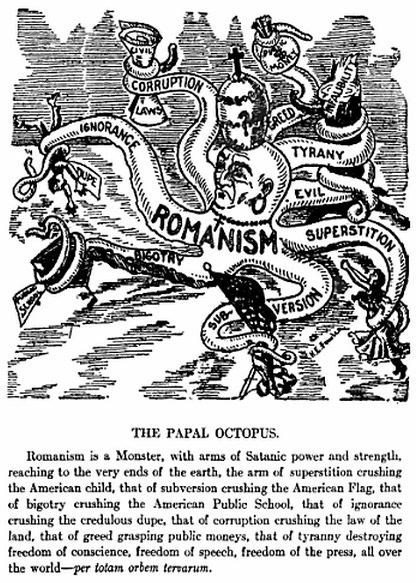
An Anti-Catholic Cartoon

In 1869, a fierce political and legal battle erupted in Cincinnati, Ohio. For some time there had been discussions on the school board about the possibility of uniting the public schools and the Catholic system. There were more than 12,000 students in the Catholic parochial system. One of the keys to the new plan was that there would be no Bible reading in classes.

Ohio State History Teacher, Harold M. Helfman, wrote:        

“The bitter clash between those maintaining pro-Bible and anti-Bible viewpoints was to drive both groups into positions of no surrender; their mutually hostile attitudes were to be seized upon by societies, editors, lecturers, ministers, and politicians bent on stirring up latent anti-Popery passions. The board of education’s action was destined to be the focus of a public opinion which plunged Cincinnati into a boiling caldron of fear and bigotry.”

Top legal minds in Ohio fought this battle out in the courts with the Ohio Supreme Court ruling in favor of the Board of Education and their no Bible reading plan. In a subsequent election, most of the board members who voted for the plan were reelected. Unfortunately, the attempts to unify the schools systems were ended by the associated vitriol.

The anti-Catholic bias in America was deeply held by many Protestants; lasting a long time. During the Presidential election campaign of 1960 between Kennedy and Nixon, former President Harry Truman was asked about the influence of the Pope on Kennedy. He cracked, “It’s not the Pope I’m afraid of, it’s the Pop.” Kennedy became the first Catholic ever elected President of the United States.

As late as 1887, the school day still contained “sacred song,” “the literature of Christendom” and “faithful and fearless Christian teachers,” according to a speech that Cincinnati superintendent E.E. White gave to the National Education Association that year. In 1957, my second grade teacher in King Hill, Idaho read a verse to us from the King James Bible every day.

During his second term, US Grant called on states to prohibit “the teaching in said schools of religious, atheistic, or pagan tenets” and ban “the granting of any school funds or school taxes . . . for the benefit or in aid, directly or indirectly, of any religious sect or denomination.” Grant concluded, “No sectarian tenets shall ever be taught in any school supported in whole or in part by the State, nation, or by the proceeds of any tax levied upon any community.”

James Blaine, a former Republican House Speaker with his own 1876 presidential ambitions, jumped at the political opportunity. He introduced a constitutional amendment seeking to codify Grant’s proposals. Although some argue that these provisions reflect a long and admirable history of separation of church and state advanced by the founders, others maintain that these provisions reflect hate and anti-Catholic bigotry that peaked in the 1870s with the national proposal.

Blaine’s amendment failed in the Senate but has been adopted into the constitution of 37 states. In 2020, the Supreme Court discussed the Blaine amendments in Espinoza vs. Montana. In their decision they the court described the Blaine amendments as being “born of bigotry.” This decision has significantly undermined prohibitions of tax dollars going to religious schools.

Thoughts on Protecting Schools and Children

There is little doubt that running multiple tax supported education systems is less efficient and more expensive. However, if that is what people want; it is doable. Unfortunately, many voucher schools and charter schools are not being held accountable. If we are to have these multiple systems, they must all adhere to public education standards and accountability. That means no discrimination and no turning away undesirable students. No anti-LGBTQ rules, no religious tests and no student academic qualifications when accepting tax payer money.