Archive | February, 2025

Teach Truth

23 Feb

By Thomas Ultican 2/23/2021

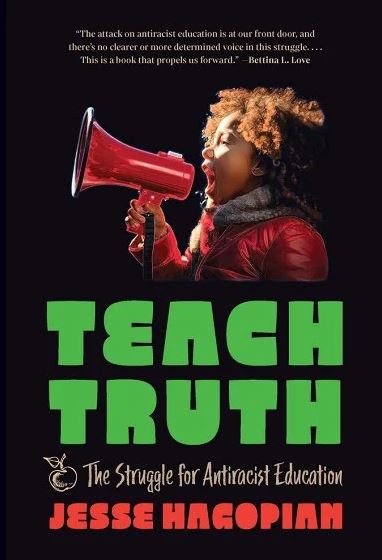
In “Teach Truth: The Struggle for Antiracist Education,” Author Jesse Hagopian takes his readers inside the struggle and shares Black culture. At the 2018 Indianapolis Network for Public Education conference, Journey for Justice Chairman, Jitu Brown, introduced Jesse as “a freedom fighter who happens to be a teacher.” What I did not understand then is that he also happens to be man who can write.  This book is exceptional.

Jesse defines two concepts that he uses throughout the book: uncritical race theory and truthcrime law.

He states, “Uncritical race theory denies that racism exists at all, or maintains that racism primarily victimizes white people, or rejects any systemic or institutional analysis in favor of an inter personal explanation that understands racism as only sporadic and merely the product of individual bias.” (Page 7)

He explains:

“A truthcrime is any act of honest pedagogy in a jurisdiction where truthful teaching has been outlawed. Truthcrime is enforced disremembering. A truthcrime law, then, is one that makes lying to children obligatory and effectively renders honest educators as truthcriminals.” (Page 16)
Interesting Take on CRT

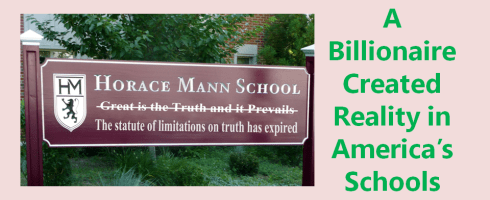
A goofball white guy from Seattle, Washington became famous by attacking critical race theory (CRT) in a completely dishonest way. Unfortunately, right-wing billionaire money trumpeted his assertions. At a time when the vast majority of America’s teachers had never heard of CRT, he claimed that public schools were indoctrinating students with CRT. For a short period of time, CRT became the racist rights number one anti-public schools slogan and a Republican campaign tool.

CRT emerged amongst scholars and lawyers in the late 1970s and early 80s as a way to understand the forces upon Black citizens after Brown v. Board of Education in 1955, The Civil Right act of 1964 and the Voting Rights act of 1965. It was pretty much the purview of graduate school seminars. (Page 6)

At a June, 2022 “Road to Majority Policy Conference” in Nashville, Tennessee, Texas Senator Ted Cruz declared, “Let me tell you right now, critical race theory is bigoted, it is a lie, and it is every bit as racist as the Klansmen in white sheets.” Hagopian observed, “The irony here is profound; while Cruz compares those who teach CRT to the KKK, his own attack on antiracist education aligns with one of the Klan’s primary objectives: thwarting Black education and antiracist pedagogy—which they have done ferociously throughout US history.” (Page 40)

Hagopian discusses why feckless Democrats did not effectively respond to the GOP’s CRT attacks. He gives the example of Democrat Terry McAuliffe’s race for the Virginia Governorship against Glenn Youngkin. When Youngkin made a full throated attack on CRT calling it “toxic” and “flagrant racism, plain and simple” that is a “poisonous left-wing doctrine,” McAuliffe replied, “I don’t think parents should be telling schools what they should teach.” This response might have cost him the race. (Page 150)

Why was McAuliffe’s answer so weak in this contest between two multimillionaire white men? Hagopian think he knows. He says, “Because many liberal politicians don’t actually support CRT, they are placed in a difficult spot during elections when Republicans attack it.” Although opposing bigotry, they do not want to support a movement that could upset their corporate sponsors. (Page 150)

Diane Ravitch wondered why so many people were silent in the face of a coordinated effort to teach inaccurate history? She wrote:

“Where was Bill Gates? Although right-wing nuts attacked Bill Gates for spreading CRT, Gates said nothing to defend schools and teachers against the attacks on them. He is not known for shyness. He uses his platform to declare his views on every manner of subject. Why the silence about teaching the nation’s history with adherence to the truth? Why no support for courageous teachers who stand up for honesty in the curriculum?” (Page 153)

Hagopian concludes, “Their lack of gusto for racial, economic, and social justice stems instead from the fact that, as with the GOP, they are predominantly funded by white billionaires who see no advantage to teaching students about systematic racism or capitalist exploitation.” (Page 156)

President Trump invokes maximum hyperbole with his unenlightened view of CRT:

“Getting critical race theory out of our schools in not just a matter of values, it’s also a matter of national survival. We have no choice, the fate of any nation ultimately depends upon the willingness of its citizens to lay down—and they must do this—lay down their very lives to defend their country” (Page 79)

Billionaire Dollars Push the Lie

Jesse began his career as a teacher at Hendley Elementary School in South Washington DC. The school’s neighborhood had a dearth of grocery stores and jobs. Hendley had a completely segregated 100% African American student population. It was 2001 and that September, the World Trade Center attack was coincident with him becoming an educator.  (Page 223)

He tells the story of his first year teaching noting seeing a police officer jack-up a fifth grade boy against a wall; the boys feet were dangling. The student was accused of throw paper in class. Jesse also describes a whole in the middle of the classroom chalkboard that his students called a bullet hole.

A poster session on US history revealed another hole in the classroom. The posters were all hung on a Friday and that weekend it rained. Upon arriving at school on Monday morning, Jesse found the floor flooded and the posters soaked. After the second classroom flooding, he wised-up and put a large trash bin below the hole in the roof. His work orders to fix the roof were never filled.

Hagopian observes, “I received a graduate degree in education theory that year by witnessing the cynicism of our nation’s ability to mobilize armies to bomb people on the other side of the world while refusing to find the money to fix the hole in the ceiling of my classroom or properly care for these children in the shadow of the White House.” (Page 224)

The attack on teaching truth in America’s classrooms is being financed by right-wing billionaires. People like Julie Fancelli, an heir of the Publix grocery fortune, former secretary of public education, Betsy DeVos, oil magnate, Charles Koch, the secretive electronics billionaire, Barre Seid, and so many more.

Jesse notes that:

“Maintaining an economic system such as ours, where eighty-one billionaires have more wealth than the bottom half of all people on Earth, doesn’t just happen by accident. It takes careful investment in institutions that shape ideas, and those investments see the biggest returns in the mass media and the system of schooling.” (Page 157)

A Surprise to Me

I was aware that homosexuality was illegal in America until the 1970s and that the legal turning point came in 1969 at the Stonewall Inn. This gay bar in Greenwich Village was the site of a gay uprising when police raided the bar. Today’s annual pride festivals originate from and celebrate the Stonewall riot.

What I did not know until reading Teach Truth is that the rebellion was led by Marsha P. Johnson and a host of Black and Brown queer people. (Page 97-98)

I highly recommend reading this book. It is full of surprises like this one.
Strange Science of Reading Law Suit

20 Feb

By Thomas Ultican 2/20/2025

December 4, 2024, two law firms from New York and Chicago respectively filed a class action law suit against reading curriculum developers not steeped in science of reading (SoR).  One of the attorneys behind this Massachusetts suit, Benjamin Elga, said he listened to the Sold a Story podcast and immediately saw “an injustice that cried out for redress.” Their main claim is that “the National Reading Panel commissioned by Congress in 1997 confirmed, all credible education and literacy research shows that daily phonics instruction is necessary for literacy success” and that these curriculum developers were deliberately deceiving schools and parents when they did not focus on systematic phonics instruction.

The suit was brought against: Lucy Calkins and her Units of Study, Irene Fountas and Gay Su Pinnell and their Reading Resources, The Reading and Writing Project at Mossflower, Teachers College Columbia University, Greenwood Publishing Group, Heinemann Publishing and HMH Education Co.

First of Its Kind Law Suit

Never before have curriculum providers been targets of this type of suit.

In paragraph-22 of the filing, the plaintiffs claim, “For decades, scientists and educators have understood that the first step in teaching literacy is robust, daily, and extensive instruction in phonics.” Unfortunately, this statement is not true.

The ideology supporting phonics comes from the National Reading Panel (NRP) that was supervised by the National Institute of Child Health and Development (NICHD). NRP was founded in 1997 and presented its findings in 2000. The report was supposed to end the reading wars but it came under immediate attack including in the minority report by Joanne Yatvin, who wrote: “At its first meeting in the spring of 1998, the Panel quickly decided to examine research in three areas: alphabetics, comprehension, and fluency, thereby excluding any inquiry into the fields of language and literature.”

Yatvin was the superintendent of a school district in Oregon, held a PhD in education and was the only panel member with classroom experience teaching reading.

Yatvin published Babes in the Woods: The Wanderings of the National Reading Panelfor Kappan (January 1, 2002) in which she directly addressed the phonics piece:

“The situation worsened when the phonics report was not finished by the January 31 deadline. NICHD officials, who wanted it badly, gave that subcommittee more time without informing the other subcommittees of this special dispensation. The phonics report in its completed form was not seen, even by the whole subcommittee, of which I was a member, until February 25, four days before the full report was to go to press. By that time, not even all the small technical errors could be corrected, much less the logical contradictions and imprecise language. Although a few changes were made before time ran out, most of the report was submitted ‘as is.’ Thus the phonics report became part of the full report of the NRP uncorrected, undeliberated, and unapproved. For me, that was the last straw, and I informed my fellow panel members that I wanted my minority report to be included.”

The blow-back to the original report was strong. Elaine Garan is an award-winning researcher, author of Resisting Reading Mandatesand educator with 24 years of experience as a reading teacher.  In March 2001, she wrote, “Beyond the Smoke and Mirrors: A Critique of the National Reading Panel Report on Phonics” published by Kappan. When two NRP panel members, Linnea Ehri and Steven Stahl, attacked her in their Kappan article, she responded:

“I used the data and words of the National Reading Panel (NRP) to establish that its report was fatally flawed in terms of the fundamental research protocols, including validity, reliability and generalizability.  I established that, rather than living up to the highly publicized claims of ‘scientific’ accuracy, the report was riddled with errors.”

Garan was right. There are no “strong correlative and causal relationships between systematic phonics instruction and reading success.”

Despite the suits claim that “all credible education and literacy research shows that daily phonics instruction is necessary for literacy success”, there are in truth many highly credentialed scholars who disagree.  Posted on Ferman University Professor Paul Thomas’s blog are many articles with links to hundreds of scholars opposing SoR. In a recent post, he noted,

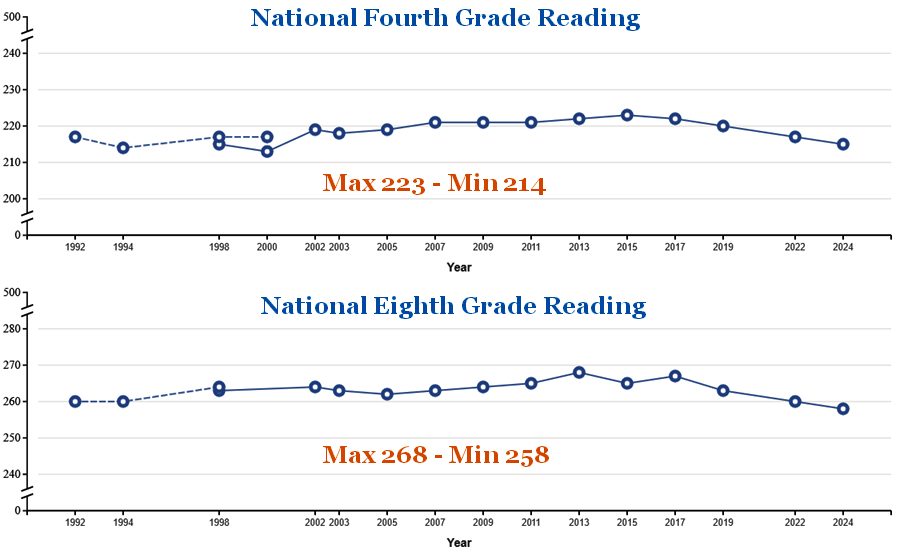
“The hand wringing over the 2024 NAEP reading results, however, seems to focus on learning loss and post-Covid consequences—not that reading achievement on NAEP was flat during the balanced literacy era and now has dropped steadily during the SOR era:”

Peter Johnston and Deborah Scanlon of the University at Albany debunked the Science of Reading (SoR) in this report.

Maren Aukerman is currently a Werklund Research Professor at the University of Calgary who focuses on literacy education and formerly served on the faculties at Stanford University and the University of Pennsylvania. She warns of journalists using logical fallacies to promote science of reading (SoR). For example, not reporting research showing students taught to read without systematic phonics “read more fluently.”

In 2023, a major study of teaching reading in the United Kingdom was released. The UK embraced a phonic first reading paradigm similar SoR in 2012. The researchers conclude an over-emphasis on phonics instruction caused reading test scores to go down. This matches what we have seen with this year’s National Assessment of Education Progress (NAEP) testing.

2024 NAEP Reading Results

Both nationally and internationally, many education researchers are openly opposed to SoR. Its support comes almost exclusively from billionaire sponsored researchers and publications.

Lawyers versus Educators

Two scholars, Robert J. Tierney, Dean Emeritus of the Faculty of Education at University of British Columbia, and Paul David Pearson, Evelyn Lois Corey Emeritus Professor of Instructional Science in the Berkeley School of Education at the University of California Berkeley, published the free to download “Fact-Checking the Science of Reading.”  

Lawyer Benjamin Elga said he listened to the Sold a Story podcast and it motivated his law suit. The education professionals wrote:

“Undoubtedly, for both of us, the precipitating event was Emily Hanford’s (2022) release of the six-part podcast, Sold a Story, broadcast by American Public Media beginning in late 2022. Hanford’s series motivated us to accelerate our response for many reasons—two of which were most pressing to us:

  1. A consistent misinterpretation of the relevant research findings; and
  2. A mean-spirited tone in her rhetoric, which bordered on personal attacks directed against the folks Hanford considered to be key players in what she called the Balanced Literacy approach to teaching early reading.” (Pages xiii and xiv)

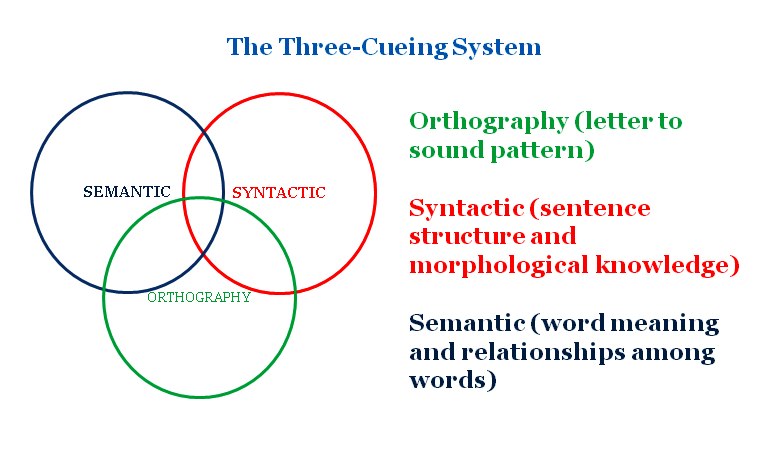
Paragraph 39 of the law suit states, “Cueing methods have been roundly criticized for teaching children to guess rather than read.”

This above is a diagram of what they mean by cueing. Orthography uses phonics type approaches to sound out unknown words. Does it look right? With the second cue, syntactic, a student tries to understand what is written. Does it sound right? What would make it conform to grammar rules? Semantics is the last of the three cues. Does it make sense?

Cueing methods like all widely used reading curriculums embrace phonics as a tool but not as part of a daily structure.

Tierney and Pearson observed,

“It seems overly limiting to discredit the use of cueing systems based on what some might consider a restrictive assumption—that reading is entirely the accurate naming of words, rather than an act of meaning making that involves hypothesizing. To dismiss the use of context as an over-reliance on ‘guessing’ or ‘predicting’ ignores important evidence.” (Page 65)

Who Are These People?

With five lawyers listed on the class action law-suit, Kaplan & Grady is a firm in Chicago specializing in commercial and civil rights cases. Justice Catalyst Law (JCL) is a non-profit law firm from New York with two lawyers listed on the case. Both firms are fairly new, Kaplan & Grady was founded in 2022 and JCL was formed in 2018 per their tax filings (TIN 83-0932015).

Not much is known about the private company but in 2022, the non-profit took in $2,185,000 in contributions and Partner Benjamin Elga has connections to big Silicon Valley money. He is a Senior Fellow at American Economic Liberties Project to which The Irish Times reports that eBay founder Pierre Omidyar is a large contributor.

New court filings are due in March and the lawyers are demanding a jury trial.

Billionaire Purchased Research Hawks Virtual Tutoring

12 Feb

By Thomas Ultican 2/12/2025

Billionaires have enlisted the aid of Universities in their push to sell kids-at-screens education. The latest effort, dutifully reported in The 74, claims that Johns Hopkins University has shown “Done Right, Virtual Tutoring Nearly Rivals In-Person Version.” They say two new studies performed there show “how high-quality virtual tutoring can help struggling students.” In Massachusetts, they are testing virtual tutoring programs on 6-year old students, which is morally repugnant.  

The 74 reports,

“In a quasi-experimental study published in December, Neitzel and her colleagues found that first-graders in Massachusetts who used Ignite Reading, a one-to-one virtual tutoring program, made substantial progress in reading, with the percentage of students reading on grade level rising from just 16% in the fall to about 50% by spring.”

Neitzel is Assistant Professor Amanda Neitzel, Deputy Director of Evidence Research at Johns Hopkins University. Ignite Reading is a for profit company specializing in science of reading (SoR) approaches to virtual tutoring. The bill for this program, which was run in 13 Massachusetts elementary schools, was paid by One8 Foundation (TIN: 04-6836735), a three-quarter-billion dollar Jewish centric foundation that regularly gives to privatizing organizations like Teach For America, KIPP and Success Academy.

The quasi-experimental study was published in December, 2024. Quasi-experimental research is research that resembles experimental research but is not true experimental research. While quasi-experimental designs don’t offer the same level of control as true experimental designs, they are still useful for studying situations where randomization is difficult or impossible. However, they can be misleading.

Page 4 of the study described Ignite Reading, as a one-to-one virtual tutoring program, fostering early literacy development. The paper states, “As part of the program, students attend daily 15-minute virtual tutoring sessions with specially paired Ignite Reading tutors who leverage a sequenced, research-based instructional plan designed to develop students’ early-literacy skills, related basic alphabetic knowledge, phonemic awareness, phonics, decoding, and fluency.” The SoR curriculum was assessed using DIBELS’s basic early literacy skills test.

The DIBELS use throws some shade on Neitzel’s research. Many educators and scholars loudly detest DIBELS. Berkley’s P. David Pearson wrote, “I have decided to join that group of scholars and teachers and parents who are convinced that DIBELS is the worst thing to happen to the teaching of reading since the development of flash cards.” DIBELS focuses on phonics and sounds and not words and meaning. Many of DIBELS assessment phrases are purposefully gibberish.

While I question the assessment methodology, I would think first graders who were forced to participate with an on-line tutor 15 minutes every day of the school year would improve somewhat. Even a bad methodology will produce some results though it might poison a baby’s mind about reading.

Billionaire Funded Air Reading

The second Johns Hopkins research article cited is about San Mateo, California’s Air Reading which was founded in 2021. Crunchbase reports that Air Reading’s last two rounds (2023 and 2024) of funding were financed by Accelerate which highlights how billionaires are bending research to their liking.

They self-claim, “Accelerate actively builds the country’s knowledge of tools and practices that significantly advance student learning.” The reality seems quite different. Accelerate appears more like a pass-through portal for billionaire dollars. The 2022 tax form 990 (TIN: 88-3207484) shows CEO Kevin Huffman’s Tennessee company has just over $14-million in assets yet they seem to be Air Reading’s main funding source. Accelerate’s funds were recently augmented with $10-million from John Arnold.

Accelerate’s Posted Funders

Arrow Impact is a $60-million dollar non-profit established by wealthy Stanford financial professor, Mark Wolfson (TIN 83-1423625). In 2023, Wolfson added another $7.5 million to Arrow Impact and he seems to be the poor guy here. Former Tennessee Governor and billionaire Bill Haslam with his wife Crissy operate a $100-million tax free foundation (TIN 62-1867423). Griffin Catalyst belongs to billionaire Ken Griffin founder of Citadel Financial. John Overdeck is the billionaire founder of Two Sigma Investments. His Overdeck Family Foundation has over $850-million in assets (TIN 26-4377643). Arnold Ventures (TIN 26-3241764), Gates Foundation (TIN 86-1065772) and the Walton Family Foundation (TIN 58-1766770) complete the list of billionaires putting investments through Accelerate.

The Johns Hopkins report informs:

“Air Reading is grounded in the Science of Reading. Comprehensive, one-on-one diagnostics identify students’ learning needs and inform group placement and bi-weekly assessments to track student progress.”

“During the 2023-24 school year, six elementary schools in a district in Texas took part in a randomized controlled trial to evaluate the impact of Air Reading on reading outcomes for first through sixth grade students.” (Page 4)

The fundamental outcome is they once again showed that students getting extra tutoring outperform students who do not. The study was monitored using the corporate supported NWEA MAP testing scheme. Neitzel et al explain that based on these outcomes, “the control group who scored at the 50th percentile would increase their score to the 55th percentile if they participate in the tutoring.” (Page 10) The report admits it was, “comparing the reading achievement of students receiving the Air Reading intervention to those receiving the standard classroom instruction.” (Page 11) In other words, the study compared those receiving 40-minutes of tutoring four days a week with those who were not.

This result is so unsurprising that it is difficult to fathom why they bothered other than billionaires want to sell putting “those people’s children” at screens.

SoR is key to putting kids a screens. That is why billionaires are pushing it down America’s throats.

Insights

Before billionaire education reform, education research was much more honest. Typically, an education researcher would study some aspect of teaching or learning, gather data, write up the study and submit it to some journal for publication. The study would go through a peer-review process in which several experts in the field would review the paper and then at a large gathering the researcher would defend the paper. If the defense went well, the respected journal would publish the paper.

Billionaires have to some extent eliminated the peer review process when their organizations like TNTP publish a paper that is promoted by billionaire funded media like The 74. Once the paper is published other billionaire funded organizations cite the sham papers in their reports or like the University of Arkansas’s School Demonstration Project financed by the Walton family, just cite their own previous bogus work.

The 74, claimed that Johns Hopkins has shown “Done Right, Virtual Tutoring Nearly Rivals In-Person Version.” If a school can convince students to log on to tutoring and pay for the online tutors, this might be true. However, the demonstrations that virtual tutoring can “nearly” rival the in person versions were extremely well resourced and had the ability to force children to log in. Even if the downside health problems associated with kids at screens are ignored and “nearly” rival is a good enough goal for your schools and their parents, it is unlikely they will get an equivalently well resourced program.

Billionaires like Laurene Powell Jobs and Bill Gates want to put kids at screens in the worst way. Unfortunately, it is a method that seriously degrades education. Their kids will never be subjected to this kind of diminished education and no other American student should be either.

New NAEP Scores No Reason to Panic

4 Feb

By Thomas Ultican 2/4/2025

Billed as the Nations Report Card, the National Assessment of Education Progress (NAEP) just released data from the 2024 testing window. The first NAEP assessments occurred in 1969 and in 1996 school testing in all states became mandatory every two years. Almost since the beginning, the testing results have been treated as a crisis moment. This year, both math and reading data came in lower than pre-pandemic levels. To the reform group, Education Trust, this is a time for action but it seems more likely that less action might be in order. The last two decades of education reform have been a harmful disaster. So prudence in our response is a better course.

The problem with all this data is summed up nicely by Peter Greene:

“As long time readers know …, I’m not one to get excited about scores on the Big Standardized Test, despite the claims that it will tell us How Schools Are Doing. There are lots of reasons to suspect that America’s Gold Standard of Testing is not all the gold standardy. And there is one serious lesson to be learned, which is that having all this cold hard data doesn’t actually change a damned thing— everyone just “interprets” it to support whatever it is they wanted to do anyway.

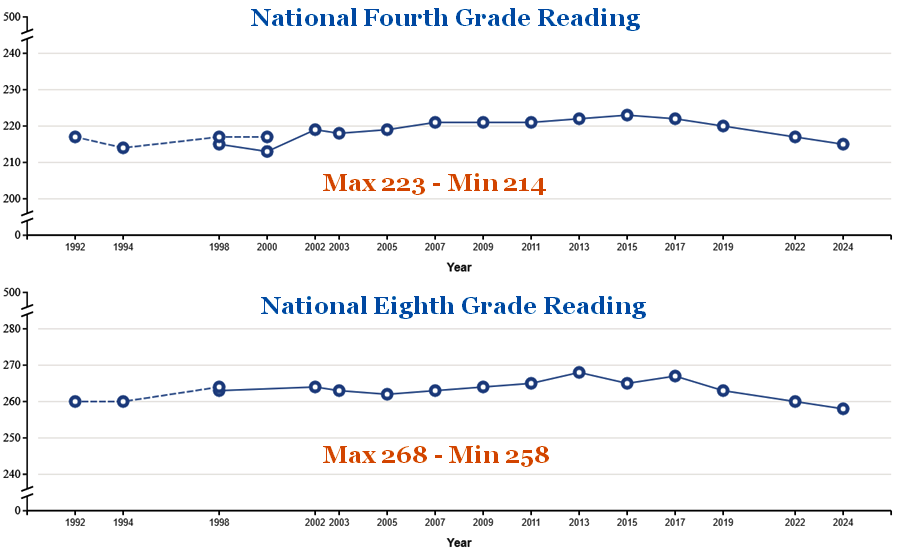
Plots of the average testing results covering math and reading for the past 32-years do not inspire much insight even if you believe in standardized testing.

The plots above were created from NAEP Data. Since 1992, both sets, which are plotted on a 500 point scale, wiggled up and down within a 10 point range.

In 2020, COVID-19 happened and this year’s 4th graders joined in-school classes a year or more late. The 8th graders missed at least their 5th grade in-school classes and some of them missed significantly more. During that year or more out of school, a tendency for truancy developed. So it is not surprising that their testing scores are not stellar, but they are still within the 10-point historical range.

Reading Scores Down

Peggy Carr, Commissioner of the National Center for Education Statistics (NCES) said, “Student achievement has not returned to pre-pandemic levels, reading scores continue to decline, and our lowest performing students are reading at historically low levels.”

For the past decade, there has been a major dispute over how to teach reading in the United States. Dozens of states have overhauled their reading instruction to adopt so called science of reading (SoR) methods. These changes came about largely due to a well financed corporate driven campaign that has drowned out literary experts.

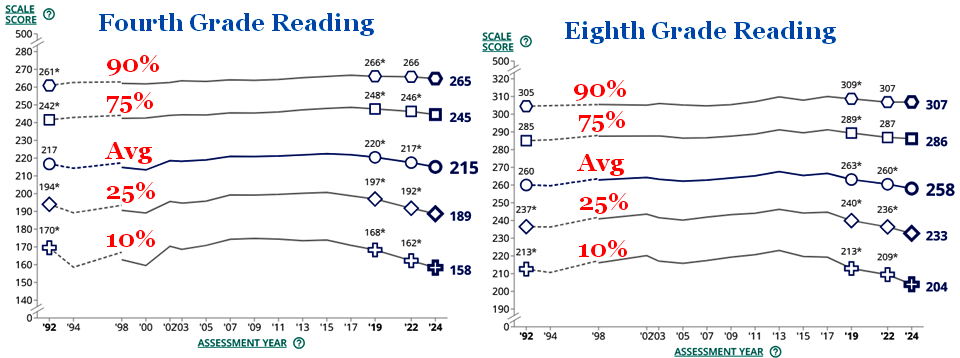
NAEP created charts based on reading data disaggregated by scoring percentiles are shown below.

In both the 4th grade and 8th grade charts reading scores started declining about 2015 and have fallen every testing window since. At about the same time, balanced literacy, which was the nation’s most popular method for teaching reading, started being replaced by SoR. The correlation between SoR and the dip in reading scores is obvious but may be misleading. Chalkbeat reports,And while federal education officials are usually reticent to explain what caused a particular increase or decrease in scores, Carr cautioned that the near-universal dips in reading should not be taken as evidence that reading reforms have not worked.”

I have believed for some time that SoR is less about good teaching and more about profits, so it is tempting to discount Dr. Carr’s warning. Standardized testing has serious limitations and it would be hypocritical to discount it only when I did not like the results and then hale the outcomes that I liked.

However, the NAEP data since 2017 certainly provides NO support for SoR.

Math Staying Steady

The 2024 math results for fourth-grade improve by 3% over 2022 but were still 2% lower than the pre-pandemic 2019 testing. Eighth-graders treaded water in 2024 with scores that were not significantly different from 2022 and were 8% lower than 2019.

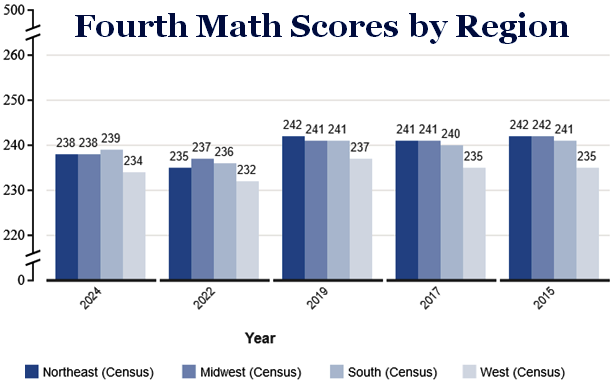
NAEP allows researchers to break down scores by region. I created this bar graph of fourth grade math for the last five testing windows. The South, Midwest and Northeast had almost identical scores while the west lagged by 4-6 percent. Would we all like to see better scores? of course. On the other hand, there is nothing here that looks dire. In 2022, there was a small drop in scores and in 2024 about half of the drop was overcome.

Absenteeism is probably holding back score recovery in both math and reading. It is generally considered that when a student misses more than 10% of the school year they are chronically absent. National Public Radio (NPR) has reported, the rates of chronic absenteeism doubled during the pandemic. NAEP also asked students, during this last testing cycle, how many days they had missed in the previous month. NPR notes that, “Across the board, lower-performing students were more likely to report missing five or more days of school in the previous month, compared with higher-performing students.”

Some Final Observations

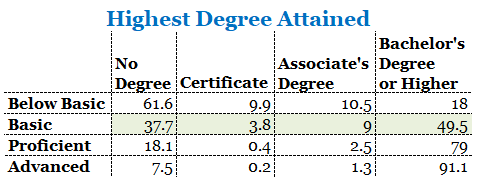
 In 2007, NCES performed a study on what happened to the 1992 NAEP participants. They were interested in how the four attainment level, Below Basic, Basic, Proficient and Advanced, matched student outcomes.

The key results are shown in the table above. It looks like the levels have misleading names. Half of the students in the Basic group achieved a bachelor’s degree or higher. This means that they were college ready and academically proficient. The NAEP labels are aligned too high; therefore misleading.

In 2019, Diane Ravitch commented on that year’s NAEP data: “After a generation of disruptive reforms—No Child Left Behind and Race to the Top, VAM and Common Core—after a decade or more of disinvestment in education, after years of bashing and demoralizing teachers, the National Assessment of Educational Progress (NAEP) for 2019 shows the results:

‘“Over the past decade, there has been no progress in either mathematics or reading performance, and the lowest-performing students are doing worse,”’ said Peggy Carr, the associate commissioner of the National Center for Education Statistics, which administers the NAEP. ‘“In fact, over the long term in reading, the lowest-performing students—those readers who struggle the most—have made no progress from the first NAEP administration almost 30 years ago.”’

SoR became the billionaire reform de jure in 2019. No Child Left Behind, Race to the Top, VAM and Common Core had come to be seen as either failures or frauds. Profiteers hoped the new SoR strategy would lead to privatizing and controlling all aspects of education and they made great efforts to promote it. Will the 2024 NAEP results be the beginning of the end for their greedy dreams?

Whatever the case, Ravitch’s 2019 NAEP analysis still holds true. The 2024 NAEP results are nothing to celebrate but certainly are not a crisis. After all, they are based on standardized testing that is not capable of measuring learning or teaching. Family wealth is about the only thing to which NAEP data correlates.