Archive | January, 2025

FCMAT Attacks Weed Elementary

28 Jan

By Thomas Ultican 1/28/2025

In 1992, California inaugurated the Fiscal Crisis Management Assist Team (FCMAT) in the aftermath of the Richmond School District bankruptcy. It was set up as a quasi-autonomous non-governmental organization headquartered in Bakersfield. Unfortunately, from the beginning, FCMAT functioned as a tool of the politically connected and never provided actual assistance to districts dealing with financial matters. FCMAT, which is pronounced fick-mat, recently started attacking the Weed Union Elementary School District, a single-school district, based on little more than feelings and rumors.

Weed Elementary School is in Weed, California on the foothills of Mount Shasta, one of the twelve 14,000+ feet high mountains in California. Weed is 230 miles north of Sacramento along interstate-5 in Siskiyou County. Abner Weed came to the county in 1889 and became a business and political success. Weed founded the Weed lumber company and at one time his sawmills were the largest producers in the world. The town he built and its schools bear his name.

Weed California Entrance

Today, this small town of 2,900 people is not wealthy. The Weed Elementary school accountability report card shows 78% of its students are socioeconomically disadvantaged. This is the target of FCMAT’s warrantless attack.

Attack Background

Over the Thanksgiving break in 2019, there was some sort of flood at Weed Elementary School. The district took measures to clean up the district office, a conference room, two special day classrooms and the library. They believed that this was all that was required.

Soon after, the superintendent resigned and the district hired Jon Ray for the job in April, 2020. When Ray entered the school, he smelled an odder reminiscent of the mold infestation at a school where he previously worked. Ray hired a vendor to investigate and they found significant mold hidden in the walls.
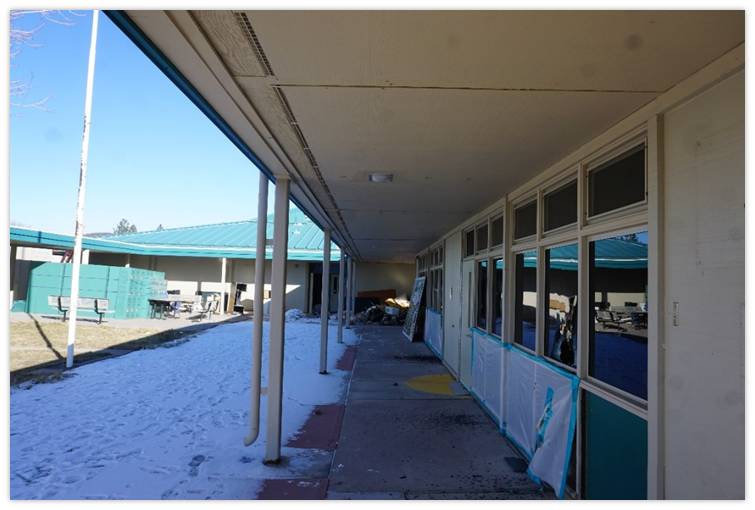
Weed Elementary School

It seems that there was some bad blood between the Siskiyou County Office of Education and Jon Ray at Weed Union Elementary School District. In an interview, Ray voiced the opinion that most of those bad feelings were generated by his decision to open school for in person classes in August, 2020.

When the county superintendent received anonymous allegations of possible fraud, misappropriation of funds or other illegal fiscal practices at the Weed Union Elementary School District, he decided to call in FCMAT at a cost of $250,000. This is probably a decision he now regrets.

As Superintendent Ray was informed, FCMAT was not here to help. They were there to find issues and concluded in their report, “Based on the findings in this report, there is sufficient evidence to demonstrate that fraud, misappropriation of funds and/or assets, or other illegal fiscal practices may have occurred specific to bid splitting and other areas reviewed.”  (Report Page 28)

However, Mr. Ray’s response to FCMAT’s report is more convincing than the report. Most of the criticism of Weed Elementary was cited as feelings. For example, FCMAT stated:

“The district’s decision to use construction management multiprime (CMMP) as its construction method seemed questionable to both FCMAT and the county superintendent. … To the county superintendent and FCMAT, it seemed the district was reacting to issues as they arose rather than following a comprehensive plan”. (Report Page 6)

Superintendent Jon Ray responded:

“These comments are exemplary of the type of impressions and feelings that permeate the entire Report. Since FCMAT is claiming that its evidence supports grave accusations like fraud and misappropriation, it is shocking to find so many instances where the basis for these charges is solely the way it ‘seemed’ to FCMAT.” (Response Page 3)

Once you go thru the FCMAT report and all of its feelings you come to one substantive charge, bid splitting. The California Department of Education web site definition of bid splitting states:

“Bid splitting is intentionally dividing purchasing to avoid getting price quotes or going out to bid using a more formal procurement method. Per Public Contract Code 20116, It shall be unlawful to split or separate into smaller work orders or projects any work, project, service, or purchase for the purpose of evading the provisions of this article requiring contracting after competitive bidding.

Mr. Ray and the district responded, “FCMAT has not provided any evidence, fact, or document indicating that the District ever split any bid to avoid a bid limit; they did not because none exists.”

Several of the FCMAT report findings seem to undermine the fraud and bid splitting allegations. Starting on page 6 in the report they site (1) the District determined that managing smaller contracts without paying a general contractor’s mark-up provided a cost savings; and (2) the district determined that it could purchase equipment, materials and supplies for projects to both reduce a contractor’s mark-up and to ensure supplies would be available during a country-wide supply chain crisis.

In 2021 and 2022, due to COVID, prices for raw materials were exploding and contractors were reticent to make commitments. Jon Ray and the board at Weed Elementary saw no choice but to act as contractor and purchase the needed materials. This was not something they wanted to do but while operating their K-8 school, concluded it was something they had to do.

Michael Fine Behind the Scenes was the Problem

Michael Fine is the chief executive officer of FCMAT. He and his team have found a Bakersfield, California money tree. Transparent California reveals that in 2023, Fine was paid $383,879.87 and there were 11 other FCMAT employees who received more than $279,000 for the year and five more workers made more than $158,000. It is a lot cheaper to live in Bakersfield than Los Angeles, San Diego, San Francisco or Sacramento. To keep their money tree alive, they just need to keep the rich and powerful happy. That is not the people in Weed, California.

The Data Center Reported that in 1992 that FCMAT had a budget of $562,000 which ballooned to $35.6 million by 2002. They also criticized its use of no-bid contracts and lack of accountability. Los Angeles State Assembly Woman Jackie Goldberg called for an audit of FCMAT in 2003. The state auditor reported that FCMAT was providing value to districts but did criticize the over use of no-bid contracts. That appears to be the only audit ever done of FCMAT.

FCMAT actually does bad financial investigating. For example, in 2022, a FCMAT study claimed that Stockton Unified School District (SUSD) was headed for serious financial difficulties when the one time spending from the federal government is gone in fiscal year 2024-25. They said the district is spending one time funding on $26.3 million in salaries, benefits and services that appear essential.

It turned out that a FCMAT consultant who previously worked for the Stockton schools, Susan Montoya, apparently created phantom positions that were the source of the $30 million dollar shortage. It was SUSD that discovered that the $30 million budget deficit was a rouge not FCMAT.

Time to Audit and End FCMAT

There are terrible FCMAT experiences all over the Golden state. What is never found is a good experience or a story of how FCMAT helped a school district. School leaders just talk about how they survived FCMAT, how costly it was and in the happy cases how they finally got FCMAT off their back.

The money going thru FCMAT needs to be examined. The salaries are outrageous and the services worse than stink.

California schools could use some expert help not a police force making money from struggling schools by finding something on them so the state can takeover.

Time to end FCMAT and start over.

Billionaires Driving Science of Reading

21 Jan

By Thomas Ultican 1/21/2025

On January 2nd, billionaire created education news source, The 74, declared there is a reading crisis in Los Angeles Unified School District (LAUSD). This was based on an LA School Report article stating that on the 2023-24 California assessments “43.1% of all LAUSD students met state proficiency targets in reading, compared with 44.1% in the 2018-19 school year, the last before the pandemic.” In math, 32.8% met standards, compared to 33.5% in 2018-19. It seems ludicrous to believe that a 1% drop in testing results, that are known to wiggle up and down, is a crisis. Furthermore, in 2021-22 those proficiency numbers were 41.7% ELA and 28.5% math and in 2022-23 were 41.2% ELA and 30.5% math which suggests that school district testing results are on an upswing.

The 74 was founded in 2015 by former CNN news anchor, Campbell Brown, along with Michael Bloomberg’s education advisor, Romy Drucker. Its original funding came from billionaires via the Dick and Betsy DeVos Family Foundation, the Walton Family Foundation, the Doris and Donald Fisher Fund and Bloomberg Philanthropies. Since then, it has been the vehicle for spreading their message of school privatization. In 2016, The 74 took over the LA School Report.

Creating an Expert

The title of The 74’s crisis article isReading Crisis in LAUSD: ‘This is… a Problem With a Responsibility That Falls on All of Us’. And it has the subtitle, “Literacy Activist Olga de la Cruz says the science of reading is the will solve (sic) literacy losses suffered mostly by poor kids of color in the pandemic.” Literary activist Olga has a BA from UCLA and a Masters of Public Administration from USC. What makes her a literary expert is mystifying. She is also senior campaign director at Families In Schools.

“Reading Crisis in LAUSD …” is an edited version of The LA School Reports interview with Olga. She states, “We need to be more intentional about listening to families, collaborating with community leaders, designing programs that directly support the needs of our students.” The LA School Report asked, “Why is the science of reading important as part of that effort?” Olga answered:

“Science of reading is not a method nor a curriculum nor an approach. It is a body of evidence based on decades of research that explains how the brain learns to read and the foundational skills that students need to become proficient readers.

“It’s about how the brain works and how children learn to read. So this requires explicit, systematic instruction, what are called the foundational skills, which are phonics, phonemic awareness, vocabulary, comprehension, fluency and oral language.”

Olga’s employers, Families In Schools, just published a report which reads more like propaganda for the Science of Reading (SoR) than a scientific review of reading education methodologies. They claim:

“Unfortunately, in many classrooms, students are still receiving reading instruction that is not based on evidence about what works …. For example, the ‘whole language’ approach is based on the idea that students learn to read naturally through exposure to literacy-rich environments, the use of context clues, and word memorization. “Balanced literacy” is a variation thereof that embraces elements of multiple approaches, including small doses of phonics instruction while retaining ineffective elements from the whole language approach.”

Last year, two highly regarded literary professors, P David Pearson of UC Berkeley and Robert J. Tierney of University of British Columbia, published Fact-Checking the Science of Reading. Unlike Olga de la Cruz, these are two actual literary experts.

In looking at the charges against balanced literacy, they detect bad testing science and assert, “As current policy pundits and reporters have done, we ask more of these assessments than they were designed to accomplish, as they spread unwarranted—and potentially harmful—claims about both the positive (phonics first will solve our woes) and negative (Balanced Literacy is the culprit) effects of curricular change.” (Page 78)

Person and Tierney also addressed Olga’s claim about “research that explains how the brain learns to read”. The professors noted, “Many fail to understand that the contribution of neuroscience to the practical task of assessment and intervention in reading disability is still rudimentary, and scientific understandings continue to be undermined by methodological difficulties and the selective use of evidence.” (Page 97)

Maren Aukerman is currently a Werklund Research Professor at the University of Calgary who focuses on literacy education and formerly served on the faculties at Stanford University and the University of Pennsylvania. She warns of journalists using logical fallacies to promote science of reading (SoR). For example, not reporting research showing students taught to read without systematic phonics “read more fluently.”

The Orwellian labeled SoR is not based on sound science. In 1997, congress passed legislation, calling for a reading study. Establishment of the National Reading Panel (NRP) was a doomed effort. They were given limited time for the study (18 months), which was a massive undertaking, conducted by twenty-one unpaid volunteers. NRP fundamentally did a meta-analysis in five reading domains, ignoring 10 other important domains. They did not review everything and there was no new research. Their search for reading studies and averaged results is the basis for “science of reading.”

SoR’s real motivation is to sell products, not helping children struggling to read. Scholars like Pearson and Tierney are ignored while pseudo-experts with limited credentials are trumpeted.

 In 2021, EdReports, which rates curricula for their alignment to Common Core or similar standards, gave both Lucy Calkins’s Units of Study and Fountas and Pinnell’s curriculum its lowest ratings. In January 2020, Student Achievement Partners (SAP) issued a report finding that Calkins’ approach to phonics was “in direct opposition to an enormous body of settled research.” Both EdReports and SAP are billionaire founded and financed companies.

Billionaire Financed Companies Selling SOR

The Families In Schools report was funded by the following philanthropies.

Supporting Families In Schools Report

The Ballmer Group is financed by the former Microsoft CEO Steve Ballmer.

Sobrato is a Silicon Valley real estate developer’s philanthropy.

Heising-Simons is also a bay area foundation which last year co-created the Early Educator Investment Collaborative, a group of early-childhood funders that also includes the Ballmer Group, the Bezos Family Foundation, the Bill & Melinda Gates Foundation, the Buffett Early Childhood Fund, the David and Lucile Packard Foundation, the Foundation for Child Development and the Stranahan Foundation.

EdVoice was established in 2003 by Eli Broad, John Walton, John Doerr, Don Fisher, Reed Hasting, Laurene Jobs Powell, Buzz Woolley and others to advance their billionaire public school privatization agenda. (See 2003 form 990 TIN 94-3284817)

GPSN is led by former charter school executives and Eli Broad employees.

Billionaires are the main support driving SoR. One of the reasons for that is having a tightly defined curriculum makes it much easier to develop a software-driven-kids-at-screens program and profit while reducing costs; think iReady or Amplify.

Conclusion

SoR advocates are trying to force everyone to use a reading education approach that is not proven and failed miserably in England. Authoritarians want to take over public education and turn it into a profit center, claiming it’s based on decades of research. That is not true and it is more likely to harm children than help. Forty states have already adopted laws that comply with billionaire wishes and in California legislation has been written and submitted. It was tabled this year but it is sure to come up again.

This is a billionaire sponsored tragedy requiring as many people as possible to become aware and oppose it.

TIMSS Scores Down Don’t Panic

13 Jan

By Thomas Ultican 1/13/2025

The latest round of international testing showed that US math scores fell between the 2019 assessment and the 2023 exam. Every four years the US participates in the Trends in International Mathematics and Science Study (TIMSS). In the 2023 cycle, fourth grade math fell by 18 points and eighth grade math fell by 27. An ABC News headline states, US students’ declining math scores are ‘sobering,’ expert says’” and the New York Times claims, U.S. Students Posted Dire Math Declines on an International Test. The reality is that these results are not wonderful but they are neither “sobering” nor “dire.”

It seems that every year there is a new data dump from a large scale assessment (LSA). Regular updates arrive from the National Assessment of Education Progress (NEAP) or the Progress in International Reading Literacy Study (PIRLS) or the testing sponsored by the international banking community, Programme for International Student Assessment (PISA). This winter the TIMSS data was released.

TIMMS and PIRLS

In 1958, a group of scholars, educational psychologists, sociologists, and psychometricians met at the UNESCO Institute for Education (UIE) in Hamburg, Germany, to confer about school effectiveness and student learning. In 1967, these early discussions led to the legal creation of the International Association for the Evaluation of Educational Achievement (IEA) headquartered in Amsterdam with a major data processing and research center in Hamburg. The every four years TIMSS assessment of math and science plus the every five years PIRLS assessment of reading are two of IEA’s major ongoing efforts.

The first IEA study began in 1959 and the completed report was published in 1962. In the forward, it stated:

“If the results so far, … are little more than suggestive, at least they offer real encouragement for believing that such researches can, in the future, lead to more significant results and begin to supply what Anderson has lamented as ‘the major missing link in comparative education’, which in his view is crippled especially by the scarcity of information about the outcomes or products of educational systems.” (Emphasis Added)

“Certainly the international group itself was sufficiently encouraged by the results of its first exploratory study to embark on a more ambitious one during which, at several key points in the secondary school cycle, as comparable samples of schoolchildren as can be obtained will be subjected to tests which bear close reference to curricula and educational aims in all the participating countries.” (Emphasis Added)

From their statements, it is clear that mathematically adept researchers saw testing as a valid way to study teaching and learning. The problem is they did not properly understand the tremendous influence of error in education testing. Family situations have extraordinarily greater influence on outcomes than either schools or teachers. These errors are so great that they obscure testing results.

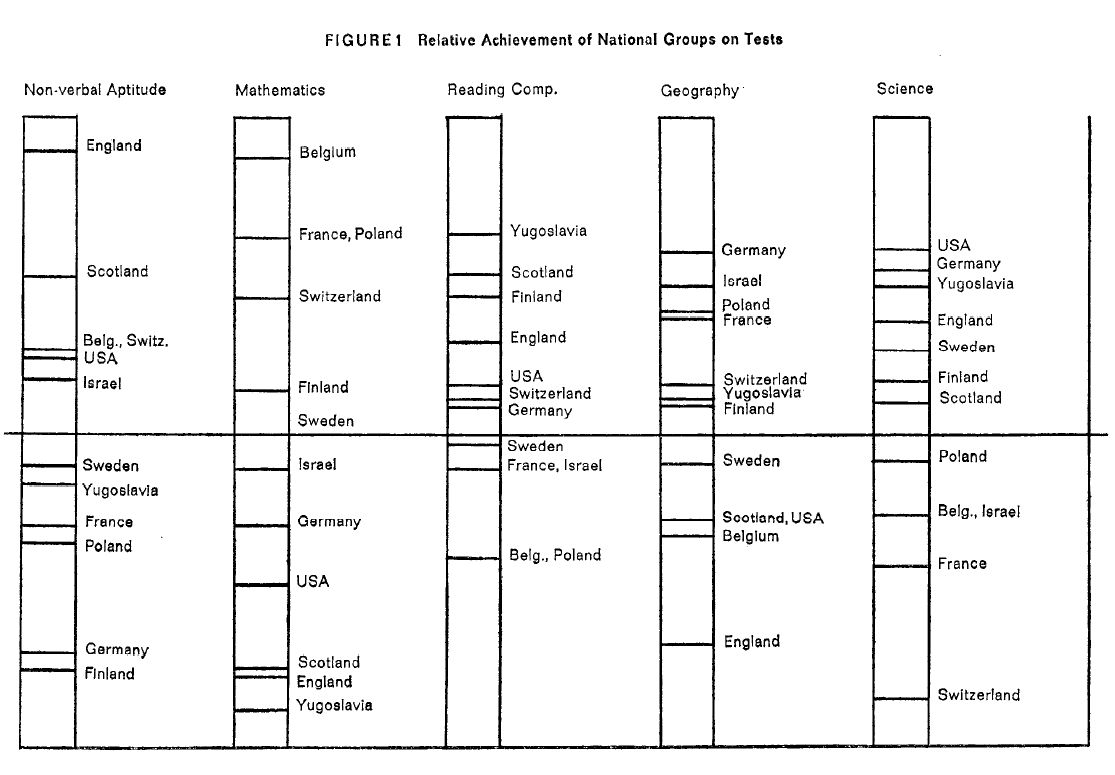
The reporting on this first study was quite crude. Their use of standard deviations to communicate the results was difficult for non-experts to follow and their graphics were not well designed. These graphics came without legends and were therefore indecipherable but one graphic on page 29 did give a sense of comparison.

Looking at this graphic we can see that in 1959, the USA was pretty good in “Non-verbal Aptitude” whatever that is. It was relatively poor in math, OK in reading, weak in geography and super in science. This trend of the US being mostly average on international standardized assessments has persisted until today.

New Data from TIMSS

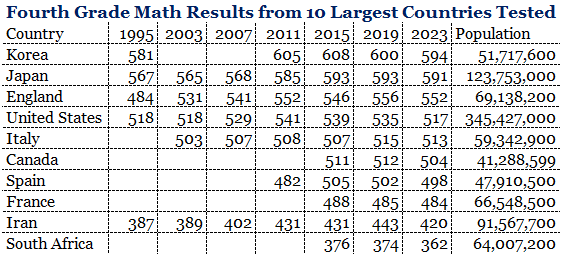
Forty-seven countries participated in the 2023 TIMSS 4th grade math study. Many of the countries studied were quite small with only Japan and the United States having populations of more than 100 million people. Using the World Population Review, I added population data to the TIMSS data and have put it into the following table for the 10 most populous countries assessed.

The table is organized in order of their average 2023 assessment results. Even though the US had an 18 point drop between 2019 and 2023, it still ranked fourth among the larger countries. The US had the second largest drop, but all of the large countries also had scoring decreases. The table reveals that the  US has a population almost three times the next largest country and the top two scoring countries have homoginous student populations with little diversity.

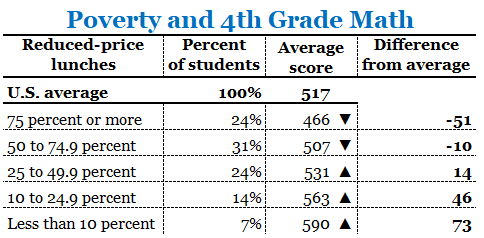
The National Center for Education Statistics (NCES) receives an expanded data set that they use to make many presentations of the outcomes. In a revealing set, NCES shows the effect of poverty on the US data with the following table which is reformatted.

This table strongly suggests that the US decrease in scores was concentrated in the 24% of students among the group with 75% free and reduced price lunches, which is believed to be a good proxy for poverty. There are many reasons to think this group was more profoundly affected by the pandemic than other students. They were less likely to participate in virtual school, were living with people in high risk of contracting the disease and were more likely to be absent once schools opened.

LSA Reliability

Recently a British group, Assessment and Quality Insights, noticed that the PISA and TIMSS testing data showed opposite trends for British math, science and reading. TIMSS tests 12 year olds while PISA tests 15 year olds, but it is remarkable that the two assessments came up with opposite trends. Since 2012, PISA has reported falling scores in the three disciplines while TIMSS has shown rising scores.  

In 2020, Jake Anders et al, published Is Canada really an education superpower? The impact of non-participation on results from PISA 2015.” They stated:

“In this paper, we consider whether this is the case for Canada, a country widely recognised as high performing in the Programme for International Student Assessment (PISA). Our analysis illustrates how the PISA 2015 sample for Canada only covers around half of the 15-year-old population, compared to over 90% in countries like Finland, Estonia, Japan and South Korea.

This highlights a common problem with comparing international test scores. It is not clear who the student are that are being tested and if countries are juking the scores for political purposes.

Another problem with LSAs is highlighted by a paper from the University of Kansas, Side Effects of Large-Scale Assessments in Education.” They note that LSAs distort the purpose of education by misleading the public into believing these assessments reflect the quality of teaching. Also curriculums get narrowed when only core subjects of math and reading are assessed. Plus the assessments cause many educators to “teach to the test” and exam induced suicides are reported in “China, Hong Kong China, Taiwan China, Korea, Singapore, Cambodia, Vietnam, and Japan (Cui, Cheng, Xu, Chen, & Wang, 2011).”  (Page 9)

LSAs also bring moral corruption to education. According to psychologist Donald Campbell’s law, “The more any quantitative social indicator is used for social decision making, the more subject it will be to corruption pressures and the more apt it will be to distort and corrupt the social processes it is intended to monitor.” LSAs are not above this law. (Page 9)

Conclusion

LSAs are very expensive and more liable to mislead than enlighten. A lot of testing companies are making money, but education is not being well served. I have the same puzzlement as Professor Yong Zhao, who wrote, It doesn’t make sense: Why Is the US Still Taking the PISA? His arguments against PISA make a strong case against continuing with TIMSS and PIRLS as well.

To me this testing malarkey is how Corporations like Pearson get their hands on American taxpayer dollars and the taxpayers get worse than nothing for their spending.

Scrap all this international testing nonsense.

Network for Public Education 2025 Conference

1 Jan

By Thomas Ultican 1/1/2025

I am going to Columbus, Ohio for the 2025 NPE conference the weekend of April 5 and 6. Since 2015, these conferences have been a forward looking delight for me. (I missed the 2014 conference in Austin, Texas.) It is a place to hear from heroes of human rights and amazing defenders of public education. It is here where we unite and organize to take on ruthless billionaires; out to end taxpayer funded free education for all. Meeting and hotel reservations are still available.

Chicago 2015

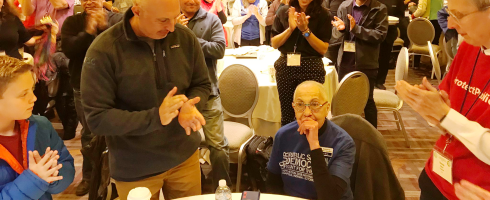
My first NPE conference, in 2015, was held in the historic Drake Hotel on the shore of Lake Michigan. I had been reading blogs by Diane Ravitch, Mercedes Schneider and Anthony Cody. They were all there. In fact, when I arrived the quite tall Cody was walking down a staircase to greet new arrivals. This got my conference off to a thrilling start. Yong Zhao, the keynote speaker, was amazing plus I personally met Deborah Meier and NEA president, Lily Eskelsen García. Always close to my heart will be the wonderful and all too short relationship I developed with our host, Karen Lewis.

Raleigh 2016

In Raleigh, I met Andrea Gabor, who was working on a book that was released in 2018, After the Education Wars; How Smart Schools Upend the Business of Reform.” She had been an agnostic on charter schools until she went to New Orleans and discovered a mess. The amazing speaker, Rev. William Barber, gave the keynote address. This leader of the poor people’s campaign” is a truly gifted speaker.

Oakland 2017

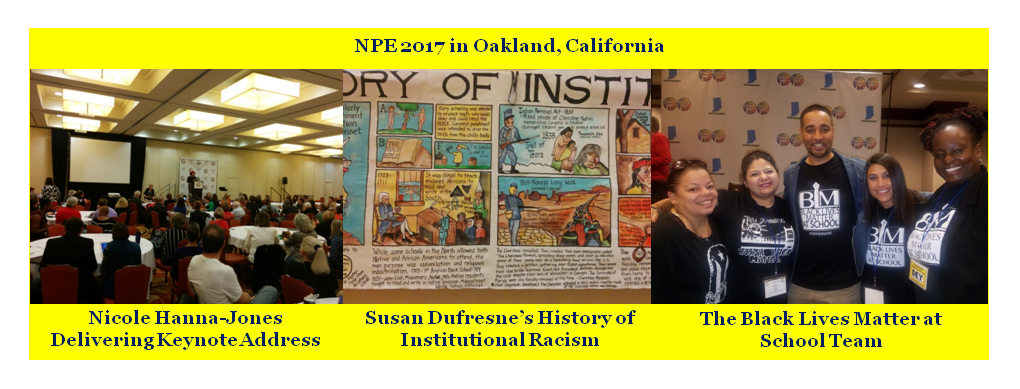
Nicole Hanna-Jones who had just won the MacArthur Foundation genius award and recently published the 1619 Project was our keynote speaker. Susan Dufresne lined the walls of the Oakland Marriot’s main conference room with her art depicting institutional racism that was published in book form 6-months later (The History of Institutional Racism in U.S. Public Schools). At a KPFA discussion featuring Diane Ravitch and Dyett High School hunger strike hero, Jitu Brown, I ran into Cindy Martin, then the Superintendent of San Diego Unified School District. She has been the number two at the Department of Education for most of the past four years. Too bad she was not the number one.

Indianapolis 2018

Diane Ravitch opened the conference declaring, “We are the resistance and we are winning!” Finish educator, Pasi Sahlberg, coined the apt acronym for the worldwide school privatization phenomena by calling it the “Global Education Reform Movement (GERM).” In Indianapolis, we met many new leaders in the resistance like Jesse Hagopian from Seattle. In his introduction, Journey for Justice leader, Jitu Brown, declared, “Jesse is a freedom fighter who happens to be a teacher.” Jesse’s new book “Teach Truth; the Struggle for Antiracist Education was just released.

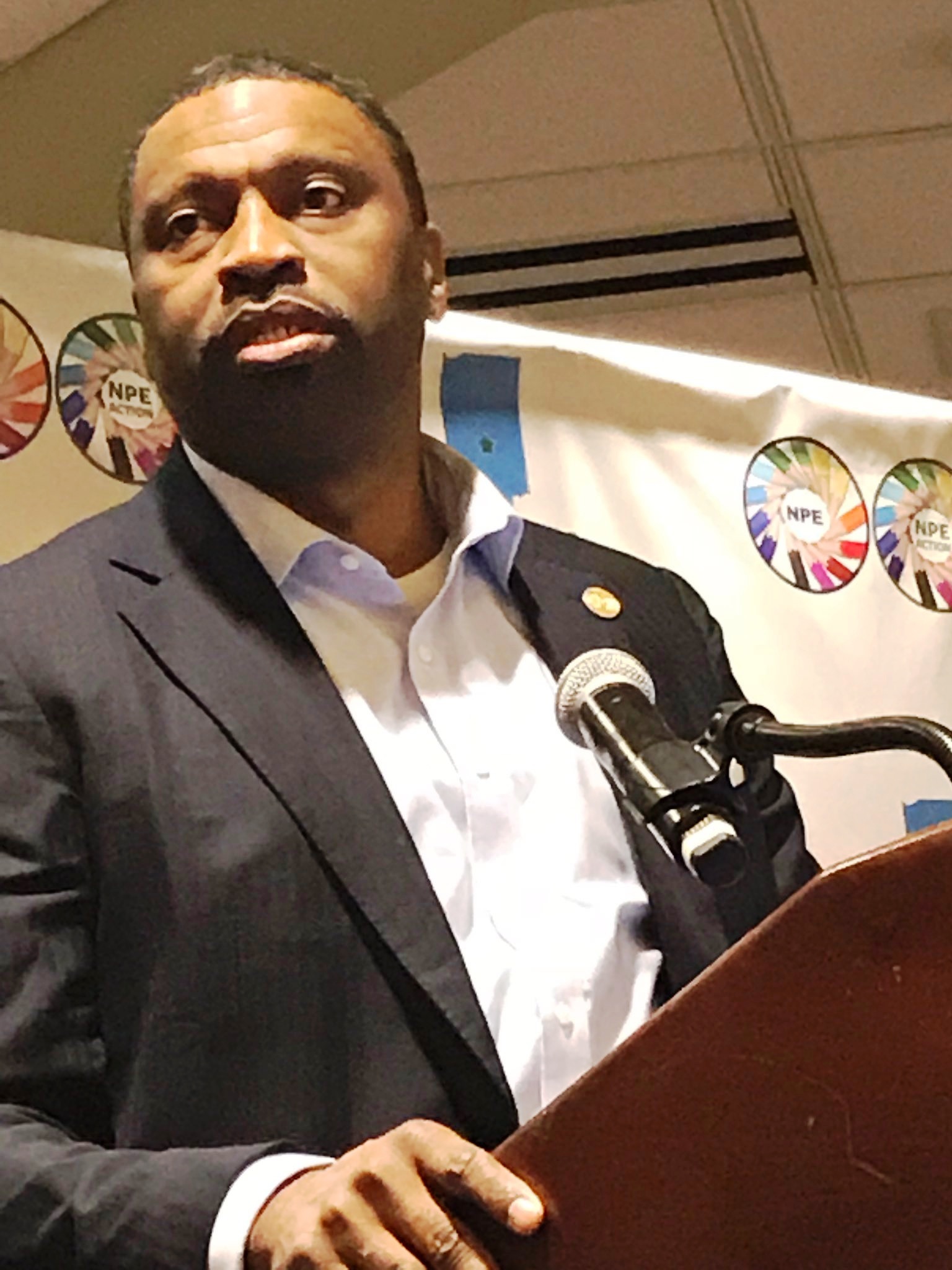
America’s leading civil rights fighter and president of the NAACP, Derrick Johnson, was our keynote speaker. He said the NAACP was not opposed to charter schools, but is calling for a moratorium until there is transparency in their operations and uniformity in terms of requirements is repaired. Derrick noted the NAACP had conducted an in depth national study of charter schools and found a wide range of problems that needed to be fixed before the experiment is continued.

Derrick Johnson, President of NAACP, Speaking at #NPE18Indy – Photo by Anthony Cody

Philadelphia 2022

Like the entire world, NPE activities were seriously interrupted by COVID-19. We were finally able to meet on Broad Street in Philadelphia March 19-20, 2022. This gathering was originally scheduled in 2020. My good friend Darcie Cimarusti, who worked for NPE, called me about joining her for a breakout session on The City Fund, the billionaire founded organization pushing the portfolio model of school management. By 2022, she was so weakened by cancer that I ended up leading the session. Sadly, Darcie passed a few months after the conference.

At the 2022 meeting, we also paid tribute to Phyllis Bush, an NPE founding board member and wonderful person. She was dealing with cancer at the Indianapolis conference and passed some time afterward.

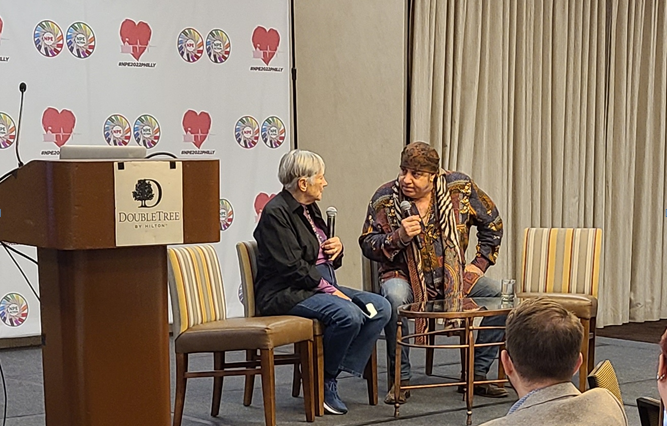
The lunchtime conversation between Diane Ravitch and social activist, musician and actor, Stevie Van Zandt, was special. “Little Stevie” co-founded South Side Johnny and the Asbury Jukes, became a member of the E-Street band with Bruce Springsteen and starred on the Sopranos. It turned out that Diane and Stevie became friends when they were walking a picket line in support of LA teachers.

Ravitch posted afterwards, “I wish you had been in Philly to hear the wonderful “Little Stevie” (formerly the EST band and “The Sopranos”) talk about his love for music, kids, teachers, and arts in the schools at #npe2022philly. Everyone loved his enthusiasm and candor.”

Diane Ravitch and Steven Van Zandt at NPE Philadelphia

Washington DC 2023

October 28-29, 2023, brought the Washington DC NPE conference, a special event. Of particular interest to me was the preconference interview (October 27 evening) of James Harvey by Diane Ravitch. Harvey is known as the author of a “Nation at Risk.” There were so many more of us there than expected; the interview was moved to the old Hilton Hotel’s large conference room. After the change and everyone settled down, Harvey commented, “I remember being at a meeting in this room fifty years ago when we heard that Alexander Butterfield had just testified that there were tapes of the oval office.” There is nothing like being there with people who made and witnessed history.

James also shared that the two famous academics on the panel, Nobel Prize winner, Glen Seaborg, and physicist, Gerald Holton, were the driving forces for politicizing the report. Strangely these two scientists did not come to their anti-public school conclusions based on evidence and they were significant to the reports demeaning public schools using phony data.

Gloria Ladson-Billings from the University of Wisconsin Madison delivered the first Keynote address on Saturday morning. She claimed, “Choice is a synonym for privatization.”  And also stated there is money in the public which wealthy elites do not think common people should have. She also noted, “We are in the business of citizen making.”  Ladson-Billings indicated that we do not want to go back to normal because it was not that great.

Conclusion

From the beginning, NPE has not sought donations from wealthy elites. The organization is 100% grass roots supported mainly by educators. When it holds a conference, the information has one purpose and that is protecting public education. If you can break free on the first weekend in April and you regard saving public education important, I encourage joining us in Columbus, Ohio for the 2025 NPE conference.