Archive | December, 2024

San Diego School Board Election Outcomes

17 Dec

By Thomas Ultican 12/17/2024

Before the recent election, I wrote recommendations for several school board seats in San Diego County. The San Diego County Registrar of Voters has posted the final official results which are transcribed here with a few comments.

San Diego County Board of Education

Gregg Robinson in district-1 and Guadalupe Gonzalez in district-2 ran unopposed and were easily reelected.

In district-4

ERIN EVANS174,25368.29%My Recommendation
SARAH SONG80,91631.71% 

NOTE: Song was an enthusiastic candidate with some support but Evans was clearly more qualified. The county board of education looks to be in good shape.

San Diego Unified School District (SDUSD)

Richard Barrera district-D and Sharon D. Whitehurst-Payne district-E, ran unopposed and were elected. 

SABRINA BAZZO40,28950.93%My Recommendation
CRYSTAL TRULL38,81849.07% 

NOTE: This result surprised me. Brazzo is a very qualified member of the board supporting public education. Trull has the academic qualifications to serve but she is also a Howard Jarvis anti-tax ideologue and seems to base her education evaluations exclusively on standardized testing. It appears SDUSD dodged a big problem by less that 1% of the vote.

Sweetwater Union High School District (SUHSD)

Trustee Area 2

ADRIAN E. ARANCIBIA21,22656.72%My Recommendation
ANGELICA S. MARTINEZ16,19543.28% 

Trustee Area 4

RODOLFO “RUDY” LOPEZ19,19262.68%My Recommendation
OLGA ESPINOZA11,42637.32% 

NOTE: Both outcomes seemed reasonable and SUHSD should be well served.

Poway Unified School District (PUSD)

Trustee Area A

TIM DOUGHERTY10,06355.09% 
DEVESH VASHISHTHA8,20544.91%My Recommendation

Trustee Area E

DAVID CHENG6,52838.34% 
CRAIG POND6,38637.51% 
CINDY SYTSMA4,11124.15%My Recommendation

NOTE: In Poway Area E, I recommended for Systema because of her strong background as an educator and former county sheriff however I think David Cheng is also an excellent choice. In Area A, I was bothered by two of Dougherty’s listed supporters, Carl DeMaio and Michael Allman. However, Dougherty looks like a normal civic minded guy and to be a supporter of public schools.

Chula Vista Elementary School District (CVESD)

Seat Number 2

LUCY UGARTE80,82469.85%My Recommendation
SHARMANE ESTOLANO34,88530.15% 

Seat Number 4

FRANCISCO TAMAYO34,22729.61% 
KATE BISHOP27,68123.94%My Recommendation
TANYA WILLIAM26,23222.69% 
JESUS F. PARTIDA15,97713.82% 
ZENITH KHAN11,4919.94% 

NOTE: Educator Lucy Ugarte was the logical choice for seat 2. I have always liked Francisco Tamayo but his odd decision to run for seat number 4 while holding seat 1 caused me to recommend against him. For outsiders, it is difficult to get a good feel for what is happening. It seems that incumbent, Kate Bishop, had alienated several people in the district including Tamayo. The new board should be fine but now has two seats to fill with Tamayo moving to seat 4 and seat 5 member, Caesar Fernandez, becoming a Chula Vista city council member.

Vista Unified School District (VUSD)

Trustee Area 1

MIKE MARKOV6,72851.91%My Recommendation
AMANDA “MANDY” REMMEN6,23448.09% 

Trustee Area 4

CIPRIANO VARGAS3,37139.06% 
FRANK NUNEZ3,07535.63% 
ZULEMA GOMEZ2,18425.31%My Recommendation

Trustee Area 5

SUE MARTIN9,54060.39%My Recommendation
ANTHONY “TJ” CROSSMAN6,25839.61%   

NOTE: The outcomes here seem fine for the school District. Incumbent, Cipriano Vargas, was the pick of the Democratic Party and many political heavy hitters but I was more moved by Gomez’s support from sitting school board members and fellow educators.

San Marco Unified School District (SMUSD)

Trustee Area A

HEIDI HERRICK7,04756.04% 
CARLOS ULLOA5,52743.96%My Recommendation

Trustee Area B

SARAH AHMAD7,09658.98%My Recommendation
BRITTANY BOWER4,93541.02% 

Trustee Area D

LENA LAUER MEUM5,94958.77% 
JAIME CHAMBERLIN4,17441.23%My Recommendation

NOTE: This new board could have problems.

Grossmont Union High School District (GUHSD)

Area 1

CHRIS FITE13,92343.30%My Recommendation
RANDALL DEAR10,48532.61% 
DEBRA HARRINGTON4,61414.35% 
AZURE CHRISAWN3,1329.74% 

Area 2

SCOTT ECKERT14,76836.64% 
JAY STEIGER13,64533.85%My Recommendation
JIM STIERINGER7,98019.80% 
MARSHA J. CHRISTMAN3,9149.71% 

NOTE: This looks like a decent outcome for GUHSD. Far right candidate, Randall Dear, was rejected even with his large cash advantage. Scott Eckert was not my first choice but he is a solid choice who cares about the district.

San Dieguito Union High School District (SDUHSD)

Trustee Area 2

JODIE WILLIAMS10,12651.22%My Recommendation
KELLY FRIIS9,64348.78% 

Trustee Area 4

MICHAEL ALLMAN8,99051.12% 
KEVIN SABELLICO8,59548.88%My Recommendation

NOTE: I was really sad to see MAGA man, Michael Allman, reelected. He has been a polarizing character since first being elected in 2020.

Escondido Union High School District (EUHSD)

Trustee Area 3

CHRISTI KNIGHT7,53865.36% 
CLAY BROWN3,99534.64%My Recommendation

Trustee Area 4

RYAN S. WILLIAMS7,84864.66% 
DARA CZERWONKA4,28935.34%My Recommendation

NOTE: In Area 3, Clay Brown dropped out of the race. Both incumbents, Christi Knight and Ryan S. Williams, were reelected. I felt there needed to be some people with education experience on the board.

Oceanside Unified School District (OUSD)

Trustee Area 2

ELEANOR EVANS6,17851.51%My Recommendation
EMILY ORTIZ WICHMANN5,81548.49% 

Trustee Area 5

MIKE BLESSING6,35453.44%My Recommendation
ROSIE HIGUERA5,53646.56% 

NOTE: The wins by incumbents, Eleanor Evans and Mike Blessing, were good news for Oceanside.

Twelve races were won by candidates I endorsed and ten went against my recommendations. Overall, there was only one of the ten districts I reviewed that I felt was hurt by this election. In San Marcos, they got rid of an incumbent with deep education experience, Carlos Ulloa, leaving SMUSD with little education knowledge. More troubling was they just elected a pro-school-choice trustee to its board.
Billionaire Sponsored Malarkey from Education Trust

3 Dec

By Thomas Ultican 12/3/2024

Education Trust (aka EdTrust), using what it calls equity analysis, critiqued various states’ Every Student Succeeds Act (ESSA) required accountability plans. University of Northern Colorado’s Derek Gottlieb reviewed their study for the National Education Policy Center. An unimpressed Gottlieb claimed, “Despite the language of ‘equity’ and attention to ‘asset-based’ framings of educational data, the vision of what high-quality accountability structures would look like and would do simply recycles the naïve hopes that fueled the original push for NCLB.” EdTrust’s non-peer-reviewed study might also be opening the way for a new version of the Elementary and Secondary Education Act to replace the now ten-year-old ESSA.

EdTrust rings a preponderance of No Child Left Behind’s (NCLB) greatest hits in its one paragraph explaining why we need federal oversight:

“The purpose of public education is to provide students with the knowledge and skills they will need to succeed after high school; the ability to access and complete a postsecondary education, pursue a fulfilling career that earns a living wage, and meaningfully participate in our democracy. All students can succeed when provided with the resources and supports to achieve. Yet, generations of students — particularly students of color, students from low-income backgrounds, students with disabilities, and multilingual learners — have been systematically denied equitable access to these educational opportunities — inequities illuminated and exacerbated by the pandemic. Federal accountability requirements are designed to ensure parents, communities, system leaders, and policymakers can better understand which schools and districts are struggling to meet students’ needs and have student group disparities, and — most importantly — use this information to target additional resources and supports to address these needs.

They are saying that through testing we can identify “struggling schools,” which is similar to NCLB’s “failing schools” but not as harsh. They claim it will allow targeting those schools with “additional resources and support.” Honestly, that sounds a lot better than NCLB’s fire the staff and close the schools but EdTrust’s plan to pay for the “additional resources and support.” is not workable. To achieve the goal, they suggest using federal school improvement funds, a 7% set-aside from Title I funding.

Typically, Title I funding represents about 2% of a state’s education budget. Unfortunately, a 7% set-aside from a relatively small amount of money is not going to be sufficient. Even if we accept that “all students can succeed,” these amounts of additional resources will not do the job.

EdTrust makes a series of recommendations that cause many of us teaching in the first decade of the 21st century to shudder.

They advocate, lowering the minimum student sample size from 20 to 10 so certain subgroups are included in school ratings. When teaching statistics, most instructors would warn that population sizes less than 20 have too large of error ranges to be statistically useful. It is odd that known data wonks would make this absurd recommendation.

EdTrust advocates using growth and proficiency with similar weighting for school accountability measurements. The standardized testing data used to assign proficiency are extremely noisy and unreliable. The famed Australian researcher Noel Wilson wrote a seminal work in 1998 called Educational Standards and the Problem of Error.” His peer reviewed paper states standardized testing error is so large that meaningful inferences are impossible. Growth models use standardized testing data and run it through opaque mathematical regimes. It is literally garbage in garbage out.

Another EdTrust recommendation says, “Increase federal monitoring and require state reporting of ESSA school improvement provisions,” which echoes the old NCLB test and punish regime.  The report adds:

“Strong actions such as state takeovers have mixed evidence of success and when done need to be undertaken in collaboration with communities. However, having these state actions as options can help motivate school and district leaders to make strategic, systematic changes to policy and practice to raise performance.”

Which means, if you are in the wrong zip code, your school is going to be a closure victim.

Professor Gottlieb concluded his review of the EdTrust report:

“Without substantially increasing the resources to be targeted for distribution, there are real and hard limits on the productive value of monitoring and reporting, no matter how good or robust our measurements are. It is one thing to have imagined, in the late 1990s, that federal accountability policy alone could transform public education across the country to finally make good on national promises of equal opportunity. It is quite another thing to pitch a wonkier version of the same approach three decades later, with so many tweaks and nuances and consistently underwhelming “successes” in our rearview mirror.”

Education Trust and the Billionaires

Kati Haycock founded EdTrust in 1990 according to the organization’s 1997 web posting. In 1973, with her newly earned bachelor’s degree in political science, University of California President, Charles J. Hitch, made her director of affirmative action for the entire UC system. By 1989, she had earned a master’s in education from UC-Berkeley and was gaining trust in neoliberal Democratic circles as shown by her becoming Executive-Vice President of the Children’s Defense Fund. It appears EdTrust was not a standalone independent organization until 1996. It was originally founded as a unit of the American Association of Higher Education.  That is probably why the National Assessment Governing Board says EdTrust was founded in 1996. (Common Core Dilemma Pages 45-48)

Haycock, who was never a teacher, became influential in education policy by promoting test-score centered American school rooms. Concerning Haycock’s expertise, Mercedes Schneider declared, “It’s like writing a cookbook without ever having prepared a meal.” (Common Core Dilemma Page 48)

EdTrust was always a diehard test based education improvement supporter. In 2008, Republican Sam Graves and Democrat Tim Waltz introduce HR 6239 to suspend temporarily the school punishments required by NCLB. Haycock and EdTrust swung into action to fight the bill. They stated in a letter to congress:

“HR 6239 would turn back the clock to a time when our country simply ignored troubled schools. That approach, the norm for generations of federal education policy, failed miserably and has wasted billions of dollars and squandered the potential of millions of our fellow citizens.  As imperfect as NCLB may be and as uncomfortable as the law may make some adults, we can’t afford—not even for a moment—to turn away from the law’s commitment to identify and intervene in schools that are not making the grade.”

At about this same time, Education Trust joined with Achieve and the Thomas B. Fordham Foundation to promote IBM CEO, Louis Gerstner’s American Diploma Project (ADP). Gerstner never studied education nor taught but he went to school and hired many people who also went to school so he considered himself an education expert. His big thing was the need for education standards. In 2008, his ADP was subsumed into Bill Gates Common Core State Standards. Interestingly, Gates had even less education background than Gerstner, but he was really rich.

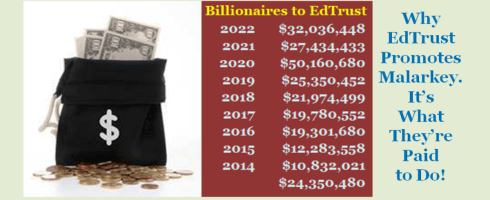
Since their inception, EdTrust has been very successful at attracting billionaire dollars. On their webpage, they list 50 entities that send them money which are mostly billionaires or billionaire financed. For tax purposes, EdTrust (TIN 52-1982223) is a tax deductible charity. Since 2014, they have received more than $24 million a year in deductible contributions.

That is a huge amount of money so I picked out four organizations to review in a little bit of detail. I chose the Gates Foundation because they send money to anyone undermining public schools, the Broad foundation out of nostalgia and curiosity, the Walton Family Foundation for the same reason as Gates and the Barr Foundation because of my friend Maurice Cunningham’s interest in them.

Amos Barr Hostetter, a cable company billionaire, founded the Barr Foundation in 1991 along with his wife Barbara but they made all of their contributions anonymously until 2010. Before then, Hostetter’s giving was hidden behind a veil of secrecy.

Conclusion

Having billions of dollars in private hands undermines democracy. The public likes their public schools, but enormous billionaire spending is driving down this regard. Propaganda like the EdTrust report is hard to counter.

If the common person is going to maintain any democratic control or rights, billionaires need to be taxed back to being millionaires.