By Thomas Ultican 9/17/2024
Article by Professor Morgan Polikoff, University of Southern California’s Rossier School of Education, is a throwback to the No Child Left Behind era. The piece’s purpose was to advertise a new report he worked on with the Center for Reinventing Public Education (CRPE). The teaser for his article at The 74 says, “Given the importance of public education and the need for student data, how can states justify doing such a lousy job at informing parents?” Because of COVID learning loss, he says state education report cards need big improvements.
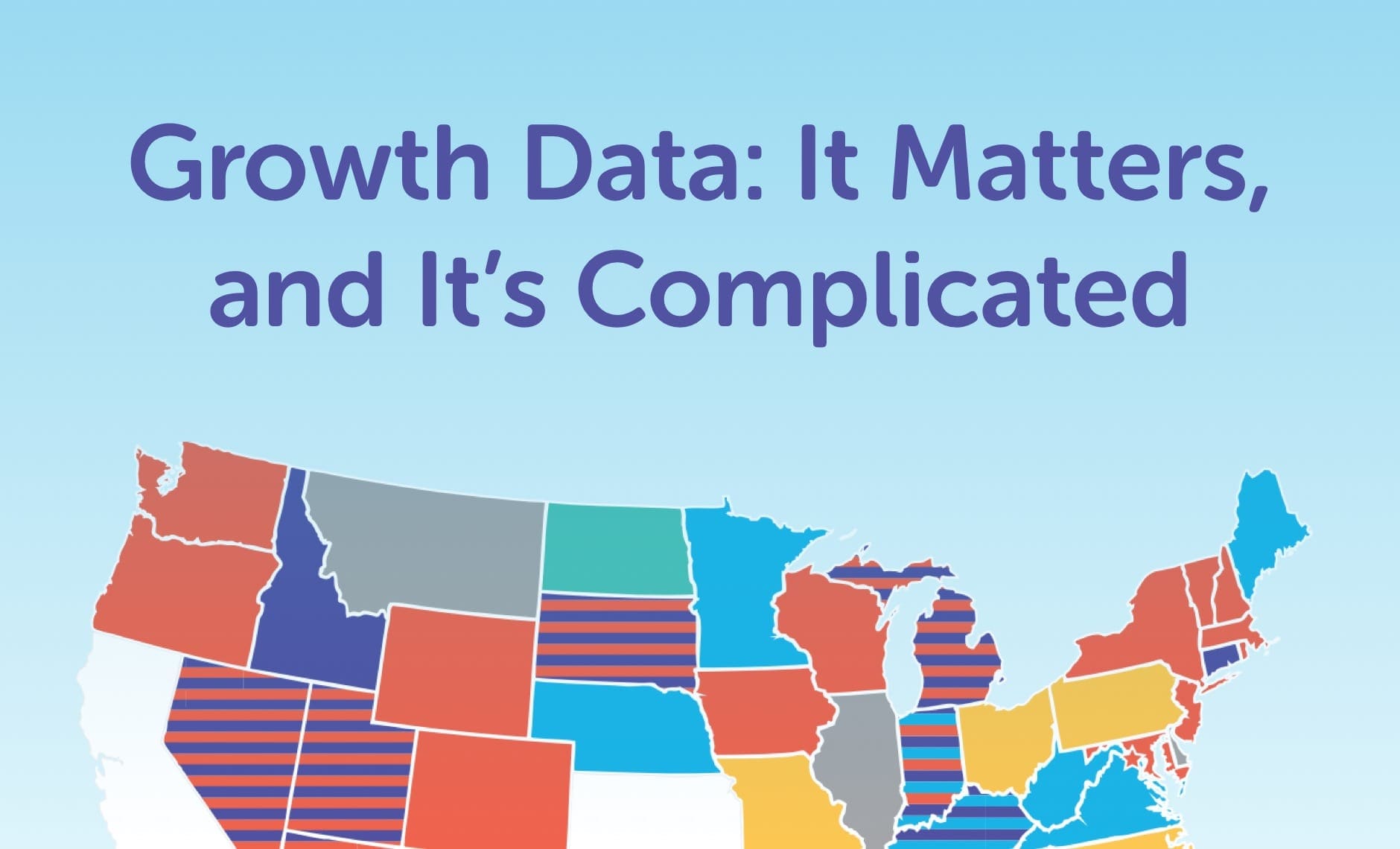
Is leaning loss a real thing? Probably not but let’s ignore that argument for now. Polikoff shared, “I’m on the board of the Data Quality Campaign and I’ve written extensively (and favorably) about the role of accountability in promoting educational improvement.” Additionally, the 2023 Data Quality Campaign “Show Me the Data Report” says, “13 [states] did not include growth data from the 2021–22 school year, and 4 states did not include growth data at all.”
Virtually everything Polikoff shares is billionaire funded baloney.
Center for Reinventing Public Education
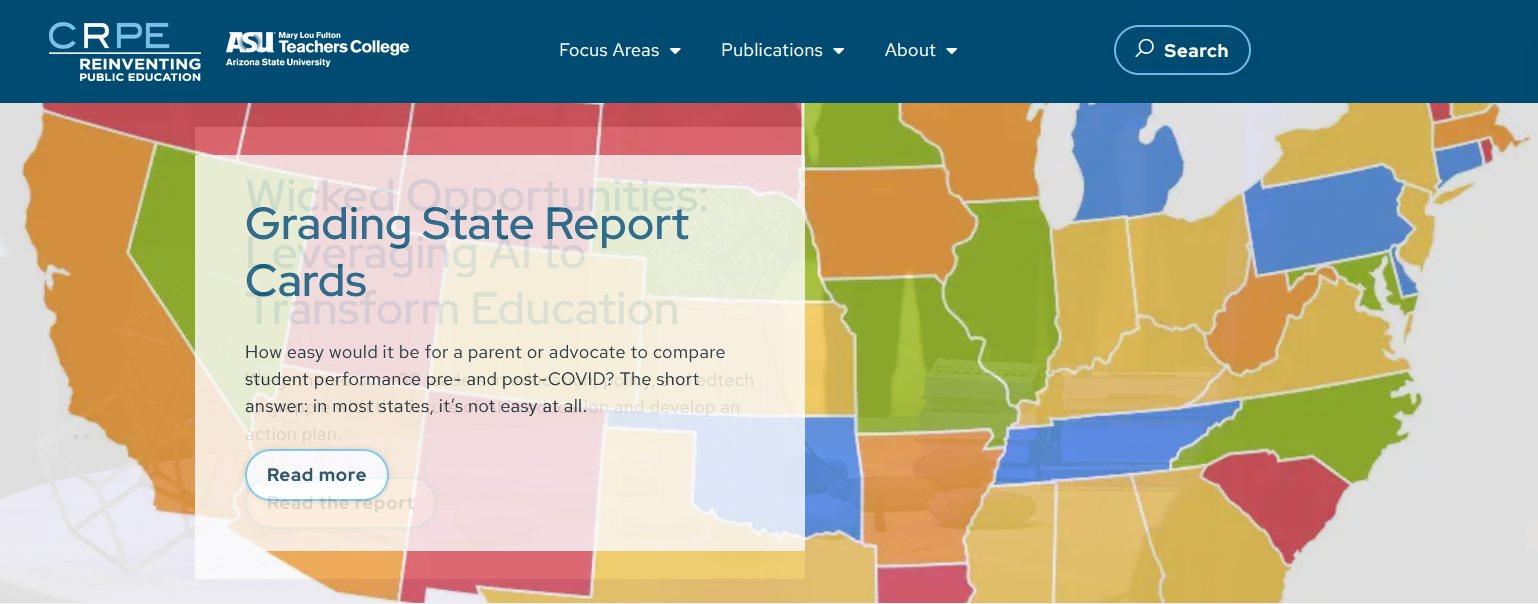
In 1993, Political Science Professor, Paul T. Hill, established the Center for Reinventing Public Education (CRPE).
Professor Hill, a Non-Resident Senior Fellow at the Brookings Institute, was a member of Brookings’ cadre of researchers convinced that American public education was failing. Furthermore, they shared a general agreement that market based business principles were central to fixing schools and declared teachers unions and governance by locally elected school boards must be overturned.
CRPE was fortunate to be in Seattle, Washington where the world’s richest man, Bill Gates, decided to implement his opinions concerning education. The fact that he was so rich appeared to be his only qualification for what became an outsized influence over public education. CRPE became one of his tools.
“Doing School Choice Right” was a CRPE project funded by the Lynde and Harry Bradley Foundation, Annie E. Casey Foundation, and Bill & Melinda Gates Foundation. CPRE listed two salient goals for their study:
- “Create models for how school districts can oversee public schools in multiple ways—including direct operation, chartering, contracting, and licensing private schools to admit voucher students. This study is conducted in partnership with the National Charter School Research Project.”
- “Examine issues involved in moving toward pupil-based funding, particularly technical, legal, and regulatory barriers.”
Out of this study, the “portfolio school” management model was created. In October 2009, CRPE published “Portfolio School Districts for Big Cities: An Interim Report.” It became popular with billionaire school reformers and in 2018 was a central purpose for Jon Arnold and Reed Hastings to establish The City Fund.
By 2019, CRPE quit sharing who it funders are. In 2018, their listed funders were:
- The Bill & Melinda Gates Foundation
- Carnegie Corporation of New York
- Laura and John Arnold Foundation
- Michael and Susan Dell Foundation
- US Department of Education
- Walton Family Foundation
Data Quality Campaign
Kati Haycock the founder of Education Trust became leader of the Data Quality Campaign (DQC). Ed Trust was a central player in foisting Common Core State Standards on America. Haycock had a lot of experience working around education but like most reformers had no actual teaching experience. Mercedes Schneider’s book Common Core Dilemma details how DQC was created and for what purpose (Pages 44-56).
DQC is described as a national collaborative effort to improve accountability and the use of data. It is an effort by technocrats to control the way standardized testing data is collected and used to improve student achievement. Originally conceived by the National Governors Association, it was assigned to Haycock and Education Trust.
The big unrecognized problem for DQC is that Standardized testing is useless. Student data does not indicate learning, teacher effectiveness or school quality. A correlation study of how testing data is affected by various factors assigns r-values of between 1 and 0. A value of 1 means 100% correlated and a value of 0 means not correlated at all. When correlation studies are done with standardized testing data there is only one factor that has an r-value greater the 0.3 (weakly correlated) and that is family wealth which has an r-value of 0.9.
Teacher quality, class size, urban or rural, race, gender, curriculum design, music availability, art availability and so on all effect education outcomes but these effects are swamped by family wealth. Noel Wilson’s famous 1997 peer-reviewed article, “Educational Standards and the Problem of Error” fundamentally states that the error involved in educational testing is so great validity is compromised. This paper has been ignored but never debunked.
In other words, family wealth so overwhelms all other effects, standardized testing becomes meaningless.
In the No Child Left Behind era, testing data was used as proof that public schools were failing. Of course, 100% of those so called “failing schools” were in poor zip codes.
DQC calls for mandating ten pieces of data tied to standardized testing, includes unique student identifiers, a teacher identifier system to match teachers to students and the ability to match student records between the P–12 and postsecondary systems. Students, parents and teachers would need to trust them and give up all pretenses of privacy.
These unprofessional and misguided organizations continue to operate because billionaires support them. As of 2022, the Bill & Melinda Gates Foundation (ISN: 56-2618866) has financed Ed Trust and DQC with more than $114,000,000 while other billionaires have also kicked in money.
Growth Models
When professor Polikoff calls for growth data he is referring to growth models.
Policy Analysis for California Education (PACE) and California Office of Reform Education (CORE) sound like official governmental organizations but they are not. Billionaires created these institutions. In 2019, PACE was determined to sell California on growth models. Morgan Polikoff, produced a policy brief stating:
“Based on the existing literature and an examination of California’s own goals for the Dashboard and the continuous improvement system, the state should adopt a student-level growth model as soon as possible. Forty-eight states have already done so; there is no reason for California to hang back with Kansas while other states use growth data to improve their schools.”
Jesse Rothstein, professor of public policy and economics at University of California, Berkeley, ran a verification test and found, “these models indicate large ‘effects’ of 5th grade teachers on 4th grade test score gains.”
There are fundamentally three types of growth models. The gain-model is the least mathematically manipulated model with the least amount of assumptions required. The residual-gain model requires significantly more manipulation and the multivariate model is the most complex, manipulated and opaque of them all. None of the three models have been decisively shown to provide accurate analysis but strong evidence has emerged that they do not.
All of these models face the same insurmountable problem when modeling testing data, garbage in leads to garbage out.
Conclusions
Polikoff excoriates state education reporting sites for being difficult to navigate and not being standardized.
The education writer, Peter Greene, wrote about Polikoff’s report:
“It’s that same childlike faith that transparency and data will drive the education marketplace towards excellence, which is doomed because A) excellence in education defies transparent data collection (BS Test results are not it) and B) that’s not how the marketplace works, anyway.”
“I’m not sure there is any audience for these sites at all. It’s the kind of thing I think of as a library publication–something that puts down information that needs to be stored somewhere, because it’s important and the odd researcher or historian may want it at some point.”
Billionaires believe in testing because it is an avenue for them to centralize power and exert greater control over public education. Growth models, which are opaque and force us to accept mathematics experts like Polikoff, are fueled by bad data. It is part of a two decades long technocratic attack on public schools.
America rose to power in the world because of democratic principles and public education. Selfish and short sighted interests are working to destroy both.


 tultican
Leave a comment