Archive | March, 2024

Goodbye Doo Wop Don

27 Mar

By Thomas Ultican 3/27/2024

Don Shalvey, with his self-selected twitter handle @dooWopDon, passed away March 16th, succumbing to a lengthy battle with brain cancer. During his long education-centered career, he worked with billionaires including Reed Hastings, Bill Gates and Helen Schwab, to privatize public education. In 1993, Don’s San Carlos Learning Center became the first charter school in California and second in America.

Before he was a charter school founder and before he was a school teacher, he was a disc jockey. That is why his twitter was @dooWopDon.

When founding the charter in San Carlos, he was superintendent of a small K-8 district, a third of the way up the peninsula between San Jose and San Francisco. This event made an obscure education administrator into a rock star in the movement.
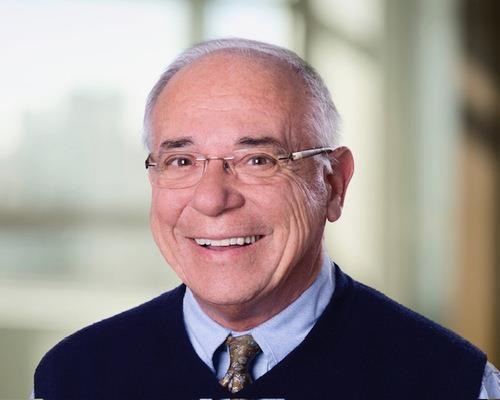
Don Shalvey September 14, 1944 – March 16, 2024

Lily Geismer writes about the Clinton administration and its embrace of education choice in her book Left Behind (page 244). In 1997, Bill and Hilary dropped off their daughter, Chelsea, for her freshman year at Stanford. The next morning they were in the gymnasium at Don’s San Carlos Learning Center for a roundtable discussion about charter schools (page 248). Geismer claimed, “The San Carlos event galvanized momentum for charter schools.”

At the time, there was a cap of 100 charter schools in California. Afterwards, “a thirty-something man with a goatee and Birkenstocks”, Reed Hastings, approached Shalvey, asking, “Do you ever think that there’ll be more than a hundred charter schools in California?” He talked Shalvey into helping to get rid of the charter school cap (page 249). “The combination of Don as Mr. Charming Establishment and me as a wealthy provocateur presented a unique challenge to the teachers union,” Hastings remembers in an interview.

Together, they successfully campaigned to end the charter school cap. At the same time, Hastings was starting his new company, Netflix. The two soon hooked up with John Doerr and NewSchools Venture Fund to invent the charter management organization (CMO). With $400,000 left from their campaign, they used it to create America’s first CMO, University Public Schools which later became Aspire.

Shalvey did most of the leg work.

The first Aspire charter school opened in 1999 in Stockton, California. During his career in education, Shalvey’s home was always a ranch in Linden, California about 10 miles from Stockton.

The Gates Foundation

From 2009 to 2020, Shalvey served as Deputy Director for K-12 Education at the Bill & Melinda Gates Foundation.

While he was at the Foundation, charter school enrollments grew by a half-million students, fueled in large part by the Charter School Growth Fund supported by Gates, the Walton family and other billionaires. The Fund was founded in 2004 by Buzz Woolley and Don Fisher (Tax ID 05-0620063). In 2005, John Walton replaced Buzz Woolley as president, indicating his privatization focus changed from vouchers to charter schools.

Gates gave Shalvey two big jobs. He was to implement Common Core standards and target teacher preparation. Unfortunately the standards were installed with no field testing. There were many good ideas within them but much of it was improperly aligned and had no buy-in from educators. There were also political issues. People saw this as Gates’ effort to take control of public education and create a centralized US education marketplace.

Focus on teacher preparation became another effort at privatizing every aspect of the education industry. Instead of working with established institutions like Columbia University or the University of California system, Shalvey and Gates looked toward private companies like the Teach for America (TFA) spinoff, TNTP.

Wendy Kopp founded TNTP (originally called The New Teachers Project) in 1997 and assigned Michelle Rhee, who had just finished a two-year TFA tour, to run it. Under Rhee’s leadership, TNTP became noted for teacher bashing.

Soon after Shalvey went to work for Gates in 2009, he became a member of the EdSource board. Gates was perhaps their largest funder and Don, his representative, remaining a board member until his passing.

Returns to Stockton

June 30 2020 was Shalvey’s last day at the Gates Foundation. For the entire time he worked for Gates, he commuted from the home he shared with wife, Sue, in Linden, California. He stated:

“For the past 50 years, the San Joaquin Valley has been my home. I’m thrilled to spend the final years of my career working to improve education for the young people in our wonderful Valley.”

The 75 year-old Shalvey was not ready to retire. He became CEO of a local non-profit called San Joaquin A+. There must have been secret negotiations before he left Gates because it is probably not a coincident that at the same time billionaire, Helen Schwab, made a $400,000 donation to the non-profit.
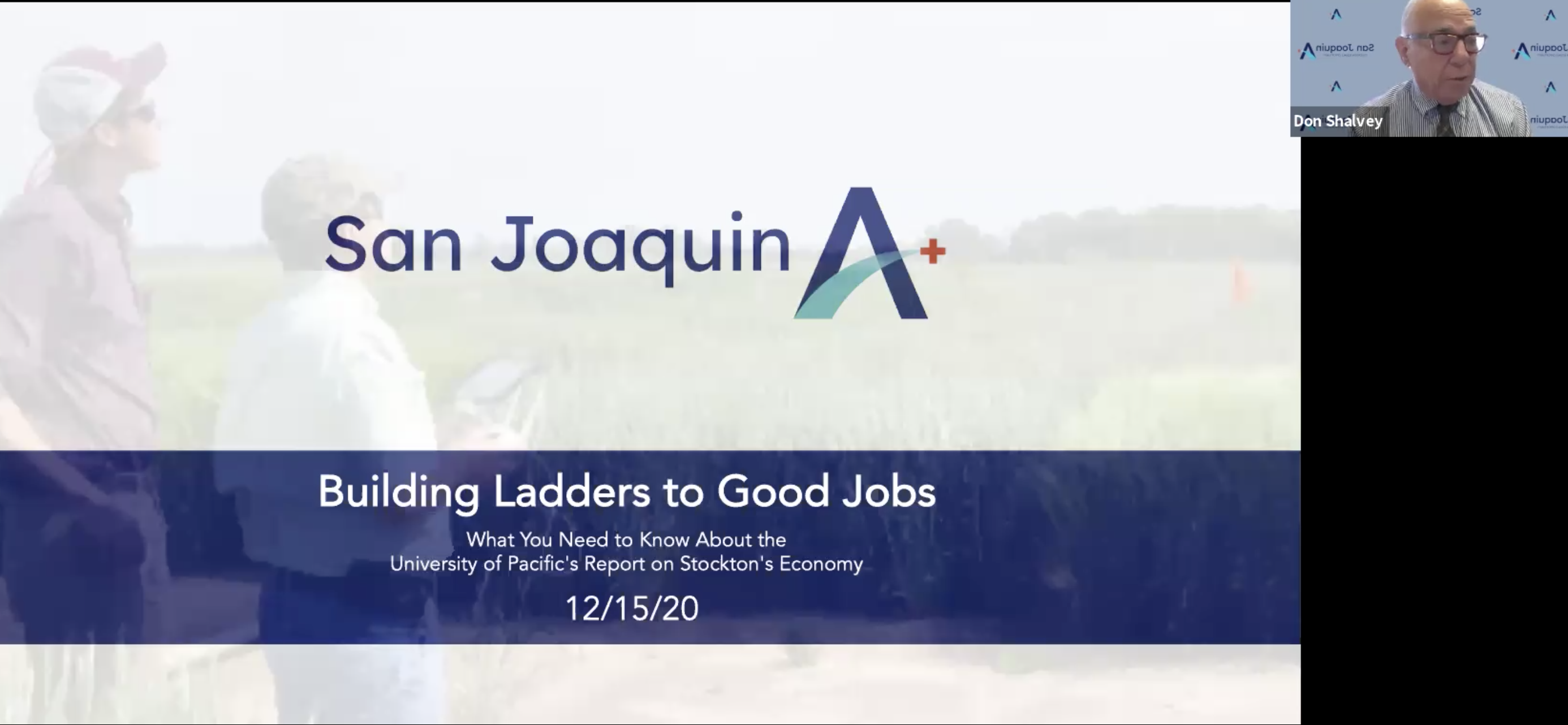
Shalvey’s new job was part-time, committing 20 hours a week to his CEO position. Tax records indicate San Joaquin A+ (Tax ID: 51-0536117) became tax-exempt in 2005. It was a relatively low key organization until his arrival. In 2019, they had net assets of $39,266. Shalvey was compensated $160,225 that first year and in 2021, $332,782. In the three years prior to his arrival, A+ had taken in $15,169. The haul in 2020 was $3,176,833 and in 2021, $3,942,790.

He was definitely a rainmaker and the question is what did his billionaire supporters expect back?

Don Shalvey was known to be a good guy with a big smile and able to work with people but some locals in Stockton disagree. Founder of Facebook news report 209 Times, Motecuzoma (Motec) Sanchez, wrote:

“Every time one of these devils dies, like with Alex Spanos, you see their legacy media puppets try to brainwash the public into believing what they did in their lifetime was admirable. Shalvey exploited poor Brown and Black kids in my hometown of Stockton, Modesto and beyond. And his creations, like a monster, continue to do so.”

The late Alex Spanos was a very successful real-estate developer from Stockton who purchased the San Diego Chargers in 1984. Motec felt Spanos was ruthless and that just the way his life story was glorified is how Don Shalvey’s life is being embellished today. From his ranch in Linden, Shalvey consistently ingratiated himself with billionaires, denigrated public schools and made profits. 

In 2022, two grand jury reports seemed out to demonize the local school districts board and leadership. A report in The 74 quoted Shalvey saying, “I think Stockton Unified might be the worst system in the country.” That was typical of the hyperbolic anti-public school statements he often made.

It is true that during John Deasy’s two years as Superintendent, the district had some financial issues which have been solved. With 82% of K-12 students coming from families of poverty, it is little wonder they did not test well but their graduation rates were reasonable and English language progress rates, among the best in the state. It is one more example of good schools in poor neighborhoods having test results used to unfairly undermine them.

Shalvey made a lot of money working to destroy public education but that money is not helping him now. He raised an admirable family and seemed to have many good traits. I feel bad about writing critically of the dead but he, unwittingly or not, made many bad choices, harming countless children.

I agree with Motec.

Don Shalvey should never be lionized.
Bad Governance with Education Vouchers

19 Mar

By Thomas Ultican 3/19/2024

 February 26, a Maricopa County Grand Jury indicted six people, including three employees of Arizona’s education department, for forgery, fraud and money laundering. The forty counts charged were related to stealing from the Empowerment Scholarship Account (ESA) program. Attorney General Kris Mayes claimed the fact that three department of education employees were involved indicates a lack of adequate fraud prevention but ESA advocates say new guardrails are not needed.

Before arriving into the 21st century, protecting against malfeasance with tax-generated dollars was considered fundamental to good governance. Arguably, voucher programs violate this basic tenet.

In the 19th century, America led the world to universal free public education. If parents wanted to put their child in a private school for religious or other reasons, it was a choice with no expectation from taxpayers. Today, voucher supporters demand Americans pay for private choices and claim accountability is just a way for liberals to kill vouchers.

In our upside-down politics, liberals are now the accountability hawks and conservatives blindly support spending tax dollars with no accountability.

 An article in The 74 quoted Lisa Snell, a senior fellow at Stand Together, brushing off the Arizona indictments with:

“I don’t think there’s any program that can regulate out the possibility of bad actors.”

“In any sector, there are people that are taking advantage of taxpayer money.”

 Stand Together was created by Charles Koch in 2003 and supports The 74.

The article continues with a quote by a director of national research at Milton Friedman’s EdChoice:

“Government employees committing fraud is a tale as old as time, and by no means unique to education”.

Arizona’s Governor, Katie Hobbs, proposed tightening accountability for the ESA program. Among eight propositions, she suggested an outside auditor to track private school use of ESA money with fingerprint background checks and minimum education requirements for teachers at these schools.

Mostly Republican ESA supporters held a rally after Hobbs announced her plan. Arizona State Senator Jake Hoffman claimed, “We’re here today to talk about Katie Hobbs’ abhorrent plan to regulate by death by a thousand cuts the Empowerment Scholarship Accounts out of existence”.

Former Arizona Secretary of Education Cathy Hoffman said:

“Ultimately, the problems with this program are bigger than any superintendent. The ESA program does not have — and has never had — enough oversight to ensure tax dollars are being spent appropriately.”

Education Vouchers

There are three main types of education vouchers.

Type 1: Voucher programs originally geared toward low-income families, allowing parents to use public education funding for tuition (in part or in full) at private schools that otherwise would be unaffordable. This includes both religious and non-religious schools. Sixteen states and Washington DC have voucher programs.

Type 2: Tax-Credit Scholarships programs offer full or partial tax credits to individuals or corporations who donate to nonprofit scholarship funds. Eligible families (usually low or middle income), looking for help paying private school tuition, apply for this through the scholarship-granting organization in their state.

Type 3: Education Savings Accounts allow eligible parents who withdraw their child from public school to get a deposit of state funds into a savings account or ESA which they use for educational expenses. It can pay private school tuition and fees but, unlike other school choice programs, may be used for other qualified expenses, like online learning programs or tutoring. In some states, like Arizona, leftover funds can even be applied for higher education.

These programs are all marketed as providing “school choice” with a sales pitch, claiming children are stuck in “failing public schools” and vouchers give them a way out.

Critics of school choice deny this claim and say funds should be reserved for public schools that serve all children. Jessica Levin, deputy litigation director at Education Law Center notes, “so-called school choice is really the schools’ choice”. She is pointing at the way private schools can and do discriminate against students they do not want.

Levin goes on to say:

“States with voucher programs usually permit participating private schools to discriminate based on disability, religion, LGBTQ+ status, English proficiency and other factors that public schools could never use to exclude or discipline students.”

Diane Hirshberg, director and professor of education policy at the Institute of Social and Economic Research at the University of Alaska—Anchorage shares, “The idea that vouchers enhance parent choice does not account for differences in socioeconomic circumstances which may constrain a family’s ability to take advantage of these or the limitations for rural and remote places”.

La Jolla Country Day in San Diego illustrates one of Hirshberg’s points. Even $11,000 vouchers are not pay enough for the $44,000 tuition but would be a nice perk for rich parents, already sending their children there. Arizona’s average ESA vouchers pay parents between $6,000 and $9,000. Low income kids are not going to high end private schools.

The Fordham Institute’s Chester Finn declared,

“It’s one thing to say parents should be able to review curriculum and have more say in what the schools are teaching and what is in the library. It’s a different thing to say parents should actually control the dollars that are spent on behalf of their child’s education and should be able to decide where those dollars are going and where that education is being delivered.”

No one would claim that Ronald Reagan’s former Assistant Secretary of Education, Chester Finn, was not a conservative but his ideology also means support for competent governance.

Director of the National Education Policy Center, Kevin Welner, observed:

“The idea is to be deregulated. For advocates of vouchers, transparency is not a good thing. Protections against discrimination in private schools is not a good thing. Oversight and data reporting and data collection, program evaluations, and accountability back to the government, none of those things are good things if you are coming from the perspective of voucher zealots.”

Voucher Schools are not Performing

Besides the fact that vouchers take money away from public schools attended by more than 90% of America’s students, they are generating horrendous test results.

Joshua Cowen is a professor of Education Policy at Michigan State University. From 2005 to 2010, he was part of an official evaluation of the Milwaukee Parental Choice Program. They followed 2500 students in the program who were carefully matched with 2500 public school students. Cowen reported, “After five years, we found very little difference on test scores between the two groups.”

This evaluation seems like the highpoint for voucher school performance. In a Time magazine article Cowen shared:

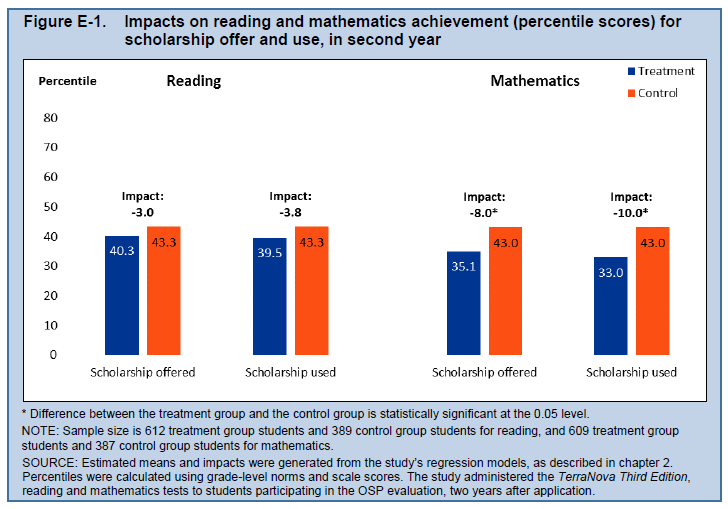
“Although small, pilot-phase programs showed some promise two decades ago, new evaluations of vouchers in Washington, D.C., Indiana, Louisiana, and Ohio show some of the largest test score drops ever seen in the research record—between -0.15 and -0.50 standard deviations of learning loss. That’s on par with what the COVID-19 pandemic did to test scores, and larger than Hurricane Katrina’s impacts on academics in New Orleans.”

DC Voucher Study Graphic (Page xiv)

Another major issue with voucher schools is that 20% to 30% of students leave every year, either giving up their vouchers or are pushed out.

It is not just Professor Cowen who is writing about these dismal results. Chalkbeat’s Mathew Barnum reported in 2019:

“That’s the grim conclusion of the latest study, released Tuesday, looking at Louisiana students who used a voucher to attend a private school. It echoes research out of Indiana, Ohio, and Washington, D.C. showing that vouchers reduce students’ math test scores and keep them down for two years or more.”

Joe Waddington, University of Kentucky professor, noted, “We’ve started to see persistent negative effects of receiving a voucher on student math achievement.”

So who benefits from vouchers?

There are three groups:

  1. Parents with children already in private schools
  2. Operators of private schools  
  3. Religious zealots who believe public schools are evil and must be destroyed

Public dollars should only go to public schools. American taxpayers generously agreed to finance public education. They have never voted to burden themselves with financing private schools. Every time given an opportunity to vote on vouchers, they said NO.

Choice is an ideology that came out of the negative reaction to Brown versus the Board of Education in 1954. It pushes people into separate silos and exacerbates division.

It is a bigoted choice and drives segregation…

Subterfuge and Learning Loss Baloney

12 Mar

By Thomas Ultican 3/12/2024

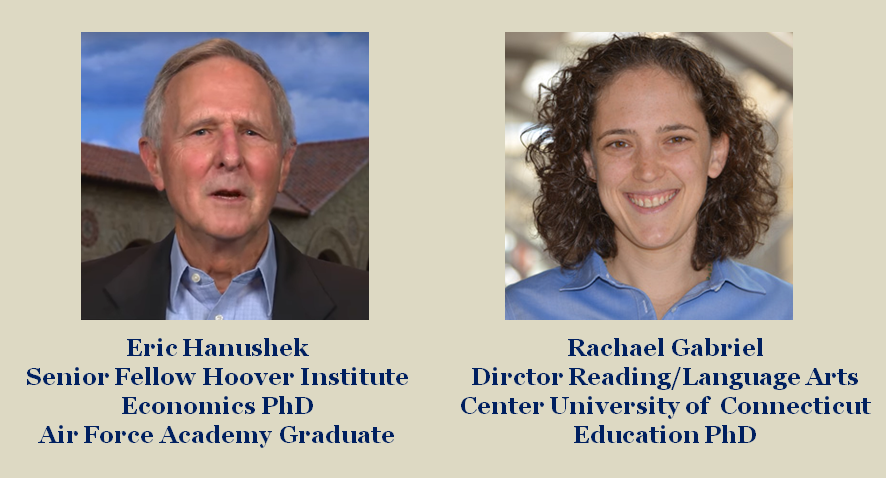
Crazy pants Eric Hanushek claims COVID “learning-loss” could cost American students $31 trillion in future earnings. He burst onto the education world’s consciousness with his 1981 paper, claiming “there is no relationship between expenditures and the achievement of students and that such traditional remedies as reducing class sizes or hiring better trained teachers are unlikely to improve matters.” This played well with billionaires from the Walton family but had no relationship with reality. Likewise, his January 2024 “learning-loss” claims were straight up baloney.

Learning-Loss Reality

In the summer and fall of 2020, NWEA, McKinsey, CREDO and others produced unfounded analysis of looming learning-loss disaster caused by school closures. Since there was no data, summer learning-loss was used as a proxy, a bad one. In 2019, Paul von Hippel’s investigation threw great doubt on the 1982 Baltimore study that powerfully supported summer learning-loss belief. He showed using modern testing analysis, learning-loss was doubtful and in some cases, students gained during the summer. This data, used to trumpet a national education crisis, had no validity.

Unfortunately, billionaire-financed organizations, out to undermine public schools, do not care.

From March 2020 to February 2021, almost a half-million people died of COVID-19. There were no vaccines or Paxlovid type drugs. Refrigerator trucks stored dead bodies and more than 2 million Americans were hospitalized, some on ventilators for months. Schools were closed; unemployment jumped to 15%, murder rates shot up by 30% and fear was rampant.

In this environment, teachers heroically switched to online education.

K-12 students lost parents, became isolated from friends and visited family members in hospitals. Many kids struggled with online classes over inadequate internet feeds, parents were losing jobs and children could not visit grandparents.

Of course the rates of learning decreased but less than one might expect.

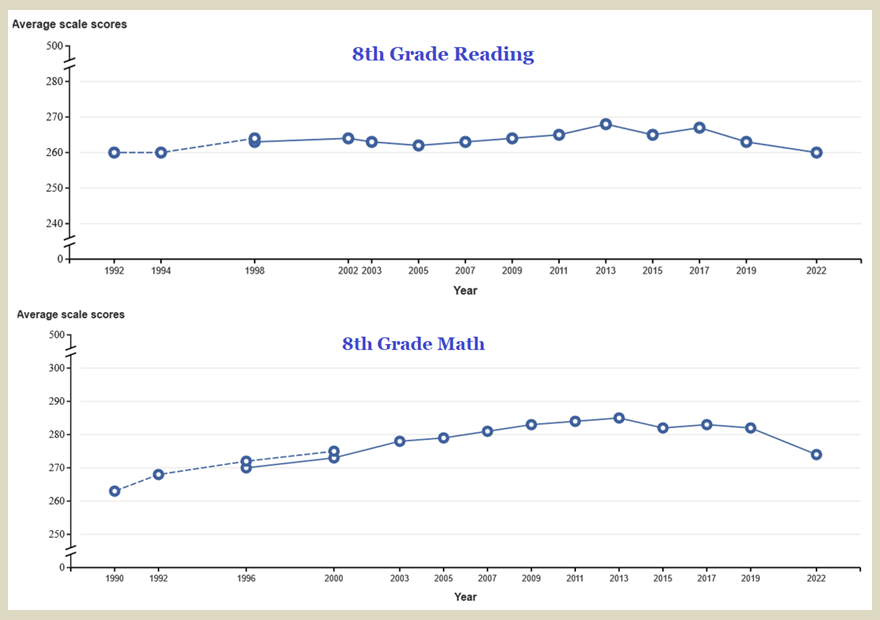
NEAP Data Explorer Graphs

The National Assessment of Education Progress (NAEP) 8th grade data graphs above show a modest decrease in both math and reading scores between 2019 and 2022. Reading fell by three points and math by eight points on a 500 point scale. I do not see catastrophe in these declines because given the context of the pandemic they strike me as rather small, with no signs of pending economic collapse.

Students have been out of school for months with medical or other reasons. I and others with this experience can testify that we were able to recover quickly. Claiming learning-loss disaster from COVID shutdown does not make sense.

Another interesting result from the 2022 NAEP test data comes from Commissioner Peggy Carr of the National Center for Education Statistics. She said, “There’s nothing in this data that tells us there is a measurable difference in the performance between states and districts based solely on how long schools were closed.”

To add further weight, New York Times opinion writer David Wallace-Wells wrote:

“In New York City, the nation’s largest school district, schools reopened in September 2020. There, average scores for reading fell by about a point for fourth graders and improved by about a point for eighth graders; in math, fourth-grade scores fell by nine points (statewide scores fell by 12) and eighth-grade scores fell by four points (statewide scores fell by six). In Los Angeles, the second-largest district, schools stayed closed through January 2021. There, average scores actually improved in fourth-grade reading, eighth-grade math and eighth-grade reading, where they improved by a robust nine points (to 257 from 248). Scores fell only in fourth-grade math (to 220 from 224).”

This January, the New York Times interactive posted Students Are Making a ‘Surprising’ Rebound From Pandemic Closures”, based on a joint project from Stanford and Harvard Universities. Its executive summary states:

“Despite the lack of improvement during 2022-23 on assessments provided by NWEA and Curriculum Associates, we find that student achievement did improve between Spring 2022 and Spring 2023: in fact, students recovered approximately one-third of the original loss in math (0.17 grade levels out of the 0.53 grade levels decline from 2019-2022) and one quarter of the loss in reading (0.08 grade levels out of the 0.31 grade level decline from 2019-2022). Such improvements in grade levels in a single school year mean that students learned 117 percent in math and 108 percent in reading of what they would typically have learned in a pre-pandemic school year. These gains are large relative to historical changes in math and reading achievement on the National Assessment of Educational Progress.”

George Bush’s Secretary of Education, Margaret Spelling, says, “We’re slowly recovering, but not fast enough.” That is from the woman who claimed 100% of America’s students would be above average by 2014. Without being a statistician, it never rang true to me. Her failure to recognize the great work of public schools says she has an agenda.

Outrageous Claims

Eric Hanushek’s new report claims, “Historical earnings patterns make it is possible to estimate what the learning losses documented by NAEP will cost the average student in the Covid-cohort: 6 percent lower lifetime earnings than those not in this cohort.” To document this, he links it to a publication by the Organization for Economic Co-operation and Development, referencing an article he wrote. Without evidence, he claimed Black students will have 8 percent lower lifetime earnings. His report is mostly unsupported assertions.

He states that “nations with more skilled populations grow faster” and asserts that pandemic learning losses mean the US will be less skilled, not growing as fast as “competitors”. Based on this, he postulated future economic losses for students of $28 trillion.

Seams he believes “competitors” would not have education setbacks from COVID.

Believing the pandemic brought harmful policy shifts, causing school quality to decline, he sees abandoning standardized test accountability as number one on his pantheon of bad moves. Teachers unions pushing for their preferred education policies seems wrong to Hanushek. After all, what do teachers know about good education? They are not trained MIT economists, like he is!

The one policy he sees bringing improvement is to put students with “top flight” teachers. This comes from the man who declared “hiring better trained teachers are unlikely to improve matters”.  Hanushek suggests, “The highly-effective teachers could teach larger classes or added sections of courses with both monetary incentives and additional support for this work.”

Remember he does not believe smaller class sizes are important.

Hanushek makes non-scientifically supported assertions and then amplifies them. Like dishonest scientists, he cites his own suspicious work as evidence for new claims. His days of learning test score conversions and estimates of economic loss are these kinds of mere postulations.

A Humanistic Perspective

Professor of literacy from the University of Connecticut, Rachael Gabriel, wrote a 2021 piece for the Washington Post Answer Sheet Blog claiming, “There is no such thing as learning loss.”  Her point was that even when not in school, young people are still learning. Professor Gabriel suggested:

“What if we imagined the “corona kids” had learned more than previous cohorts?

“What if we assumed they were more resilient, well-rounded, creative, and had even more potential than previous cohorts because of what they have lived through and lived without?

“What if we assumed that instead of behind, they were advanced in ways that matter beyond measure?”

Everyone should be confident that if schools and school teachers are allowed to do their job with no “expert” interference, students will be fine. Education and learning are not linear processes. When children are ready to learn, an explosion of growth occurs. It is the intellectual equivalent to that year I grew a foot taller.

Learning-loss is not the big danger facing America’s students. The real danger is the likes of McKinsey, NWEA, CREDO and research leaders like Eric Hanushek.

Public Education Attack Measured

7 Mar

By Thomas Ultican 3/7/2024

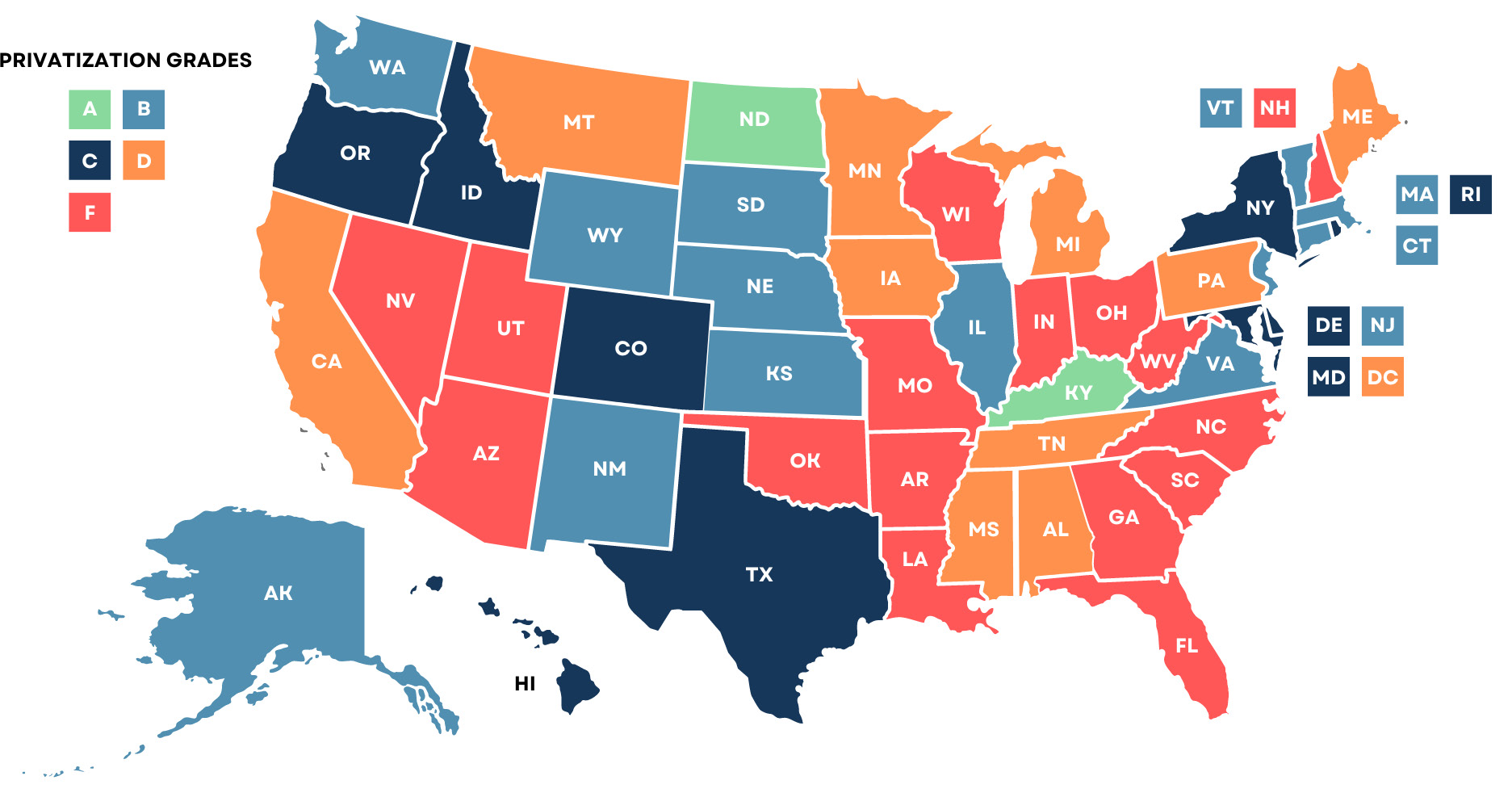
A new report from Network for Public Education (NPE) concludes, “The war on public education has always been a part of Christian nationalism” (Page 32). NPE graded America’s schools using a 111 point scale:  a) Voucher and Charter Expansion and Protections – 66 points, b) Homeschooling governance – 7 points, c) Financial Support for Public Schools – 14 points and d) Freedom to Teach and Learn – 24 points (Page 9). The results from these category totals indicate, among other things, the extent of radical Christian and billionaire libertarian influence in each state.

No state earned a perfect 111 points with North Dakota’s 98 points being the high score. NPE translated the scores into letter grades of A – F: A – 86 to 98, B – 78 to 85, C – 67 to 77, D – 55 to 66 and F – 54 and below (Page 10). The top five states, all with A’s, and bottom five states, all with F’s, are listed below (Page 11).

                                    Top and Bottom Five

A GradesScore F Grades Score
North Dakota98 Arkansas37.5
Connecticut93 North Carolina32
Vermont90.5 Utah29.5
Illinois89 Arizona22.5
Nebraska87 Florida19

Interesting Privatization Observations

Stunningly, voucher costs have grown exponentially since 2000 while private school enrollment shrunk, decreasing from 11.38% in 1999 to 9.97% in 2021 (Page 5). The only way this could happen is if the public started paying for students who were already in private schools.

Of the 240 new charter schools in the US from 2022-2023, thirty of them had 25 or fewer students. A comparison of the National Center for Education Statistics data between 2021 and 2022 revealed 139 charter schools closed (Page 5).

NPE reported:

“Neighborhood public schools remain the first choice of the overwhelming majority of American families. Despite their popularity, schools, which are embedded in communities and governed by elected neighbors, have been the target of an unrelenting attack from the extreme right” (Page 4).

The title for most privatized school system in the US belongs to Florida. Even there, with its 74% public school enrollment, the popularity is unchallenged (Page 6).  

Public schools enroll about 90% of America’s K-12 students.

A Pennsylvania investigation discovered that 100% of voucher schools examined, engaged in some form of discrimination. The schools’ decisions were based on LGBTQ status, disability, academic capacity, family religion and “even pregnancy”. Dayspring Christian Academy declared that supporting the rights of LGBTQ students was also a reason for being denied enrollment or expulsion (Page 12).

The District of Columbia and 30 states have voucher programs with many having multiple programs. Some states allow participants to be in more than one program. Middle class and wealthy families who never had children in public schools now have tax-dollar generated sources flowing toward them (Page 12).

We now have the ludicrous situation where poor people are supporting private school students from wealthy families.

Root of Christian Nationalism

Carol Burris and her team at NPE observed:

“The war on public education has always been a part of Christian nationalism. As that movement rises, so do the attacks on public schools. Randall Balmer of Dartmouth College argues in his piece in Politico that the origins of the political power of the Religious Right began not with Roe v. Wade but rather with Green v. Kennedy, which denied segregation academies tax-exempt status. According to Balmer, that decision gave religious conservative Paul Weyrich an opening to leverage Evangelical political power. Today, the Heritage Foundation, the organization he co-founded, is part of a billionaire-funded effort to destroy ‘government schools’ under the banner of school choice.” (Page 32)

In 1973, Paul Weyrich co-founded the Christian nationalist think-tank, The Heritage Foundation, which has been brutal to the America I love. They attacked the separation of church and state guaranteed in the 1st amendment to the US constitution, undermined democratic action and demanded fidelity to their ideals. In their world, it is forbidden to embrace humanistic principles, share resource or help non-Christians.

Katherine Stewart discussed Weyrich in her book, The Power Worshippers. After the Democratic Party’s embrace of civil rights, Richard Nixon’s “Southern strategy” became a winner. Stewart shared, “If the right could access the religious vote, Weyrich reasoned, power would be in its grasp” (Worshippers 60).

In historian, Randall Balmer’s book, Thy Kingdom Come: How the Religious Right Distorts the Faith and Threatens America, Weyrich claimed that it was the 1975 IRS action against Bob Jones University that caused the Religious Right’s rise, not abortion. Only after New Right leaders held a 1978 conference call to discuss strategy, was abortion was put on their political agenda (Worshippers 64).

With the Soviet Union’s fall, Weyrich saw an opportunity to unite with religious conservatives in Russia and Eastern Europe. Stewart noted:

“All told, Weyrich made more than a dozen trips to Russia and Eastern Europe in the aftermath of the fall of communism. At the time of his death in 2008, even as he was riding high on a wave of plutocratic money in the United States, he was writing and speaking frequently in defense of Russia and facilitating visits between U. S. conservatives and Russian political leaders.” (Worshippers 270)

The long relationship between Christian nationalists and Russian plutocrats informs us why some Republicans support Russia against Ukraine. A pro-Russian attitude goes along with opposing public education. To Christian nationalists, the enemy is secular humanism and public schools reek of it.

Weyrich spent the last decade of his life in excruciating pain. In 1996, he fell on black ice, suffering a spinal injury. By 2001 he required a wheel chair to get around and in 2005; both his legs were amputated from his knees down. He was in constant pain until his death in late 2008.

Why was Florida Last

The team at NPE has provided a fair and well researched assessment of public schools across America. Their four categories and weightings they used to compare schools from many jurisdictions are reasonable. Clearly privatization efforts do significant harm to public education; making giving them 51% of the grade acceptable. Assigning 22% of the grade to protect freedom to teach may be a little low but OK. School finance, getting 13% of the grade, is definitely not too much and 6% of the grade, coming for homeschooling protection, is a needed new category.

With homeschooling accelerating over the last two decades, the need to protect children educated at home has become more critical. The Coalition for Responsible Home Education  was founded by adults, who were themselves homeschooled. Their database contains documented stories of brutal neglect, including homeschooled children murdered, sexually assaulted, imprisoned, and starved. Unfortunately these stories almost never garner national attention. Students in brick and mortar schools also suffer this kind of abuse but they are around mandated reporters (teachers) every day and are not hidden from sight like homeschooled kids.

Using well-sourced data and a four-category rubric, NPE has provided parents throughout the United States with tools to evaluate their states education leadership.

NPE mentioned The Heritage Foundation and its connection to Christian nationalism, which is leading the war against public education. Before he was elected governor of Florida, Jeb Bush served on the Heritage board. It was there he developed his agenda for privatizing public education. His most influential adviser was Patricia Levesque, a graduate of Bob Jones University, the fundamentalist Christian school in South Carolina.

Little wonder that Florida was dead last in supporting public education in America.