Archive | August, 2023

Roll-Back Advanced Placement

29 Aug

By Thomas Ultican 8/29/2023

Advanced Placement (AP) in high school is an assault on good pedagogy. Teacher and author, Annie Abrams, reports, “The College Board is closing in on ownership of a national curriculum that holds not only high schools, but also universities to the company’s academic standards and its philosophy of education.” (Page 6) Pricey private high schools and colleges are abandoning AP but public schools are short changed.

John Dewey studied life and how it functions. In the first half of the twentieth century, America’s preeminent philosopher advanced pragmatism. Stanford University’s philosophy department states, “Use of Dewey’s ideas continues apace in aesthetics and art criticism, education, environmental policy, information theory, journalism, medicine, political theory, psychiatry, public administration, sociology, and of course in the philosophical areas to which Dewey contributed.”

In his book, Democracy and Education, Dewey wondered:

“Why is it, in spite of the fact that teaching by pouring in, learning by passive absorption, are universally condemned, that they are still so intrenched in practice? That education is not an affair of ‘telling’ and being told, but an active and constructive process, is a principle almost as generally violated in practice as conceded in theory.” (Page 46)

Alfred North Whitehead, a famous educator, philosopher and scientist, active in the late nineteenth and early twentieth century, wrote the three-volume Principia Mathematica (1910–1913), with his former student, Bertrand Russell. This was the 23rd of the 100 best non-fiction books in the century. Whitehead founded process philosophy and in his amazing essay, “The Aims of Education,” shared:

“In training a child to activity of thought, above all things we must beware of what I will call ‘inert ideas’—that is to say, ideas that are merely received into the mind without being utilized, or tested, or thrown into fresh combinations.” (Page 1)

“And I may say in passing that no educational system is possible unless every question directly asked a pupil at any examination is either framed or modified by the actual teacher of that pupil in the subject.” (Page 5)

“But the first requisite for educational reform is the school as a unit, with its approved curriculum based on its own needs, and evolved by its own staff. If we fail to secure that, we simply fall from one formalism into another, from one dung-hill of inert ideas into another.” (Page 13)

The greatest philosophers and education theorists of the twentieth century warned, in no uncertain words, against the College Board style of cram and exam. Instead of pragmatism and process philosophy, behaviorism is implemented with standards and standardized tests, accompanied by a trophy or punishment.

Short Changed: How Advanced Placement Cheats Students
Standardization in public schools began in 1892 with the Committee of Ten. There was consternation among elite schools over student quality. Charles William Elliot, President of Harvard University and a former chemist, led the group of men—all men—establishing the first standards. This was the terrible idea which opened the road for College Board and AP programs.

Annie Abrams’s Short Changed documented the road to AP and identified James Bryant Conant, Harvard University President <another chemist>, as leading the way. He believed in standards and standardized testing. Abrams stated, “Conant’s advocacy for reform based on intellectual merit and technocracy set the stage for the Advanced Placement program” (Page 23) and shared:

“ETS would produce test with scientific precision and the other organizations would guide the programs of testing. The College Board, the American Council on Education, and the Carnegie Foundation would come together under the aegis of the Educational Testing Service. The new agency’s trustees elected Conant chairman of the board.” (Page 41 and 42)

“Conant’s position of power represented a victory by believers in the notion of quantifiable IQ … Conant was obsessed with testing and admitting students on the basis of ‘aptitude’ instead of ‘achievement’ …” (Page 42)

“For Conant, an objective metric like the SAT would ensure rational, impartial selection of the next generation of leaders based on intellectual merit, which tests would be able to identify.” (Page 43)

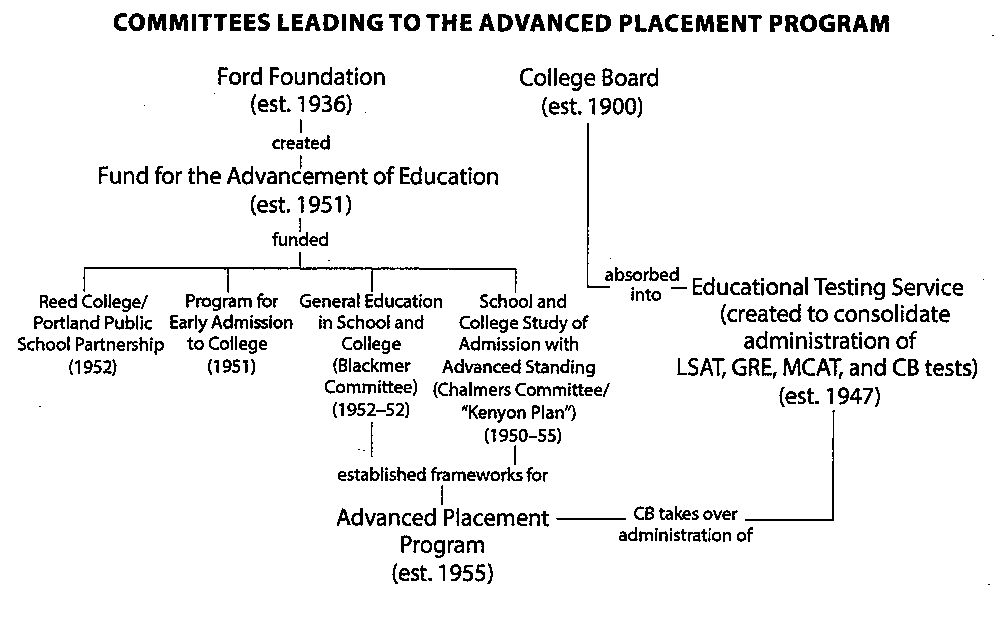
Beginning in 1951 a major force, the Ford Foundation, supported four different approaches to the same goal of enriching education for the superior student. In 1953, it issued a paper on the four strategies, including the Blackmer report and the Kenyon plan. (Page 72)

The Kenyon plan, led by Gordon Keith Chalmers, produced “School and College Study of Admission with Advanced Standing.” Abrams noted it as the “most immediate blueprint for the AP program.” The Blackmer Committee developed “General Education in School and College,” recommending schools and colleges reconsider their roles in making education more efficient and meaningful.  

These two plans became the Advanced Placement program. (Page 13)
(Page 14)

The founders of AP did not want a national curriculum. However, beginning in 1955, with the first AP exams, the College Board started moving toward that eventuality.

Inside Higher Education reported in 2020:

“Ten years ago, AP teachers were given a course description with a brief curriculum outline and sample exams to study. They were given a fair amount of autonomy that replicated the academic freedom of a college professor. That is no longer the case.”

Bad Pedagogy from the Uninformed

In 2012, former college professor and AP teacher, John Tierney, wrote “AP Classes are a Scam” for Atlantic magazine, stating:

“To me, the most serious count against Advanced Placement courses is that the AP curriculum leads to rigid stultification — a kind of mindless genuflection to a prescribed plan of study that squelches creativity and free inquiry. The courses cover too much material and do so too quickly and superficially. … The AP classroom is where intellectual curiosity goes to die.”

Peter Gray PhD, writing for Psychology Today, learned that a group of high school teachers could not use his teaching methods. The classes were so scripted that to prepare the students for end of course exams, they could not make time for anything else.

Gray also noted, “The College Board has been a failure as an aid to education, but a resounding success as a business.” It continuously strives to bring in money, expand its customer base and add new fees. The president makes over a million dollars per year and upper executives, $300,000 to $500,000.

Nicholas Tampio, Professor of Political Science Fordham University, noted “AP courses should only count for high school credits and no more,” and shared “The AP has ‘quietly emerged as a below-the-radar national curriculum for able high school pupils and top-notch teachers.”’

Unfortunately, big money drives AP.

Rising Above the Gathering Storm is another polemic.

In 2005, Lamar Alexander announced one of the day’s star witnesses for the education committee:

“Peter O’Donnell is here, who is a member of the National Academy’s Committee that produced ‘The Gathering Storm,’ and his work in Dallas is one reason for the inclusion in ‘The Gathering Storm’ report of the advanced placement recommendations.”

Another modern edu-philanthropists with no education experience nor training, O’Donnell testified:

“The Advanced Placement Incentive Program succeeds because of three fundamental concepts: the high standards of Advanced Placement, which is built on a strong curriculum, rigorous national exams, and measurable results; emphasis on excellent teacher training; and financial incentives for teachers and students. Incentives are key to the success of our program. They provide extra pay for extra work and are paid by private donors.”

His program became the National Math and Science Initiative (NMSI). It calls for teacher merit pay, a hundred-year-old idea with a hundred-year failure record. Students get cash when they pass the AP exam!

Peter Greene wrote:

“While there may be similar-ish programs in districts across the country, the big dog in the AP bribery biz is the National Math and Science Initiative. NMSI is an organization that was launched ‘to address one of this nation’s greatest economic and intellectual threats – the declining number of students who are prepared to take rigorous college courses in math and science and are equipped for careers in those fields.’ You may recognize that as a classic reformster talking point– low test scores are a threat to our national security– and in fact, the big launching funders of NMSI include Exxon, the Michael and Susan Dell foundation, and the Gates Foundation.”

Elite private schools have been dropping AP courses. In 2018, Sidwell Friends, Georgetown Day, National Cathedral and St. Albans in the District of Columbia, as well as Landon and Holton-Arms School in Bethesda, Maryland and Potomac in McLean, Virginia all ended their relations with AP. That was just in the Washington DC area after querying 150 colleges and discovering students won’t face entrance penalties.

A Personal Experience

In 2004, I moved from middle school to high school to teach a combined regular and AP physics class. My eight AP students were taking six AP classes each. Flabbergasting!

There used to be an aphorism, saying, American high school students were the laziest in the world. They played sports, partied, did very little academic work, graduated and three months later, showed up in college as the top students in the world.

Low-pressured high schools were what students of the 1950s through the 1970s needed. They were not mature enough for college. Today, suicide rates are skyrocketing and intellectual curiosity has cratered.

·  AP classes are Not needed in high school!
A National Warning

14 Aug

By Thomas Ultican 8/14/2023

An unholy alliance between neoliberal Democrats and education reform oligarchs is harming Delaware public education. This is a lesson for the rest of the nation.

A new charter school law introduced to reduce principal professionalism is the latest example. Data clearly shows for almost two decades, top-down education reform has been ineffective and seriously damaged a once, exemplary system.

In March, Delaware Professional Standards Board recommended charter school certification requirements match public school rules. Kendall Massett, executive director of the Delaware Charter Schools Network, immediately responded, “All Delaware charter schools are led by highly qualified administrators.” She said charter school principals have a different role than public school leaders and need to be excellent marketeers to raise funds and drive enrollment.

Did she mean charter school principals don’t need to be professional educators?

For the Standards Board recommendation to take effect, adoption by the State Board of Education is required. Before they acted, Senate President Pro Tem David P. Sokola introduced senate bill 163 to relax certification rules for charter school principals.

The heart of Democrat Sokola’s legislation says:

“The bill creates new subsections in Section 507(c) of Title 14 of the Delaware Code to define the licensure and certification requirements more clearly within Chapter 5 of Title 14. Finally, the bill requires the Secretary of Education to work with the Delaware Charter Schools Network to create a qualified alternative licensure and certification pathway for charter school administrators engaged in the instruction of students (Instructional Administrators).”

Teachers’ union leader, Mike Matthews, wrote to the Senate Executive Committee:

“I was disheartened to see that SB 163 — a bill that will actually deprofessionalize the education profession — was introduced by Senator Sokola. I was even more disappointed — and concerned — to see it filed in the Senate Executive Committee instead of the Senate Education Committee where it belongs. Why was that?”

Bill was passed by the State Senate and is currently awaiting action in the House Administration Committee. The House Education Committee, like its counterpart in the Senate, is not involved.

Neoliberal Education Reform

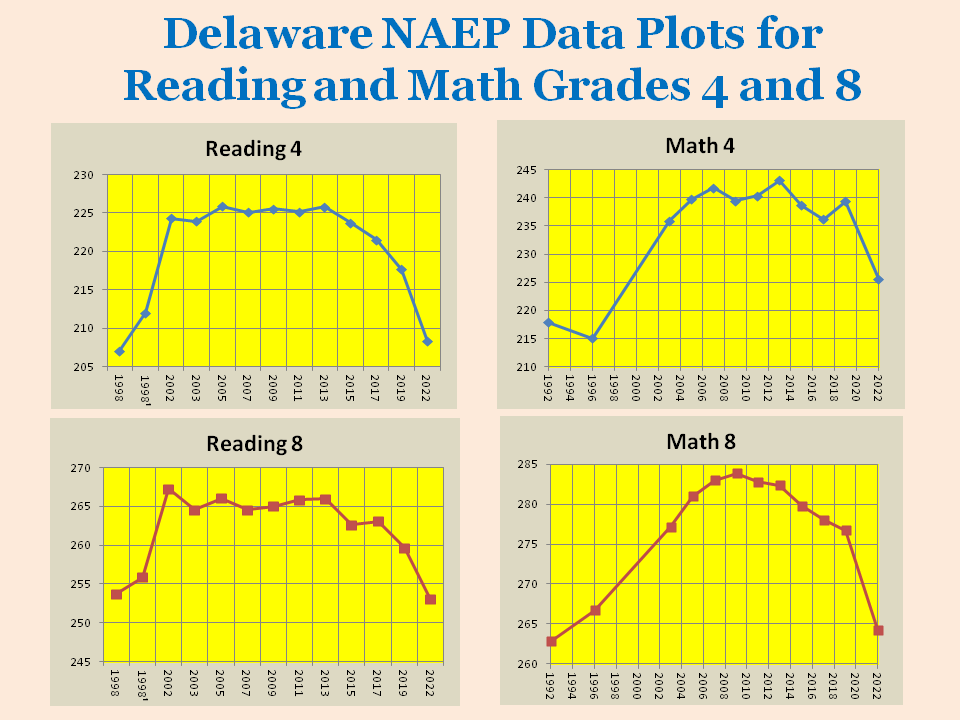
A Delaware Live headline howls, School test scores dismal again despite new math, reading plans.” Two decades of 4th and 8th grade reading and math data on the National Assessment of Education Progress (NAEP) support the headline. NAEP is often referred to as the nation’s education report card. The above graphs beg the question, “what happened in 2010?”

Long-term NAEP data showed from 1971 until 2002, there was steady growth in math and reading. The steady growth ended concurrent with the adoption of the bipartisan Kennedy-Bush education reform, No Child Left Behind. The graphs illustrate this phenomenon.

Why did Delaware’s scores start falling?

In 2010 educator and blogger, Susan Ohanian, reported,

“Delaware and Tennessee came out on top in round one of RTTT: Delaware got $100 million (about $800 per student), and Tennessee $500 million (about $500 per student). Since these states radically changed their education strategies to receive what amounts to 7 percent of their total expenditures on elementary and secondary education, the feds are getting a lot of bang for the buck.”

The $4.5 billion dollar Obama era Race To The Top (RTTT) program was administered by Education Secretary Arne Duncan. Grants were given to states that complied with three key elements: (1) Evaluate teachers based on student test scores (2) Close and turn into charter schools public schools that continue to get low test scores (3) In low-test score schools, the principal and half of the staff are to be fired and replaced. In addition, states were encouraged to create more privately-managed charter schools. 

Education historian and former Assistant US Secretary of Education Diane Ravitch predicted the program’s utter failure when it was announced:

“All of these elements are problematic. Evaluating teachers in relation to student test scores will have many adverse consequences. It will make the current standardized tests of basic skills more important than ever, and even more time and resources will be devoted to raising scores on these tests. The curriculum will be narrowed even more than under George W. Bush’s No Child Left Behind, because of the link between wages and scores. There will be even less time available for the arts, science, history, civics, foreign language, even physical education. Teachers will teach to the test. There will be more cheating, more gaming the system.”

For more than a century, brilliant educators have been skeptical of top-down coerced education reform like those from Duncan, Obama, Bush and Kennedy. Alfred North Whitehead published his essay, “The Aims of Education,” in 1917, stating:

“I suggest that no system of external tests which aims primarily at examining individual scholars can result in anything but educational waste.” (Page 13)

“But the first requisite for educational reform is the school as a unit, with its approved curriculum based on its own needs, and evolved by its own staff. If we fail to secure that, we simply fall from one formalism into another, from one dung-hill of inert ideas into another.” (Page 13)

Former McKinsey Consultant and Democrat with neoliberal inclinations, Jack Markell, was elected Delaware Governor in 2009. His first major victory was winning the RTTT grant. He said:

“What’s really important today is where we go from here; whether we have the will to put our children first and move forward with reforms to improve our schools so that Delaware children can successfully compete for the best jobs in an increasingly competitive global economy. That won’t be easy, but we have proven in these past few months that it can be done.  I would like to thank all those who worked with us in support of our application and look forward to moving ahead to improve our schools.”

Markell praised then Senate Education Committee Chair, David Sokola, for his work on the RTTT grant proposal, the same Senator who just introduced legislation to soften certification requirements for charter school principals.

Since the RTTT announcement, Delaware has gone from consistently scoring above the national average on all NAEP testing to dropping well below.

Science of Reading is NOT the Answer

Delaware Live reported that because of the relative drop in reading scores, the state is implementing the “science of reading.” The article stated, “Today, after a decade of emphasizing training teachers in the science, Mississippi students handily outperform Delaware’s, which has dropped below the national average.”

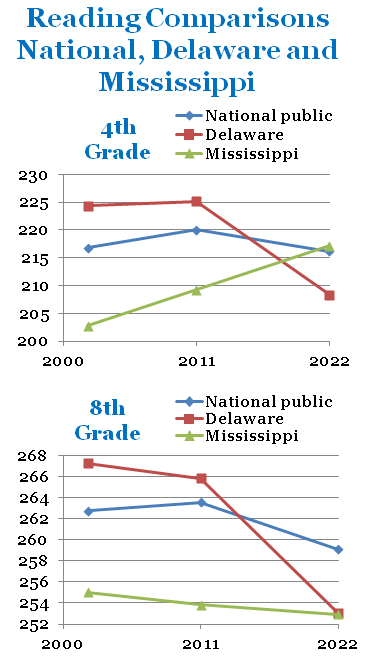
While the scoring drop in Delaware looked real, the success in Mississippi was a mirage. The graphs to the left plot 2002, 2011 and 2022 NAEP scoring data for 4th and 8th grade reading. Delaware is graphed in red, Mississippi in green and National Public in blue. The 4th grade Mississippi data looked amazing but in 8th grade, they returned to being significantly below national average.

The anomaly is explained, in part, by Mississippi retaining all third graders who did not pass the state reading test. It made the 4th grade NAEP data look good but the 8th grade data indicated no earth-shaking advancement to emulate.

In 2021, Delaware’s Department of Education doubled down on oligarch-driven education reform. Monica Gant, Ph.D. from the Delaware Department of Education (DDOE), presented their strategy to accelerate learning in March 2021.

Under the heading “Literacy Professional Learning,” Professor Grant noted, “Participants will have a chance to apply their learning of the Science of Reading either through their district HQIM or utilize free OER (Open Education Resources) HQIM for this work.”

HQIM and OER are both programs financed by Bill Gates, Laurene Powell Jobs and other billionaires.

To guide Delaware public schools’ literacy program, DDOE has turned to the International Dyslexia Association (IDA) who advocates the “science of reading”, to validate Delaware’s programs. IDA is leading the effort to monetize dyslexia and establish state-mandated science of reading curriculum, purchased from specified vendors.

 While jurisdictions throughout the US saw a tick down in 2022 NAEP reading scores, Delaware’s scores, after a year of “science of reading”, were one the largest drops in America.

Final Observations

The reform movement in Delaware is still being pushed in a destructive direction. Senator Brian Pettyjohn, a Republican from Georgetown and member of the Senate Education Committee, commented on recent testing results:

“Our state must do more to hold school districts responsible for students’ academic success. The current mechanism in place for holding schools accountable is ineffective, and it is time for the state to establish a new system that recognizes school districts for their accomplishments and holds them responsible when they fall short of their objectives.”

The concern is understandable but his solution is wrong-headed. More mandates from politicians who do not understand education are not likely to be helpful.

There appears to be a privatization-promoting organization in Delaware called First State Educate. They just hired Julia Keleher as Executive Director. Serving as Secretary of Education in Puerto Rico, Keleher, who is not Puerto Rican, secured a new law allowing for charter schools and vouchers, as well as, the closure of hundreds of schools.

At a San Juan rally, protesters chanted, “Julia go home!”

Things went sideways for Keleher. December 17 2021, a federal judge in Puerto Rico sentenced her with six months prison, 12 months house arrest and a $21,000 fine. She pled guilty in June to two felony counts involving conspiracies to commit fraud.

Today she is another voice in Delaware, pushing for top-down reform and privatization of public education.

Delaware schools were most successful when local educators and school leaders took charge. Since then, after standards were imposed and teacher accountability mandated, school performance suffered. Alfred North Whitehead was right in 1917.

Give autonomy back to schools and professional educators. Politicians at state capitals have little understanding of local school needs or good pedagogy.

Empower teachers and Delaware education will shine again.

Propaganda from The 74 and Johns Hopkins University

1 Aug

By Thomas Ultican 8/1/2023

The 74 recently ran an opinion piece, America’s Education System Is a Mess, and It’s Students Who Are Paying the Price”. Author David Steiner, Executive Director of Johns Hopkins’ Institute for Education Policy, claimed, “The fundamental cause of poor outcomes is that policy leaders have eroded the instructional core & designed our education system for failure.” He was referencing the recent decline in math and reading scores on NAEP testing while ignoring The Stolen Year lost to a pandemic. Ironically, Steiner has been one of America’s most powerful education policy leaders for almost two decades.

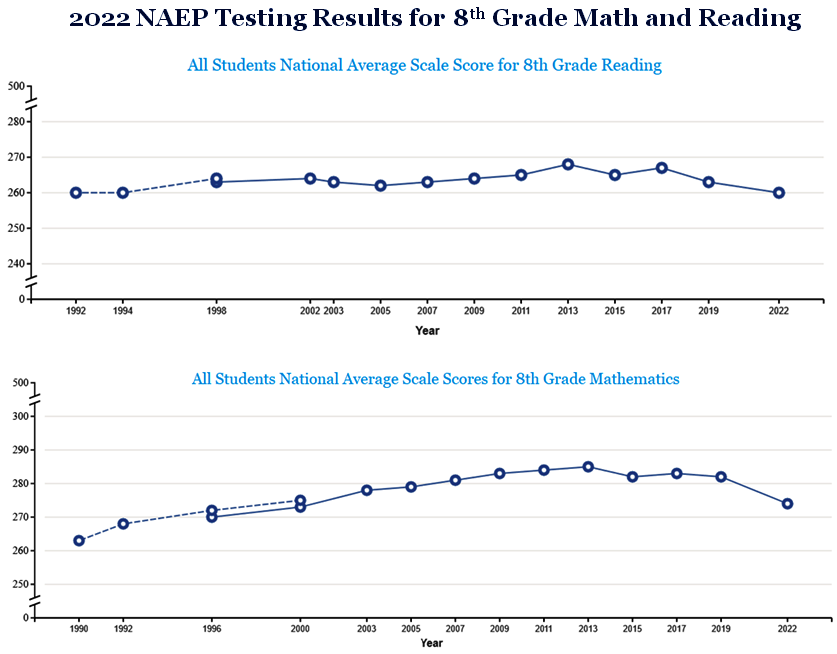
The above graphs used NAEP Data Explorer, based on a 500-point scale, all scores fit within a 30-point range. Since 1992, reading and math scores have wiggled up and down on a small range. In 2022, almost all students missed one year of in-person instruction and in some states, like California, more than half the three years tested. If there had not been a dip in scoring, it would have been powerful proof about the uselessness of standardized testing.

Steiner claimed:

When the recent NAEP long-term trend results for 13-year-olds were published, the reactions were predictable: short pieces in the national press and apologetics in education blogs. COVID-19, we were told, was continuing to cast its long shadow. Despite nearly $200 billion in emergency federal spending on K-12 schooling, students are doing worse than a decade ago, and lower-performing students are today less capable of doing math than they were 35 years ago.”

He linked an almost hysterical report in The 74 about the NAEP testing “CRISIS” and a Washington Post article, citing COVID-19 as a cause. “Apologetics” points to a post by former Assistant Secretary of Education, Diane Ravitch, who asserted:

“The release of the NAEP Long-Term Trend data yesterday set off the usual hysterical reaction. The scores fell as a consequence of the pandemic, when most kids did not get in-school instruction.

“These are not secrets but they bear repeating:

“*Students don’t learn what is tested when they are not in school for long periods of time.

“*Learning online is inferior to learning in-person from a qualified teacher.

“*It’s better to lose points on a test than to risk serious illness or death or infecting a family member or teacher or other member of the school staff.”

Steiner tried to both-side the issue, using Ravitch’s concluding question, “Will politicians whip up a panicked response and demand more of what is already failing, like charter schools, vouchers, high-stakes testing, and Cybercharters or will they invest in reduced class sizes and higher teacher pay?” His counterpoint was, “On the other [hand], their conservative critics point to lack of school choice, poor teacher preparation programs and (more recently) the woke invasion of classrooms.

He seems to be speaking for himself.

Employing “woke” undermines credibility. “Woke” is a talking point, used by many GOP politicians but has no erudite meaning; it is baseless. He probably did not use CRT here because it is the worn-out 2021 unfounded attack on public education.

The opinion piece shows Steiner believes in a need to test students, younger than eight, and that standardized test scores should carry consequences for test takers. He is a big fan of high school exit exams, corporate style education standards and standardized testing. It can be inferred that he admired the “No Child Left Behind” and “Race to The Top” programs, foisted on America by Presidents Bush and Obama.

David Steiner

Escaping Nazism in 1940, David Steiner’s father, George Steiner, and his family emigrated from France to New York City. George met and married New Yorker, Zara Shakow, in 1955. They both became successful academics. He earned many honors and degrees, including a PhD from Harvard. She became an authority on international relations and served as vice-president for New Hall in Essex (UK). While living in Princeton, New Jersey, their son, David, was born in 1958.

Although birthed in the US, David grew up in Cambridge, England where he eventually attended the Perse School and earned a B.A. and M.A. from Balliol College Oxford University. Returning to America, he earned a political science PhD from Harvard University.

From 1999-2004, David served as a professor of education at Boston University and for two years, he worked at the National Endowment for the Arts. In 2005, he was appointed Dean of Hunter College City University of New York.

Billionaire, Merryl Tisch, became Chancellor of New York State Board of Regents in 2009 and believed in standardized testing so strongly that Diane Ravitch dubbed her, the doyenne of high-stakes testing.” Like the Heritage Foundation, she decried the government monopoly over public education and saw a like-minded educator in the Hunter College dean.

In 2008, Steiner created Teacher U at Hunter College, a new teacher preparation program, requested by charter school founders, Norman Atkins of Uncommon Schools, David Levine of KIPP charter school and Dacia Toll of Achievement First (Relay 59). This move coincided with Tisch’s thinking and the following year, she picked Steiner to be the New York State Commissioner of Education.

After he became Commissioner, the Board of Regents authorized independent teacher preparation graduate schools (Relay 60). It was a move to undercut the university-centered monopoly on education training that Tisch and he opposed.

In 2011, Teacher U became Relay Graduate School of Education. Steiner was a founding board member and is still on the board. Relay is a fraudulent school, privatizing teacher training.

Steiner bolstered his resume by supporting the neoliberal agenda, waiving the superintendent of schools job requirements, for Cathie Black, head of the Hearst magazine chain, to take over New York City public schools. Despite not having required teaching experience and professional degrees in administration, he claimed her “success” in business made her, in the words of Mayor Bloomberg, a “superstar manager.” She lasted on the job less than 100-days.

In an interview with Frederick Hess, Steiner proudly pointed to three policies he drove as Commissioner of Education: “commitment to standards-based curriculum”, “commitment to improved testing” plus “rethink and redesign teacher and principal certification.”

July 12, he was a guest speaker for a Pioneer Institute event. Pioneer Institute is affiliated with the very anti-public education State Policy Network. Recently appointed to Hoover Institute’s Practitioners Council, he serves with pro-privatization enemies of public education like Michael Horn, Patricia Levesque and Don Shalvey.

Johns Hopkins

In 1867, merchant, banker and railroad director, Johns Hopkins, bequeathed $7 million to establish America’s first research university in Baltimore. Since then, the private university has been a major success and boasts 29 Nobel Prize recipients. It is truly a world leader in medicine and the sciences.

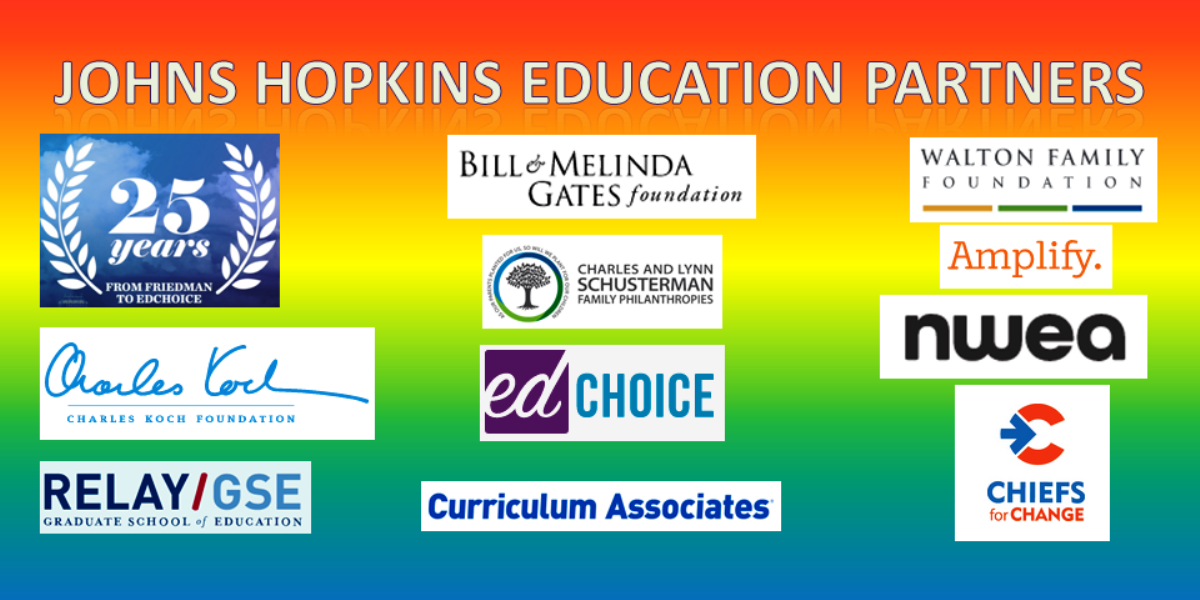
It is sad to see billionaire dollars corrupting this respected institution and undermining public education. The following graphic shows some of the most virulent, anti-public education entities in America are supporters, listed on the Johns Hopkins’ Institute for Education Policy about page. From 2015-2018, the donor-directed Silicon Valley Community Foundation, a dark-money fund, sent $27,381,018 to Johns Hopkins.

Alum Michael Bloomberg is the largest donor to Johns Hopkins University. In 2018, he gave a whopping $1.8 billion to the school.

When neoliberal Democrats in Rhode Island decided to take over the Providence public school system, they contracted with Johns Hopkins to do a study. The school districts demographics were 65% Latinx, 16% Black, 9% White, 5% Asian, 4% Multi-racial and 1% Native American. In addition, 31% of students were multilingual learners, 16% received special education services and 55% came from homes where English is not the primary language. An unbiased study would have quickly revealed that the schools were not failing and the poor testing results reflect deep poverty, language learners and a large special education population.

The Johns Hopkins study was commissioned in May and presented in June. By July 19th, Mayor Elorza officially petitioned the state to take over schools.

Last year, The Institute for Education Policy at Johns Hopkins wrote a joint paper with Jeb Bush’s Chiefs for Change, calling for more testing.

When it comes to education, Johns Hopkins University has abandoned unbiased objectivity and joined a corrupted agenda.

The 74

The 74 was founded in 2015 by former CNN news anchor, Campbell Brown, along with Michael Bloomberg’s education advisor, Romy Drucker. Its original funding came from billionaires, Dick and Betsy DeVos Family Foundation, the Walton Family Foundation, the Doris and Donald Fisher Fund and Bloomberg Philanthropies. Since then, it has been the vehicle for spreading the billionaire message, undermining public schools.

Campbell Brown, the original face of The 74, supported charter schools, opposed teacher tenure and was convinced schools were full of sexual predators. In response to a reporter, she stated,  

“I agree we have a point of view; it’s a ­nonpartisan point of view. It’s a clear point of view, and that is that the public education system, in its current form, is broken, and there’s an urgency to fix it.”

Public education is being molested by billionaires, for different reasons. It is not broken.

Some billionaires see the non-sectarian nature of public education as a threat to their dreams of a Christian theocracy. Others are libertarians that oppose free universal public education. They believe everyone should pay their own way and not steal other people’s property through taxation. Many are firmly convinced that education should be run like a business and respond to market forces.

None are experts in pedagogy nor have experience in running schools.