Archive | July, 2022

Teachers Unions are Selfless

27 Jul

By Thomas Ultican 7/27/2022

Dr. Keith Benson wrote the research paper “Teachers Teach and Do the World Good ….” In this scholarly piece published by Scientific Research, Keith, an inspirational young man and community leader, described the world wide neoliberal attack on public education highlighting the often dangerous stand teachers take to save public schools. In the introduction, Benson writes, “To be sure, teachers have a rich and valuable history of standing up and pushing for the best interests of their societies, and it is my intent to discuss just some of that here.” (Benson 218)

In 2016, Benson earned a Doctorate of Education from Rutgers Graduate School of Education. His website shares, “Dr. Keith Eric Benson, is a Camden public school educator, qualitative researcher, and current President of the Camden Education Association (CEA).” It is from this background as a scholar and teacher activist that he states unequivocally teachers’ unions are fighting for far more than self interest. They are standing up for the future of public education and well being of their communities.

Why They Went on Strike

The Chicago teachers strike in 2012 was pivotal. At the time, a corporate ethos had eclipsed democratic ideals of public education. Neoliberal politician from both of America’s major political parties and their deep pocketed backers were working to change school governance in the image of free market capitalism. They were coalescing around the deceptive banner of “reform.” With few exceptions, the burgeoning business centered education groups had two things in common: they embraced market solutions to school improvement and viewed teachers’ unions as major barriers to changes sought.

A book, A Fight for the Soul of Public Education: The Story of the Chicago Teachers Strike, by University of Illinois labor education professors Bob Bruno and Steven Ashby is a postmortem on the 2012 strike. First, the authors look deeply into the bargaining process and how the parties eventually produced a labor agreement whose pro-teacher substance few thought possible.

In a TV interview author Bob Bruno stated,

“Second, we seek to tell, through the teachers’ and staff’s voices, the story of how the CTU was transformed from a top-down, bureaucratic organization into one of the most member-driven unions in the United States. In this process, a labor conflict focused solely on compensation at the start developed into a challenge to a national education reform movement that, teachers charged, was systematically destroying public education and using Chicago as its test case. Unlike in past strikes, tens of thousands of teachers, clinicians, and paraprofessionals marched repeatedly in Chicago’s neighborhoods and downtown. Thousands of community members and parents joined the demonstrations. Crowds swelled, shutting down streets in the city’s Loop district. Instead of accepting the loss of classroom control and corporate style-management of schools, which teachers had been told for decades was “inevitable,” the CTU reinvigorated a national teachers movement by fighting back. The ripple effects of the 2012 strike are being felt in school districts and union halls across the country.”

Red for Ed swept across the nation in 2018 with such ferocity that right wing media outlet Breitbart claimed, “This teachers union effort, called #RedforEd, has its roots in the very same socialism that President Trump vowed in his 2019 State of the Union address to stop, and it began in its current form in early 2018 in a far-flung corner of the country before spreading nationally.” Ultra-conservative political leaders were frightened by successful teachers’ strikes in right to work states like West Virginia, Oklahoma and Arizona.

A Red for Ed Rally in Arizona

As the Red for Ed movement stormed into 2019, the Jacobin described its objective which did not include spreading Karl Marx ideology.

“Of the 2019 work stoppages, the most important were certainly January’s strike in Los Angeles and October’s strike in Chicago. Each were offensive actions to reverse the education policies imposed by corporate Democrats over the past two decades; each foregrounded “common good” demands on behalf of students as well as the broader community.

“These common good demands, for example, included an increase in the number of nurses and counselors as well as smaller class sizes. Importantly, each of these strikes highlighted the interconnection between the fight for public education and racial justice.”

In January 2019, 30,000 members of the Los Angeles teachers union walked out to the picket lines. In this first strike in 30 years, wages were far from being the only issue. Reporting by the Las Angeles Times after the six day strike agreement was reached noted,

“Striking teachers were sincere, though, when they said the walkout was always about more than salary. The broader concerns they voiced — about overcrowded classrooms and schools without nurses on hand to help when a student got hurt or fell ill — had a lot to do with why the public responded so warmly and cheered them on, bringing food to the lines and even bringing their children to march alongside the strikers.

“For students who rallied and picketed, the strike was a real-life civics lesson, while students inside the thinly staffed schools were watching movies, doing online coursework or playing with cellphones.

“Families identified in particular with teachers’ complaints about overly large classes, because class size affects them directly.”

In March 2019, it was the same story in Oakland, California. EdSouce reported,

“Teachers’ union President Keith Brown, in announcing the agreement, called the strike historic. “We have achieved so much in the seven days of our historic strike in Oakland, in spite of an employer who has said that the sky is falling, that they could not pay for a living wage, they could not pay for lower class sizes,” he said.  “They couldn’t make the investments for needed student support such as nurses, counselors, psychologists and speech therapists.”

In October 2019, Chicago teachers staged another strike lasting 11 days before their demands were met. The problem for city leaders was that parents and students were supporting teachers and marching with them. The Guardian reported on the big issues,

“Teachers said the strike was based on a social justice agenda and aimed to increase resources, including nurses and social workers for students, and reduce class sizes, which teachers say exceed 30 or 40 students in some schools. Union leaders said the strike forced the city to negotiate on issues such as support for homeless students.”

“The Chicago strike was another test of efforts by teachers’ unions to use contract talks typically focused on salaries and benefits and force sweeping conversations about broader problems such as affordable housing, protections for immigrants and class sizes.”

The Neoliberal Agenda

Benson’s well sourced paper asserts,

“Neoliberal Democrats like Hillary Clinton, Rahm Emmanuel, Barack Obama, Cory Booker, and Andrew Cuomo, much like Republicans and Libertarians, view education less as a social responsibility where through its process students are empowered to think critically and view themselves as agents of change, a la Freire, Greene, and hooks, but more of private commodity whereby students increase their human capital for their personal economy.” (Benson 222)

“Education privatization efforts in cities as large as New Orleans (Buras, 2011), and Detroit, along with lesser referenced locales like Puerto Rico and Providence, Rhode Island (Morel, 2018), and cities as small as Chester, Pennsylvania (Maranto, 2005) and Camden, New Jersey (Benson, 2018) serve as exemplars where the blueprint of weakened teachers unions, increased standardization of curriculum and assessments, and installation of corporate-operated charter schools coalesced to cripple the delivery of traditional, democratic public education.” (Benson 222)

When it came to attacking public education, Benson’s list of Neoliberal Democrats omits Albert Gore who was among the most effective.

Lily Geismer’s new book Left Behind: The Democrats Failed Attempt to Solve Inequality provides important insights into how these neoliberals gained political control of the Democratic Party and what they were selling. She points to Colorado Democratic Congressman Gary Hart’s call to “end the New Deal” as a starting point. (Geismer 22) After Walter Mondale’s trouncing by Reagan in 1984, market oriented politicians created the Democratic Leadership Council (DLC). Geismer shares,

“The architects recruited as founding members a lineup of fourteen senators, including Nunn, Chiles and Gore (who had just moved chambers); seventeen representatives, like Wirth, Gephardt, Leon Panetta of California, and Les Aspin of Wisconsin; and ten governors, such as Robb, Babbitt, James Blanchard of Michigan, Richard Lamm of Colorado, and Bill Clinton of Arkansas.” (Geismer 45)

 In 1990, when Bill Clinton became the chairman of the DLC also known as New Democrats, the organization stated its intention to modernize both the government and the Democratic Party. Geismer recounts,

“By 1990, the DLC had issued a statement called the New Orleans Declaration that deemed the ‘fundamental mission of the Democratic Party is to expand opportunity, not government,’ ‘economic growth is the prerequisite to expanding opportunity for everyone,’ and the ‘free market regulated in the public interest, is the best engine of general prosperity.’” (Geismer 107)

In a 1991 speech, Presidential candidate, Bill Clinton called for “public school choice.” (Geismer 127)

Clinton’s confidant and the founding architect of the DLC, Al From, created the Progressive Policy Institute (PPI) as a counter balance to the Heritage foundation. PPI supported what it called the “third-way” which included Clinton’s free trade agenda and hostility toward labor unions. At the time, unions calculated that George H. W. Bush was a bigger threat and supported Clinton. The 1990s DLC led administration “attempted to put a nail in the coffin of New Deal liberalism.” (Geismer 170)
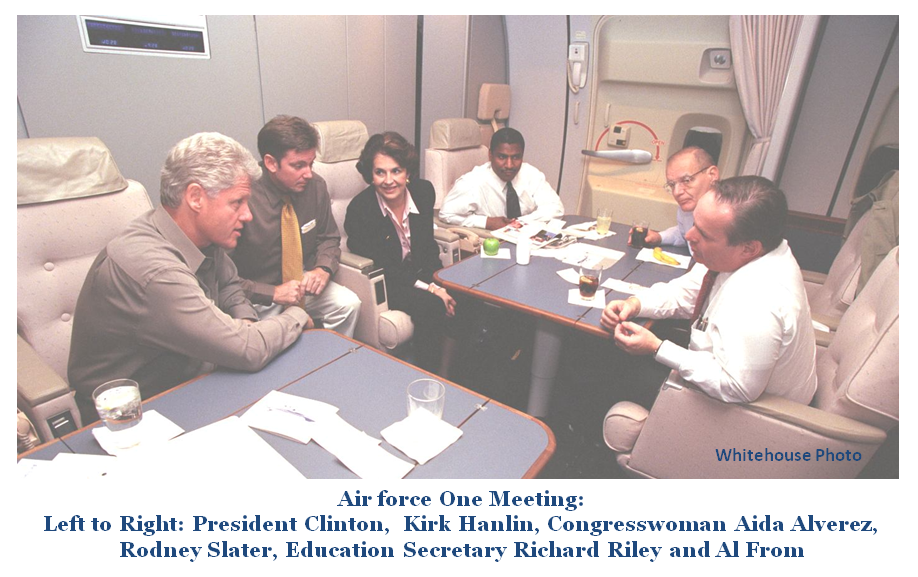
Then Vice President Al Gore was convinced public schools were failing and needed a new direction. During a monthly “Gore-Tech session”, the Vice President asked venture capitalist John Doerr, “If you Silicon Valley types are so smart, why can’t you do something to create new schools?” Doerr who had scored big with investments in Netscape, Amazon and Google, like Gore, was certain public schools required radical change. He wanted “better schools based on Silicon Valley’s principles of accountability, choice and competition.” (Geismer 233-234)

Gore’s question and a Stanford business student’s ideas led to founding The NewSchools Venture Fund. The article Organized to Disrupt shows the staggering amounts of money Doerr and his friends put into this fund which is still selling privatization and education technology. NewSchools was at the forefront of venture philanthropy also known as “philanthrocapitalism.”  

Some Ending Quotes from Dr. Benson

“Similar to what we witnessed in America over the past twenty years, Latin American educators are cast by their respective governments as hindrances to the educational and economic progress of their students and, by extension, their respective nations’ economy as well (Lobo, 2019a).” (Benson 224)

“Over the past three decades, Latin American teacher unions played a major role in policy making positively impacting education at the schoolhouse primarily through professionalization of the field, and policy advocacy through informing law makers about education, contributing to research, and push against neoliberal influence (Gindin & Finger, 2014).” (Benson 225)

“Australian teachers cautioned that the corporatization of schooling was, as noted in other global contexts, diverting governmental and social responsibility to provide education as a societal good and a collective responsibility. Where schools should, in their view, stress social justice, democracy, and the common good as the aspirational ideal, instead, Australian schools are witnessing increased influence of corporate think tanks and consultancies that shape the delivery of public education to suit corporations’ economic needs (Reid, 2019).” (Benson 226)

Dr. Benson’s paper ended on this sour note:

“Adding to the difficulties educators worldwide are experiencing at present, a global pandemic that claimed over 5.75M lives worldwide (Our World in Data, 2022) will undoubtedly contribute to a further radical remaking of the profession as the presence of Big Tech appears to be less of an emergency stopgap to deliver educative services to students barred from attending school in person, but likely here to stay. Indeed, after witnessing how ‘well’ virtual classrooms ‘worked’ for NYC students, newly elected mayor Eric Adams, commented that now New York City teachers can lead virtual classrooms of up to ‘three or four hundred students year-round (Stieb, 2021).’ Sigh.” (Benson 228)

Our American public education system is an amazing legacy which is foundational to that other great American legacy, democracy. It is not a coincidence that democracy’s future is now viewed as uncertain after the past 40-years of scurrilous attack on public education. Humanism should be the guiding principle of public institutions and democratic governance; not neoliberalism.

Not a Day behind Bars for A3 Charter Grifters

12 Jul

By Thomas Ultican 7/12/2022

The A3 Charter School Conspirators fraudulently collected $400 million from the state of California, misappropriated more than $200 million and according to the Voice of San Diego’s Will Huntsberry outright stole $80 million. The two ring leaders were fined $18.75 million each, given four year jail sentences and credited with four years for time served while under house arrest awaiting court dates. Of the 11 people charged in the A3 charter school scam, the largest in California history, not one of them will spend a day behind bars.

In 2019, the San Diego County Grand Jury heard testimony from 72 witnesses and voted out a 67-count indictment against Sean McManus, Jason Schrock, Justin Schmitt, Eli Johnson, Steven Zant and six others. Their criminal scheme involved a network of 19 online charter schools enrolling thousands of students. For the plotters, their summer athletic programs which had no teachers or classes were particularly successful for purloining ill gotten gains.

Schrock and McManus established the Academic Arts and Action charter Academies in 2015; soon dubbed A3 charters. An early step in establishing the A3 empire came when Steven Zant, a former superintendent of the tiny Dehesa Elementary School District in San Diego County, brokered the sale of the online nonprofit charter school Mosaic Online Academy of Southern California to A3 for $1.5 million. The A3 non-profit tax filing for 2016 indicates that McManus received salary and benefits totaling $487,781 and Schrock collected $368,015. It shows A3 revenues of $14,205,716 and a profit of $10,587,203. The new non-profit business was lucrative from the start.

Before hooking up with McManus, Jason Schrock’s linked in page states he was principal at Valley Christian School in Cerritos, CA for seven years starting in 1999. He then became “Regional Advancement Director” for Iowa based Northwestern College affiliated with the Christian Reformed Church in America. In 2014, he became co-owner of Creative Arts Early Leaning Academy in Orlando, Florida and apparently is still associated with them. Also in 2014 he became CEO of Learning Re: Defined which catered to a Christian clientele. They appear to be defunct.

Sean McManus had been chasing charter school gold several years before partnering with Schrock. From 2009-2015, he was CEO of the Academy of Arts and Science Charter Schools (AAS). Network for Public Education Executive Director Carol Burris reports that it was here he developed his model for using cash-strapped small districts to authorize his online schools. The seed money for AAS was provided by the U.S. Department of Education’s Charter School Program (CSP). Eleven Academy of Arts and Sciences charter schools that used the for-profit K-12 curriculum received a total of $2,825,000 from the CSP state grant to California. Today, all 11 schools are closed.

McManus learned a lesson while running AAS. Some of the schools were hybrid models that had in class training which meant physical addresses. Los Angeles Unified School District sued AAS for opening classrooms in their territory without authorization. The A3 charters would be 100% cyber schools with no physical classes.

How the Scam Worked

Under California Education Law, small school districts had an incentive to authorize charter schools. They get 3% of the revenue. Schrock and McManus approached small districts throughout the state to establish cyber charters.

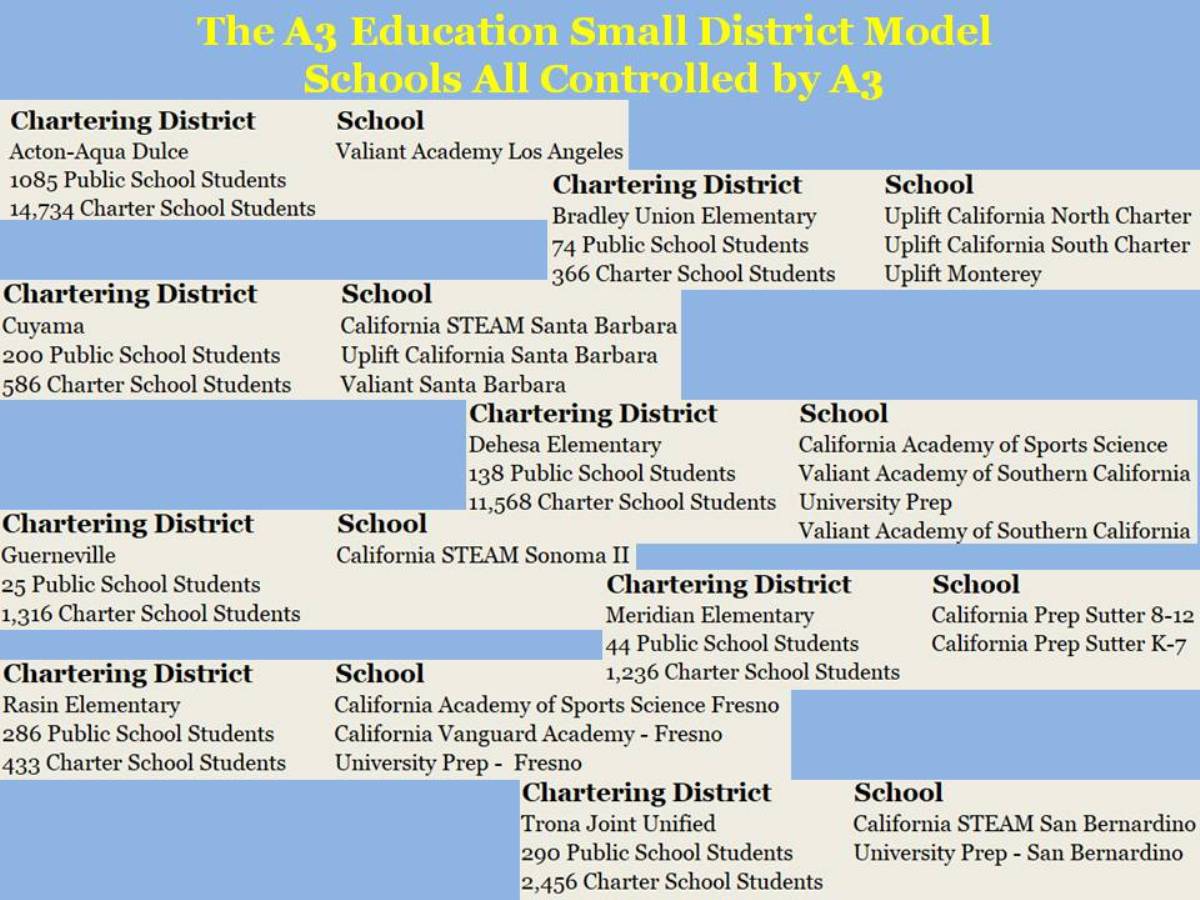
The chart above shows authorizing districts for each of the 19 A3 charter schools. To read the chart, follow the example of Dehesa Elementary District on right side second chartering district down. Dehesa served 138 elementary school students and was supervising 11,568 charter school students in four A3 schools. The largest district authorizing an A3 school was Acton-Aqua Dulce with 1085 students and supervising 14,734 charter school students. It is unlikely that any of these small districts had the bandwidth to monitor the schools they had authorized.

A Los Angeles Times article from 2019 listed some of the charges in the indictment. The following is a summary.

Sean McManus and Jason Schrock hid the fact that they essentially owned and operated the charter schools at the same time that A3 contracted with those schools. This allowed them to operate multiple businesses that charged their own charter schools millions of dollars for services and then channel the money from those businesses into their own charitable trusts and personal bank accounts. They used this scheme to invoice at least $83.3 million from the charter schools.

More than $8.18 million went into personal bank accounts, some in Australia, and into charitable trust accounts for McManus, Schrock and their wives, and $500,000 went to a family member of McManus. They used $1.6 million of A3 Education’s funds to buy a private residence for McManus in San Juan Capistrano.

The Los Angeles area was serviced by the A3 School Valiant Academy of Southern California. Its performance in both English and math testing was extremely low. The school’s performance was so poor that the California Charter Schools Assn., which advocates for charter schools, recommended closing it.

Those original reports underestimated the scope of the fraud. In July 2022, the San Diego Union reported that A3’s fraudulent activities totaled approximately $400 million of which only $240 million has been recovered.

No Time Behind Bars.

A news report from Santa Clarita noted,

“If convicted, McManus and Schrock each face up to 40 years in state prison. Sentences for the other nine defendants if convicted could range from 4-11 years.”

The report also said that Sean McManus had fled to Australia and that there was a $5 million bench warrant issued for his arrest. McManus is still in Australia and has only participated in court proceedings from his local lawyer’s office.  

The court case was handled by the highly respected San Diego Superior Court Judge Frederick Link. He was originally appointed to the Municipal Court in 1981 by Jerry Brown and was elected to the Superior Court in 1990. At his recent retirement party, fellow Superior Court Judge Michael Smyth praised him saying, “Forty-one years and he’s been crushing it as a judge, as they say, and he hasn’t lost a step.”  That makes the outcome in this case even more puzzling.

Some of the reasons for no jail time must have resulted from prosecutors making deals and the judge signing off on them. It seems that all of the minor figures have had their felony charges reduced to misdemeanors and were sentenced to fines and probation.

Accountant Robert Williams provided financial services and let his offices be used as A3’s business address. He pleaded guilty to one felony count of altering or falsifying corporate records with the intent to defraud. From 2019 leading up to his 2021 sentencing, he remained free on his own recognizance. Williams received a $300,000 fine and three years of unsupervised probation.

Last September, Judge Link sentenced McManus and Schrock to four years in prison for their guilty pleas to two felony counts, one count of conspiracy to misappropriate public funds and one count of conflict of interest. However, the Judge indicated the law required that he take time spent under house arrest into consideration. Therefore the four year prison terms were fulfilled. There must have been some kind of an agreement struck with the prosecutor to get this outcome.

Schrock has been serving his house arrest in Orange County and McManus in Australia. McManus attended the sentencing hearing over Microsoft Teams from his lawyers office. Judge Link said at the trial,

“Mr. McManus and Mr. Schrock were thieves. And I don’t like to dance with thieves. I think they should be punished. That being said, Mr. McManus and Mr. Schrock came forward and basically divulged everything they could come up with. Without the cooperation of Mr. Schrock and Mr. McManus, we would not be here today with the amount of money that the receiver has been able to recoup. Except for that, I would definitely be putting both of these fellas in prison for a significant period of time.” 

The judge’s sentiments sound heartfelt but do not tally. McManus and Schrock misappropriated $400,000,000 of which only $240,000,000 has been recovered and they stole $80,000,000. The large fines come well short of equaling the amounts stolen. Their four year prison sentences were satisfied by two years of house arrest and McManus has never returned to face his charges in person.

I cannot help wondering how that Australian house arrest was monitored.

Broken Legal System Must Be Reformed

This result was not a legal deterrent. Conspirators were able to fraudulently acquire so much wealth they could buy their way out of jail. Rich people hate fines but fear jail time. It is nice that some of the A3 theft was recovered but society would be much better served if moneyed racketeers faced certain jail time.

The A3 saga painfully highlights how unjust and manipulated in the favor of means our legal system has become. American style blind justice must be reinvigorated. Well-heeled scofflaws need to face jail time and large fines. The A3 outcome is an absurd miscarriage of justice painting the prosecutor and Judge in a bad hue.

Genuine Reforms by Real Education Professionals

5 Jul

By Thomas Ultican 7/5/2022

The tragedy of modern school “reform” is that it stopped education improvement. Politicians from the Democratic and Republican Parties agreed that government-run organizations were inferior to privatized ones and market forces were the path for lifting all boats. Their economic theories led to charter schools and vouchers for private, mostly religion sponsored schools. Moguls and legislators, with no education training or knowledge decided that standards, modeled on business practices were, required. It has become a tool for privatizing public schools, controlling classrooms by politicians in capital cities, and is making learning dreary.

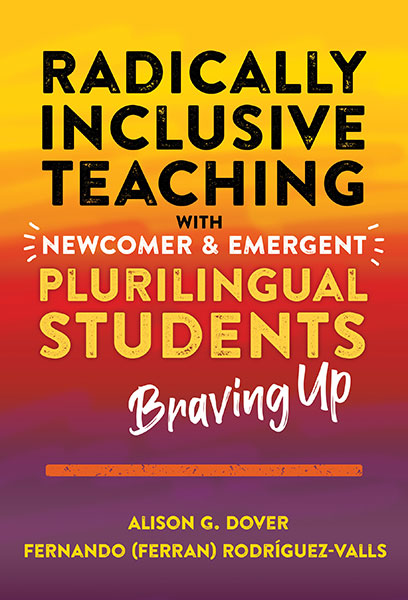
It is wonderful to learn of professional educators standing up to this folly and implementing practices promising to undo some of the damage.  In Orange County, California, Alison Dover and Fernando Rodríguez-Valls, associate professors in the Department of Secondary Education at California State University, Fullerton, have been developing the Language Explorers program since 2015. The methods they used can be adapted to any classroom or discipline. Their newly published book by Teachers College Press is Radically Inclusive Teaching with Newcomer and Emergent Plurilingual Students Braving Up. With this book when combined with the supplemental materials at Professor Dover’s web site, any teacher’s practice can be advanced.

Cultural Destructiveness

In 2001, I began teaching in a California school, often being the only White guy in classrooms where the bullring in Las Playas de Tijuana was in sight. Naturally many many of the students were native Spanish speakers and some of them had almost no English abilities. Surprisingly a student’s multilingual abilities were not prized. In fact a state law pushed by software developer, Ron Unz, mandated English only instruction.

Around the change of the millennium, Unz financed legislative initiatives in California and Arizona, replacing bilingual education with English immersion programs, also known as the “Unz initiatives.” They were detested by many teachers, administrators and parents alike and eventually challenged in Arizona. In 2015, the San Francisco-based 9th U.S. Circuit Court of Appeals ruled in favor of the state rejecting the plaintiffs’ argument that the approach violated the federal Equal Educational Opportunities Act.

By 2004, Massachusetts, California and Arizona were subjecting 40% of America’s newcomer language learners to anti-bilingual policies. After more than two decades of academic failure, these language laws are almost all repealed. However immigrants are still being labeled. Dover and Rodríguez-Valls write, “Instead of amplifying emergent bi- and Plurilingual students’ already expansive linguistic resources, schools routinely frame newcomer students as ‘English Learners’ who lack the communicative skills to fully participate in academic settings.” (Radically Page 4)

Newcomers and emergent plurilingual students are not half-empty vessels that need to be filled with English language skills. The authors share,

“In our work with teachers and administrators, we challenge them to position newcomer students as Emergent Plurilingual (EP) students, who enter our classrooms with unique and expanding linguistic repertoires that are ready to be utilized as classroom resources; in fact, most students whom districts label as ELs are actually already plurilingual, in that they have the ability to use multiple languages at varying levels of proficiency and for different purposes (Council of Europe, 2007). Our challenge, then, is not to address students’ ‘deficits,’ but to figure out how to support all students – including  monolingual and plurilingual students – in exploring, playing with, and using their linguistic repertoires as a bridge to complex disciplinary content.” (Radically Page 13) 

Central to the education malpractice that Dover and Rodríguez-Valls are addressing is the trust in monoglossic ideologies.  Influenced by academic articles like Undoing Appropriateness: Raciolinguistic Ideologies and Language Diversity in Education by Nelson Flores and Johnathan Rosa, they share this perspective,

“Monoglossic Ideologies lead educators to shut down students’ use of multiple languages, encouraging them to ‘focus on English,’ rather than consciously stretch their linguistic repertoires by making connections between their existing linguistic structures and new content and concepts. While few educators with a monoglossic ideology see themselves as oppressive, monoglossia reflects the colonial, assimilationist roots of US public education, in which being monocultural and monolingual (in English) has historically been positioned as more desirable than multicultural and plurilingual identities. This is sometimes referred to as one of the ways ‘White gaze’ shapes educational and linguistic policies and practices, irrespective of the racial and linguistic identities of educators and students themselves …” (Radically Page 16)

Dover and Rodríguez-Valls tell us that braving up is about creating alternative, plurilingual spaces that evade restrictive policies and mandates. This “radically inclusive teaching” challenges educators to take a stand and do what is right for their students and engage with this approach:

“As university-based researchers and teacher educators, we see our role not as providing ‘professional development’ per se, but rather as collaborating with school-based educators to reimagine what it means to teach and learn in radically inclusive, plurilingual environments. We use the word ‘radical’ intentionally; one of the first conversations we have with prospective Language Explorer teachers invites them to first define and describe the culture of schooling as it is now, and then participate in a visioning process in which they reimagine school as affirming and culturally robust.” (Radically Pages 29-30) 

Rejecting the Banking Model

In 1970, the famed Brazilian educator, Paolo Freire, wrote Pedagogy of the Oppressed, addressing the classroom model in which learning is one-directional; teachers teach and students learn. He labeled this the “banking model” where “knowledge is a gift bestowed by those who consider themselves knowledgeable upon those whom they consider to know nothing.” Dover and Rodríguez-Valls update this observation stating, “Despite movements toward more student-centered pedagogies, ultimately most educational experiences remain structured around the knowledge teachers want to impart to students.” (Radically Page 82)

The book emphasizes the needs and benefits associated with recognizing students’ cultural “funds of knowledge” as assets to the classroom along with their raciolinguistic identities (ascribed to students without their knowledge or consent) and daily languaging practices. In doing so, monoglossic ideologies are disrupted, heteroglossic classrooms emerge and “plurilingual superpowers” are unleashed. (Radically Page 43)

To accomplish this, three core principles are emphasized: modeling, open dialogues, and co-learning. All of these are nuanced and in this piece I will not delve into them in any detail. However here is an example from the core of modeling which is “We do every project first.” (Radically Page 43)

Based on the modeling principles framework, a non-negotiable practice for educators is that “teachers do every single project themselves before assigning work to students.” Unlike classrooms where modeling is focused on concrete skills, the language explorer teachers use modeling as a form of academic disruption in which they use themselves as “models to illustrate principles of vulnerability, humanity, and linguistic experimentation.” (Radically Page 43)

Authentic Teacher Training

For the past 30 years, there has been an effort to privatize teacher training financed by billionaires. For example, Relay Graduate School is a fraudulent effort created by the charter school industry and made possible by billionaire financing. TNTP is an unqualified teacher training organization, spawned by Teach for America, whose training program would be laughable if it was not so harmful. These and many other teacher and administrator training programs have all been lavishly financed by billionaires, with one of three agendas: (1) advance neoliberal causes; (2) implement libertarianism; or (3) realize a religious approach to schooling. Improving public education is not their priority.

In this book we find an authentic effort to improve pedagogy in public schools, full of useful ideas and stimulating insights. More importantly this is how teacher development should be. Fullerton State University is located in Fullerton, California just north of Anaheim in Orange County. The department of Education there hosts teacher training and programs for school districts throughout Orange County and the Los Angeles basin. These publicly supported professionals from Fullerton are improving schools, enhancing student equity and supporting education justice.

One of the partners for the Fullerton team is Anaheim Union High School District (AUHSD). Its 20 middle and high school campuses serve 30,000 students, utilizing 1,200 teachers. Twenty percent of the students are classified as emergent plurilingual with 54 languages spoken in the district. AUHSD takes in on average over 300 students from 20 different countries every year, making it a natural client for the Language Explorer program. (Radically Page 123)

AUHSD is led by Superintendent Michael Matsuda who taught in the district for 22 years before assuming its leadership. He is focused on equity, inclusion and teaching democracy. In 2015, the district turned to Fullerton State for help when an influx of newcomers arrived including many refugees from the Middle East. Matsuda’s team wanted a summer bridge program created for the new students. This situation widened the path on which radically inclusive teaching could travel.

Dover and Rodríguez-Valls forcefully state that the Language Explorers learning is done in academic enrichment classes. They explain,

“They are not remedial programs to meet perceived gaps in students’ academic or linguistic foundation. This framing is both intentional and strategic; within many districts, ‘enrichment’ is typically interpreted as primarily for academically elite and linguistically dominant students. However, by positioning the Language Explorers as an enrichment program – one in which students earn elective credit; go on field trips; access smaller class sizes and mentorship; engage in creative, project-based learning; develop leadership skills; and present to outside audiences – leaders can situate newcomer programming to serve the broader educational mission of the district.” (Radically Page 135)

Language Explorers wants us to brave up our pedagogies and methodologies. Dover and Rodríguez-Valls state, ‘Radical teaching does not happen in isolation; changing systems of oppression is a collective process.” (Radically Page 136)

I was personally impressed by the methods taught in this book.