Archive | December, 2020

St. Louis Public Education Theft Accelerates

30 Dec

By Thomas Ultican 12/30/2020

A proposal to close 11 more public schools in St. Louis came before the school board on December 15. Based on Superintendent Kelvin Adams’ recommendation the final decision was postponed until January. It is not clear why Adams pulled back his own recommendation, but it is clear that public education in St. Louis is being dismantled.

In 1967, St. Louis’s school population peaked at 115,543. It was by far the largest school district in the state of Missouri. In 2020, total enrollment sank below 20,000 to for the first time to 19,222 and St. Louis Public Schools (SLPS) is no longer the state’s largest K-12 district.

From 1967 to 2000 there was an enrollment decline of over 71,000 students. In a 2017 article, Journalist Jeff Bryant took an in depth look at the forces undermining St. Louis and its schools. He noted three defining events that turned St. Louis into the World’s most incredible shrinking city.

An 1876 home rule law enacted by city business leaders to keep control of the city’s economic engines created and locked in city boundaries. Today, there are over 90 municipalities surrounding St. Louis. After World War II, federal housing policies and racists lending practices created white flight to the burgeoning adjacent communities. Finally Bryant explains,

“Legislation passed in the 1970s, 80s, and 90s deregulating a number of key industries – including airlines and banking – put large St. Louis employers at a disadvantage. Then, new laws lifting anti-trust enforcement, passed during the Ronald Reagan and Bill Clinton presidential administrations, subjected St. Louis’s leading industries to corporate takeover or rendered them uncompetitive.

“Consequently, St. Louis went from hosting 23 Fortune 500 headquarters in 1980 to hosting just nine in 2015.”

The Attack on Public Schools

 From 2000 to 2020, the student population in St. Louis has again fallen by more than half from 44,264 to 19,222. Some of that decline can be attributed to the continuation of migration to the suburbs which now includes Black families. However, a large portion of the drop is due to the growth of charter schools. The charter school enrollment for 2020 was at least 11,215 students which represents 37% of the district’s publicly supported students.

Like the national trend, the privatized schools chartered by the state, educate a lower percentage of the more expensive special education students; charters 11.4% versus SLPS 15.1%.

In 1997, the Heartland Institute reported,

“Although Missouri does not yet have a charter school law, a Charter Schools Technical Assistance Conference was held in St. Louis on November 22 with Mayor Clarence Harmon as the keynote speaker. Sponsored by the Charter Schools Information Center, the Saturday workshop featured state legislators, business leaders, and national and local charter school experts, including the Center’s director Laura Friedman and Paul Seibert of Charter Consultants.

“Although a charter school law failed to win legislative approval last spring, there appears to be strong support for the concept and hopes run high for passage in the coming session.”

The Heartland Institute is an extremely conservative organization with Libertarian ideals including opposition to climate change legislation and support for privatizing public education. Two of Heartland’s key funders are the Bradley Foundation of Milwaukee and Charles Koch of Koch Industries.

Mayor Harmon and the Heartland team saw their hopes rewarded in 1998 when Missouri became the 27th state to pass a charter school law. The University of Missouri notes, “Charters were one part of legislation designed to end three decades of court-ordered desegregation in Kansas City and St. Louis, and were limited to those two urban areas.”

In 2000, Mayor Harmon welcomed the first charter school in St. Louis, Lift for Life Academy.

The next year Francis Slay defeated Harmon in the mayoral race.

Slay like Harmon was a Democrat. He would serve for the next four terms. Over that time Slay developed a reputation as a charter school champion.

In 2002, Slay put together almost $800,000 to bring 50 fake teachers in from Teach For America (TFA). “Fake” because they have almost no training. It’s like calling a liberal arts college graduate with five weeks of summer training a lawyer or a dentist or an architect.

Slay increased his control over SLPS by putting together and financing a slate of four candidates for the seven member school board. A 2003 report in the River Front Times states,

Slay loaned $50,000 from his campaign fund to support the slate. Major area corporations kicked in with Anheuser-Busch, Ameren and Emerson Electric each giving $20,000. Energizer Eveready Battery Company gave $15,000. The coalition raised more than $235,000.

Within a month of taking their positions, the school board voted to hire Alvarez & Marsal (A&M), the corporate turnaround consultants. St. Louis paid A&M $4.8 million to run the district. A&M had never worked in a school system before. Former Brookes Brothers CEO William V. Roberti was to be superintendent of schools. His official title was changed to “Chief Restructuring Officer.” The clothing store leader had never worked in a school before.

Bryant reported, “Slay and this team attended training on how to remodel the district along business lines provided by the Broad Foundation, a private foundation that has long been a powerful advocate of charter schools.” However, their decision to bring in business professionals turned into a disaster. Deficit ballooned, teachers revolted, the district lost state accreditation and the state took over from the elected school board.

In 2005, the billionaire, Rex Sinquefield, returned to his roots in Missouri. Rex a former orphan became wealthy when he and a partner from the University of Chicago developed and marketed the first index funds. Rex also has economic views that align with the libertarian small government ideology of his Nobel Prize winning peers Milton Friedman and James M. Buchanan. 

Rex and wife Jeanne are proponents of “school choice.” They fund the Children’s Education Alliance of Missouri (CEAM) claiming that the St. Louis based organization is the leading education reform organization in the state. They contribute millions to the right wing think tanks Show-Me Institute, which Rex also founded, and Missouri Club for Growth.

Sinquefield has made large campaign donations to Mayor Francis Slay plus Slay’s cousin, Laura Slay, is the Executive Director of CEAM. Laura is also owner of a public relations firm which regularly represents Rex. 

In 2011, former TFA corps member Charli Cooksey and three other former corps members founded the now defunct InspireSTL. In 2016, Cooksey resigned from InspireSTL to run for the powerless school board. The leadership at InspireSTL went to another former TFA corps member, Adam Layne.

Susan Turk of St. Louis Schools Watch reported that Cooksey received a $30,000 campaign contribution from Leadership for Education Equity (LEE). LEE is a billionaire funded and directed organization spending to elect former TFA corps members to school boards and other political positions.

In 2018, a former TFA corps member and employee for 14 years, Eric Scroggins, founded The Opportunity Trust. That same year The City Fund gifted the newly formed Opportunity Trust $5.5 million. That is the fund started in 2018 by former Enron trader John Arnold and Netflix CEO Reed Hastings. They consider The Opportunity Trust their partner in St. Louis.

Charli Cooksey left the school board to found WEBPOWER, an organization meant to create community leaders to advance the privatization of public education and school choice.

In 2019, Cooksey’s successor at InspireSTL, Adam Layne, followed her path to the SLPS school board. He and fellow TFA alum Tracee Miller won the two seats available in 2019. That is the same year the state finally handed back control of SLPS to the elected school board. Miller raised local money and got a $1000 donation from LEE. Layne’s campaign raised almost no money but got a large donation from Public School Allies the political arm of The City Fund.

Tracee Miller has since resigned from the school board and written a scathing article about her experience:

“Shortly after my election to the BOE, I was approached by Eric Scroggins, founder and CEO of The Opportunity Trust, to visit The Mind Trust, an organization with a similar mission in Indianapolis. He personally selected three members of the BOE to attend. I am a person who is open to ideas and who believes in public education. I joined the trip with the understanding that it would be an opportunity to learn about innovative strategies being used in another Midwest city. However, the more questions that I asked and the more non-answers or unsatisfactory explanations that I heard, the more I realized that their agenda, and not students, was the priority.”

“I met with WEPOWER employee Gloria Nolan in what felt like a friendly conversation where the stated goal was to explore ways to bring the BOE and WEPOWER together; however, less than a week after this conversation WEPOWER attacked my credibility with false information and an out-of-context recording during the public comment portion of a BOE meeting. In addition, when I expressed concerns about the trip to Indianapolis, financial connections to school board members, or that these groups did not seem to focus on all education providers but only on SLPS, both WEPOWER and The Opportunity Trust ceased communication with me.”

“Mr. Scroggins eventually contacted me to let me know that he found my questioning of his approach to education reform to be misguided. He used patronizing and intimidating language to attack my ethics and integrity on account of my opposition to Senate Bills 525, 603, and 649 regarding the expansion of charter schools, and accused me of being uninformed and incapable of leadership, of ignoring science, and of perpetuating inequity.”

“Most notably, The Opportunity Trust funded the strategic plan for the Normandy School District, which resulted in the hiring of Marcus Robinson, former Executive-in-Residence at The Opportunity Trust, as its new superintendent. Normandy is opening their first charter school (also funded in part by The Opportunity Trust) in Fall 2021.”

In 2017, longtime 28th Ward Alderman, Lyda Krewson, became the next neoliberal Democrat serving as Mayor in St. Louis. After she doxxed people calling on her to de-fund the police, a large demonstration heading to her home made national news. Krewson’s gun toting neighbors, Mark McCloskey and his wife Patricia, threatened the passing crowd with guns, admonishing them to stay off their property.

Mayor Krewson has kept up the nepotistic schemes attacking public schools. Jack Krewson the mayor’s son is a co-founder of Kairos Academies along with creator Gavin Schiffres. The school’s design was developed in 2015 as a capstone project for Schiffres’s undergraduate degree at YALE. The Opportunity Trust also invested in the incubation and then launch of Kairos Academy, the first personalized learning school in St. Louis.

In other words, three TFA alums, Scroggins, Schiffres and Krewson, have teamed up to sell edtech to St. Louis. They have an “innovative” plan to put kids at screens, the last thing 21st century kids need. At the same time excellent public schools with real teachers are being closed.

Developing the Portfolio District Model

The City Fund is known for its support of the portfolio district management model. It is a method that removes control of schools from elected boards and replaces them with private businesses either for profit or non-profit. The evaluations are based on standardized testing results meaning the lowest performing schools are closed and replaced invariably by a privatized school. Since standardized testing only measures relative family wealth accurately, this plan guarantees schools in poor communities will be privatized.

 In 2008, the state overseers selected Dr. Kelvin Adams (is it OK to call him Dr.?) to be Superintendent of schools in St. Louis; the position he still occupies. At the time, Peter Downs the President of the elected school board called the selection unacceptable.

Adams came to St. Louis from the Recovery School District in New Orleans where he was second-in-command to the infamous Paul Vallas. Prior to the Saint Louis announcement, Vallas had stated publicly that Adams was his top choice as a successor. Being thought of as a successor to a known virulent opponent of public schools was a big concern. However, Adams took over the mess left by A&M; fixed the financial issues, raised attendance rates, lowered dropout rates and got the district accreditation restored.

Adams also continued to close schools. SLPS has gone from 93 schools when he arrived to 68 schools now and he wants to close 11 more.  

A component of the portfolio model school districts in both Indianapolis and Denver is Innovation Schools. The American Legislative Exchange Council has created model legislation for the development of these schools which are removed from the purview of the elected school board and given to a non-elected board. The ultra-right wing billionaire Charles Koch of Koch Industries is the key funder of ALEC. Koch has a long history of opposing public education.

Superintendent Adams is an outspoken advocate of school choice, the portfolio model and innovation schools. In fact, he claims as an achievement, “Created a portfolio of schools to provide meaningful choices for students and parents.” In 2019, Adams introduced innovation schools to Saint Louis calling them the Consortium Partnership Network. The announcement on the SLPS webpage states,

“Beginning January 2019, the CPN school principal and teacher leadership teams began a 4-month planning process together to define school structures, working conditions, priorities and budgets. This process was facilitated by Bellwether Education Partners…”

Bellwether Education Partners came into being in 2011 when it was cofounded by New Schools Venture Fund founding CEO Kim Smith and former Clinton administration domestic policy advisor Andrew J. Rotherham. Both Smith and Rotherham have had lucrative careers attacking public education for their billionaire funders.

It is clear that St. Louis Public Schools are in trouble and the vultures are circling. They have been weakened and are targeted by billionaires like Rex Sinquefield, Reed Hastings, Alice Walton, John Arnold, Bill Gates…

A paper written by National Board Certified Teacher Ceresta Smith, Why People of Color Must Reject Market-Based Education Reforms, has a profound message for the large Black population in St. Louis. Their democratic right to govern their own schools is being stolen and they must resist. Most of the 23 page paper cites other studies that support her opening statements:

“Reformers assert that test-based teacher evaluation, increased school “choice” through expanded access to charter schools, and the closure of “failing” and under enrolled schools will boost falling student achievement and narrow longstanding race- and income-based achievement gaps.”

    •  “Test scores increased less, and achievement gaps grew more, in “reform” cities than in other urban districts.
    • “Reported successes for targeted students evaporated upon closer examination.
    • “Test-based accountability prompted churn that thinned the ranks of experienced teachers, but not necessarily bad teachers.
    • “School closures did not send students to better schools or save school districts money.
    • “Charter schools further disrupted the districts while providing mixed benefits, particularly for the highest-needs students.
    • “Emphasis on the widely touted market-oriented reforms drew attention and resources from initiatives with greater promise.
    • “The reforms missed a critical factor driving achievement gaps: the influence of poverty on academic performance.”

In the conclusion Ceresta says to care givers for students of color,

“Of high importance, they must not fall prey to the trap of “school choice,” which in itself is a method of racist exclusion that provides for a “few” at the expense of the “many.”  Instead, they must first and foremost, stop allowing their children to be used to further the inequities in public education and ultimate wealth building.”

Democracy and Education

20 Dec

By Thomas Ultican 12/19/2020

Democracy and free universal public education are foundational American ideologies. They have engendered world renowned success for our experiment in government “by the people”. Two new books – Schoolhouse Burning by Derek Black and A Wolf at the Schoolhouse Door by Jack Schneider and Jennifer Berkshire – demonstrate that these principles which were integral to the American experiment are shockingly under serious attack by wealthy elites.

After his father Fred died in 1967, Charles Koch took a disparate set of assets – a cattle ranch, a minority share in an oil refinery and a gas gathering business – and stitched them together. Today it is the second largest privately held corporation in the world. In the excellent 2019 book, Kochland, Christopher Leonard states, “Koch would eventually build one of the largest lobbying and political influence machines in US history.”

Both the introduction to A Wolf at the Schoolhouse Door and the “Through History’s Eyes” chapter of Schoolhouse Burning mention the same quote from Charles Koch. In 2018, the Koch network held its annual three day gathering near Palm Springs, California. It was a 700-person confab of some of the richest people in America. Black wrote,

“Charles Koch told the audience that ‘we’ve made more progress in the last five years than I had in the last 50…. The capabilities we have now can take us to a whole new level…. We want to increase the effectiveness of the network … by an order of magnitude. If we do that, we can change the trajectory of the country.’ One of the donors at the summit explained that education is ‘the lowest hanging fruit for policy change in the United States today … I think this is the area that is most glaringly obvious.’

“Let that sink in for a moment; change the trajectory of the country and do it through education. In other words, the agenda is not to improve education. The agenda is to change America.”

In Kochland, Leonard gave some context to the effects of the progress for the 160,000 households in the wealthiest 0.1% that Charles Koch was addressing,

“In 1963, the top 0.1 percent of households possessed 10 percent of all American wealth. By 2012, they possessed 22 percent. This gain came as the vast majority of Americans’ lost ground. The bottom 90 percent of Americans possessed about 35 percent of the nation’s wealth in the mid-1980s. By about 2015, their share had fallen to 23 percent.”

Clearly, the great transfer of wealth in America has been from the working class to billionaires and privatizing public education is seen as key to continuing and accelerating that trend.

Schoolhouse Burning Documents the Legal Evolution of Public Education

In the introduction Derek Black states,

“From it first days, the nation’s theory of government depended on educated citizens. The founders feared that democracy without education would devolve into mob rule, open doors to unscrupulous politicians, and encourage hucksters to take advantage of citizens even as they stood in line to vote.”

The Massachusetts Constitution of 1780 is the oldest working constitution in the world and had great influence in the writing of the US Constitution. It divided the powers of government into three branches – the executive, the legislature and the judiciary. Its education clause states that, “wisdom and knowledge … diffused generally among the body of the people [are] necessary for the preservation of their rights and liberties…. [Thus,] it shall be the duty of the legislatures and magistrates, in all future periods of the commonwealth, to cherish the … public schools.”

Before the US Constitution was adopted, public education was written into the national legal framework. Black notes that every bound volume of the current United States Legal Code begins with a section called Front Matter which includes the four “organic laws” in chronological order. It is made up of the 1776 Declaration of Independence, the 1777 Articles of Confederation, the 1787 Northwest Ordinance and the 1789 US Constitution.

Black outlined how the Northwest Ordinance fits,

“…, the Northwest Ordinance’s substance is a constitutional charter of sorts. Practically speaking, it established the foundational structure for the nation to grow and organize itself for the next two centuries. Precise rules for dividing up land, developing the nation’s vast territories, and detailing the path that these territories would follow to become states are not the work of everyday legislation. They are the work of a national charter. Those rules and their effects remain in place to this day.

“From this perspective, the Northwest Ordinance’s education agenda cannot be separated from our constitutional structure and vision. And it was under this constitutional structure and vision that George Washington, John Adams, Thomas Jefferson and James Madison took office and served as presidents of the United States. To no surprise, all would assert education’s utmost importance and call for its expansion.”

In the north, the ideals of public education were fully embraced and the only debate was over the details. It was different in the antebellum south where poorer whites paid almost no taxes and the wealthiest southerners paid two-thirds of all taxes. Johann Neem explains in Democracy’s Schools, “Because of their political power and the way the tax burden fell largely upon them, slaveholding elites spread an antitax gospel to convince ordinary whites that taxes were a bad thing”

During the period of reconstruction following the civil war, the US congress made provisions for freed slave education and political rights to be enforced by federal troops.  The thirteenth amendment to the constitution which passed December 6, 1865 abolished slavery. In 1866, the fourteenth amendment which prohibited discrimination in various aspects of life and extended citizenship to African Americans was adopted.

Requirements for states being readmitted to the union included ratification of the 14th amendment and adopting a constitution that conforms to the “Constitution of the United States in all respects.”  This last provision was a demand to establish a republican form of government which in turn meant enshrining public education in their state constitution. Because of growing signs of recalcitrance, Congress imposed an education commitment as an explicit condition for the last three states to reenter the Union – Virginia, Texas and Mississippi.

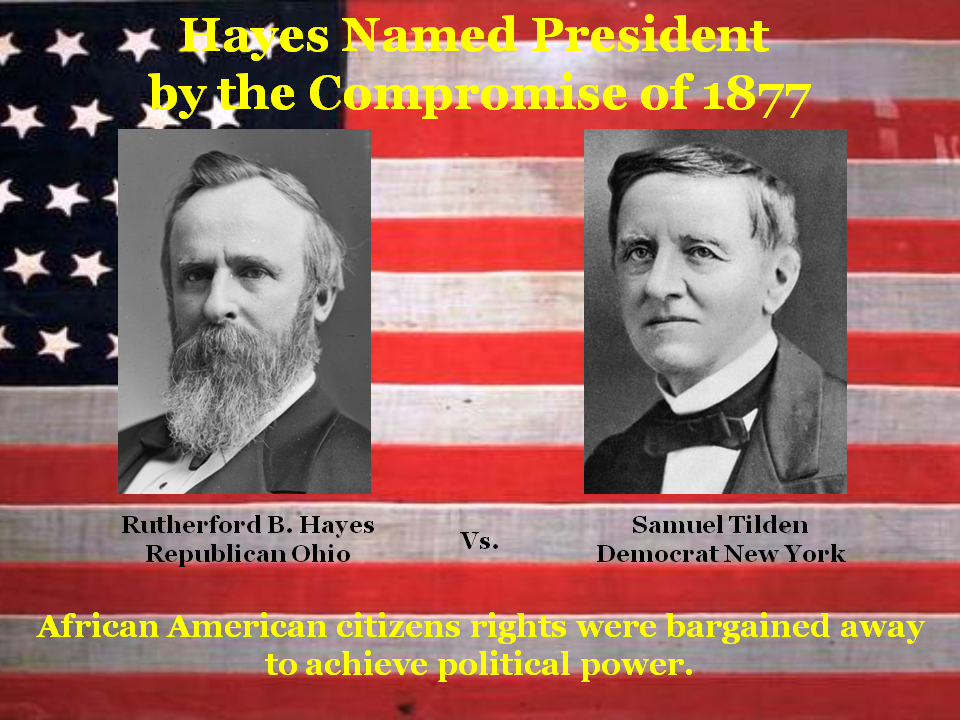
The compromise of 1877 undermined legal protections for black people in the south and financial support for public education. A closely divided corrupt election pitted a Republican abolitionist from Ohio, Rutherford Hayes, against the Democrat Samuel Tilden of New York. Tilden gained the most votes but 20 electors were disputed. A committee of 8 Republicans and 7 Democrats decided Hayes would become President provided he agree that

  • Troops will be recalled from the statehouse property in the three states. [South Carolina, Florida and Louisiana]
  • “Funds will be provided to build the Texas and Pacific Railroad.
  • “A southerner will be appointed as Postmaster General.
  • “Funds will be appropriated to rebuild the economy in the South.
  • “The solution to the race problem will be left to the state governments.”

All decisions were made on party line votes of 8 Republicans for and 7 Democrats opposed.

Throughout the south, segregated schools were soon mandated, spending on educating the newly minted citizens was reduced to lower taxes and voting rights were restricted. Black writes,

“Planters saw the value of competent workers but no value in ‘inflat[ing] the economic and political expectations of workers.’ The only thing education would accomplish would be to ‘spoil good field hands.’ Even worse, education would lead blacks to push for even more social and political equality.”

Thurgood Marshall and other lawyers from the NAACP won many court victories including the famous Brown vs. the Board of Education case that declared education “must be made available to all on equal terms.” Black says the one phrase the court omitted in its 1954 opinion was a clear declaration that education is a fundamental right.

After that case, the Supreme Court expanded desegregation efforts. In the early 1970s a backlash came with the election of Richard Nixon. Nixon campaigned against the Supreme Court and especially against forced desegregation. Between 1969 and 1974, he appointed four justices – Burger, Rehnquist, Powell and Blackmun. Rehnquist held the view that Plessy v. Ferguson which Brown overturned had been correctly settled. Even more troubling, Justice Powell while on the Richmond, Virginia school board and later the Virginia state school board supported school segregation and the massive resistance movement against Brown.

In the 1974 case of Millikan v. Bradley, the court dealt a death blow to desegregation efforts. Black shared,

“By a vote of 5-4, the Court insisted that plaintiffs needed to show intentional school segregation, not just in Detroit’s city schools, but in its suburban districts, too. Absent that, lower courts could not order metropolitan-wide school desegregation.”

By the 1990s, no new Federal Court orders to end school segregation were in the works and those underway were being ended. Since then schools have been re-segregating.

“Are You Trying to Scare People?”

A senior scholar asked this question after reviewing an early draft of A Wolf at the Schoolhouse Door. The authors’ response was, “In a word, yes.”

Schneider and Berkshire declare that ideas which for multiple decades have been considered fringe thinking are now central. The radical right and especially leaders in the religious right like Trump’s Secretary of Education, Betsy DeVos, denounce the whole concept of public education.

So, what do these ever more potent deep pocketed funders and conservative politicians want? The authors lay out the four main principles of the radical right.

“1. Education is a personal good, not a collective one.”

“2. Schools belong in the domain of the free market, not the government.”

“3. To the extent that they are able, ‘consumers’ of education should pay for it themselves.”

“4. Unions and other forms of collective power are economically inefficient and politically problematic.”

The conservative enemies of public education today sound like Fred Koch and his John Birch Society did in the 50s and 60s. From A Wolf at the Schoolhouse Door,

‘“Elementary and secondary education in the U.S. is the country’s last remaining socialist enterprise,’ declared Joseph Bast, CEO of the libertarian Heartland Institute, in a 2002 blog post. Bast was explaining his distaste for public education while making the case for so-called universal private school vouchers, which conservatives view as a way station en route to whole-sale privatization.”

The socialist charge has also been directed at teachers. Writing about the 2018 teacher uprisings Schneider and Berkshire explain,

“They demanded that the wealthy pay higher taxes to fund public education, employing a hashtag slogan – #RedforEd.… While the slogan, and the cause it represented, attracted widespread public support, conservative critics saw #RedforEd as something more nefarious. Leaders of Arizona’s teacher protest movement, warned one Republican state representative were using ‘teachers and our children to carry out their socialist movement.’”

The push to privatize public education had foundered until charter schools appeared and a newly formed Democratic Leadership Council (DLC) was created to push the Democratic Party more to the center. A Wolf at the Schoolhouse Door reports, “When the DLC unveiled its official agenda at a 1991 gathering in Cleveland, its head, a rising young Southern governor named Bill Clinton, gave school choice a full-throated endorsement.”

Not only has the push to privatize public education been a bipartisan effort of political elites from both major political parties but even more strangely they have also joined together in attacking labor. From the book:

“The irony is that weakening the influence of organized labor – teachers’ unions in particular – has been largely a bipartisan cause. Bill Clinton made his attack on Arkansas teachers a centerpiece of his 1983 gubernatorial campaign, burnishing his image as a new breed of Democrat who wasn’t afraid to take on the party’s own ‘special interests.’ And during Barack Obama’s eight years in the White House, tough talk against teachers’ unions as protectors of the status quo emerged as party orthodoxy. ‘It’s time to start rewarding good teachers, stop making excuses for bad ones,’ Obama proclaimed in a 2009 speech in which he praised the idea of merit pay for teachers, long a favorite policy tool of Republicans.”

In A Wolf at the Schoolhouse Door, Schneider and Berkshire explain the pursuit of profits in education and the push to implement virtual learning. They ruminate on the history of government regulation (child labor – meat industry – healthcare products and practices) and the push to end regulation. Here like in school privatization there is a religious like belief in markets to be self-regulating and superior to any “big government” organization.

They delve into the marketing that comes along with market driven privatized education. Especially interesting is the potential for micro-targeting student families using companies like Facebook. It enables schools to target only certain demographics.

They also address teachers being pushed into the gig-economy and its ramifications.

The push for “personalized learning” at computers employing AI algorithms to guide students through lessons instead of teachers has the twin goals of reducing teacher costs and creating an edtech market. With cyber-schools, costs are reduced in two ways, facilities requirements are significantly cheaper and with their large class sizes teacher costs are reduced. Even more promising for cost reduction at cyber-schools is the prospect that all classes can be conducted by hourly paid gig workers. Schneider and Berkshire note:

“Of course, the replacement of flesh-and-blood teachers by personalized learning programs will not be universal. Students from privileged families will continue to be educated much as they always have been, with students and teachers coming together as communities of learners.”

Concluding Remark

There is a lot to these books. They highlight the multiple dangerous paths our nation is on which is indeed scary. Together Schoolhouse Burning and A Wolf at the Schoolhouse Door paint – a maybe not probable – but a very possible grim picture for the future of public education in America. Even grimmer is that this attack on universal free public school is also an attack of America’s 250-year experiment with government “of the people, by the people and for the people.” It is a credible attack on democracy.

“Coal Miner’s Daughter” Hawks Digital Learning

8 Dec

By Thomas Ultican 12/8/2020

The last Democrat and first woman to serve as Governor of North Carolina, Bev Perdue, has become one of the nation’s leading advocates for digital learning. She presents herself as a simple country girl from a poor family, but doesn’t mention that her coalminer father became a rich mine owner by the time she was in college. She is known as a powerful political and financial operative with connections that go all the way to the incoming Biden administration.

Creating a New Career

Governor Perdue has a background in education. After obtaining a bachelor’s degree in history, she taught kindergarten in 1970-71, ninth grade 1971-73 and high school 1973-74. She then returned to college where in 1976 she earned a Doctorate in Education Administration. Her thesis was focused on education gerontology.

Following earning the education doctorate, she worked in long term care and geriatric services. She ran for the North Carolina House of Representatives in 1986 and won. Four years later, she won a state senate seat; holding it for a decade before making successful runs for Lieutenant Governor in 2000 and again in 2004. This all positioned her to become North Carolina’s first female governor in 2008.

For Perdue, the wheels flew off the campaign bus in 2012. She was facing tanking polling numbers when members of her 2008 campaign pled guilty to finance violations. Greensboro businessman Peter Reichard, the finance director, pled to a felony and lawyer Julia Leigh “Juleigh” Sitton, a fundraiser for the campaign, pled to a misdemeanor in order to avoid a felony charge. Perdue soon announced she would not be a candidate for Governor in 2013.

The June following her exit from the Governor’s mansion, the Newsobserver.com reported, “Former Democratic Gov. Bev Perdue has recently finished her teaching fellowship at Harvard’s John F. Kennedy School of Government, and plans to launch an education consulting business from her home in Chapel Hill.” The next month, the Bill and Melinda Gates Foundation gave Perdue a $250,669 grant to “develop a business and operation plan for the Digital Learning Institute (digiLEARN).”

That September digiLEARN received notice from the IRS of their successful application identifying them as a charitable organization. To do the heavy lifting at digiLEARN, Purdue brought in her advisor from the governor’s office on e-learning and innovation, Myra Best. Prior to joining Perdue in Raleigh, Best served as Director of the Business Education Technology Alliance (BETA) which established North Carolina’s first statewide Virtual Public School. BETA was a committee of 27 business, political and education leaders established by the North Carolina General Assembly in 2002. The chair of the committee was Lieutenant Governor Bev Perdue.

DigiLEARN’s about web page states,

“Digital Learning Institute is a non-profit organization dedicated to accelerating digital learning for all ages with a goal of increasing personal learning options for students and expanding instructional opportunities for teachers and instructors. In addition, DigiLEARN will focus on cultivating an innovative economy for education technology start-ups and entrepreneurs.

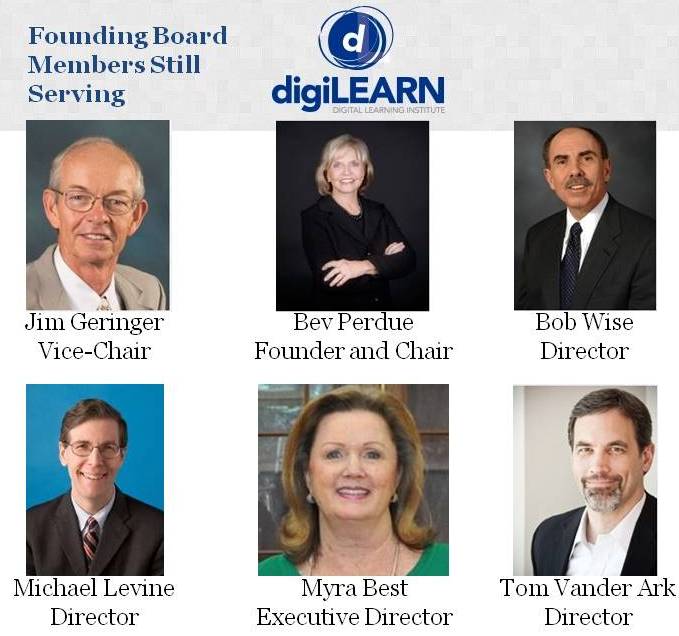
“DigiLEARN was founded and is chaired by former North Carolina Governor Bev Perdue, with former Wyoming Governor Jim Geringer serving as vice chair.”

In 1997, the vice chair, Jim Geringer, was one of the governors who established the non-profit Western Governors University in Salt Lake City. It was an early adopter of cyber and competency based education. In a lengthy interview for the Wyoming State archives, Geringer speaks glowingly about the school and its methods.

The membership of the first digiLEARN board of governors made it clear that it was politically connected and aligned with the goals of the edtech industry. In addition to Geringer and Perdue former West Virginia Governor Bob Wise became a founding Director on the board.

In 2010, Jeb Bush and Bob Wise launched the Digital Learning Council which promoted cyber schooling and “personalized learning.” In 2015, North Carolina State University honored Wise at the Friday Institute for Educational Innovation’s Friday Medal presentation. The institute notes, “The Friday Medal is awarded annually in honor of William C. Friday to recognize significant, distinguished and enduring contributions to education and beyond through advocating innovation, advancing education and imparting inspiration.”

Besides the three ex-governors, two North Carolina State Representatives – Craig Horn and Joe Tolson – were on the original board. Also on the board was one of edtech industries most widely published advocates, Tom Vander Ark. He became a national name in 1999 when named the Executive Director of the Gates Foundation in charge of education initiatives. In 2001 his notoriety grew when testifying before congress making the case for the now failed Gates small schools initiative. Teacher activist Anthony Cody wrote questioning Vander Ark’s 2016 push for new testing in a Washington Post piece,

“The growing ‘opt out’ movement poses a huge threat to the standardized testing ‘measure to manage’ paradigm.

“So what is to be done?

“Reinvent the tests once again, using technology. And who better for the job than Tom Vander Ark, formerly of the Gates Foundation, and now associated with a long list of education technology companies. The latest package of solutions is being called ‘competency-based learning,’ and it was featured prominently in the Department of Education’s latest ‘Testing Action Plan.”

Michael Lavine is also on the board. For almost 11 years he was Executive Director of the Joan Ganz Cooney Center where according to his LinkedIn page, he “Founded research and development institute (a new division for the company) devoted to accelerating young children’s learning through the integration of proven and promising educational technologies.” For seven years, he served as an Advisory Board Member at Teach For America (TFA).

DigiLEARN focuses its activities on developing a network of support for competency based education and digital learning. Of particular note are their connections with The Friday Institute of Education Innovation and The Innovation Project both headquartered on the campus at North Carolina State University. They spend most of their billionaire provided largesse on Digital Scholars, a program developed to help teachers see the value in digital learning and to successfully institute it.

Liz Bell of EDNC (Education North Carolina) reported on the 2017 plan for establishing Digital Scholars:

“The program is operating on a $1.5 million budget, $900,000 of which will be for the 40 total Scholars training, travel, and experiences. The other $600,000 will be used to hire a full-time Digital Scholar, and for contracts, publications, and other expenses.”

“We have realized now that if you can put teachers really skilled in digital learning in every school in a state, or in every school in a district, then you can build to scale this thing we call personalized learning,” she [Perdue] said.”

A libertarian conservative named A. J. Dillon observed,

“This continued push in Digital Learning comes despite a study from January 2016 that says digital devices are a major distraction to students and achievement levels were suffering.

“The study was done by Bernard McCoy University of Nebraska Lincoln which was published in the Journal of Media Education and involved college students.

“A variety of recent research suggests that digital device access is lower academic progress, creating developmental delays for young children and has become a real distraction in the classroom. Digital learning is also proving to be very, very expensive.”

Dillon also urged her followers to read, “Screens In Schools Are a $60 Billion Hoax.”

Director Tom Vander Ark just published a new piece about Governor Geringer’s Western Governor’s University (WGU). In it he shares,

“WGU put together a skills architecture team alongside national competency networks. They then used EMSI, a common way to describe skills, to tag them to a competency and execute dynamic audits of performance.”

He quotes Marni Baker Stein, Provost and Chief Academic Officer at WGU,

‘“Over 90 institutions who are actively involved in this work. Ourselves, SNHU, Georgia State System, ACE, Wal Mart, Amazon, Udacity, US Chamber, more… Concentric Sky.’ (sic)

Vander Ark concludes,

“These developments will lead to a skills library that everyone can use and will encourage diversity in employment and educational institutions. Tagging all things to a skill makes them universally valuable — something that is particularly important with Human+ degrees.”

Behavioral badging in China (gamifying good citizenship) is quite similar to the dystopian future being offered here. Edtech enabled micro credentialing includes behavior modification using badging as a way to move schooling away from a rounded liberal arts program to a marketable skills program. Students complete small discrete skills at a screen and are rewarded with badges as proof of meeting the standard. Wall Street leaders in the online learning and edtech industries are making major investments in this scheme which holds the potential for destroying community public schools, generating large profits and lowering taxes on the wealthy. It has also proven to be bad pedagogy.

EDNC reported that this October, Lawmakers at the North Carolina Joint Legislative Education Oversight Committee heard a proposal to make micro-credentialing a statewide system of professional development for teachers.

“Former Democratic Gov. Bev Perdue, head of digiLEARN, a nonprofit focused on ‘accelerating digital learning,’ is spearheading the development of a micro-credential program along with partners such as the state Department of Public Instruction, RTI International, and New America.

Rep. Craig Horn, R-Union, a chair of the committee, said that micro-credentials can help people better understand what kinds of teachers are in a classroom.” (Representative Craig Horn is a digiLEARN founding board member.)

Perdue, Vander Ark, Horn and everyone else at digiLEARN must be thrilled that Catherine Truitt is the incoming Superintendent of Public Instruction for North Carolina. Chancellor Truitt of the North Carolina branch of WGU is leaving the competency based cyber school for her new position.

Billionaires like Bill Gates, Michael Bloomberg and Laurene Jobs Powell have spent lavishly to create an education publishing group to get out their message of school choice and edtech. Both Perdue and Vander Ark are regular contributors to The 74 Million and Perdue is featured at The Education Post. One of her early pieces for Education Post was A Nation At Risk 2.0. In it Perdue echoed the calamity rhetoric of 1983’s “A Nation At Risk” declaring, “Right now, alarm bells should be clanging all over America louder than they were for President Reagan and business leaders more than 30 years ago.” She was decrying the slow implementation of edtech in schools.

Perdue has added a new position to her resume, Managing Partner for Education, at the Ridge-Lane Limited Partners. The former Pennsylvania Governor and first Secretary of Homeland Security, Tom Ridge, has partnered with financier R. Brad Lane to create the company. Their about page says it is “a strategic advisory and venture development firm … focused on root-cause solutions to grand challenges in Education, Sustainability, and Information Technology.

Along with Perdue, former West Virginia Governor Bob Wise is on the Ridge-Lane board. Also on the board is former New Schools Venture Fund CEO and Obama’s Under Secretary of Education Ted Mitchell. He has strong ties to the investor community and the privatization movement. Two TFA alumni Hana Skandara and John White are on the board as is Chris Cerf.

With this lineup of education leaders there is little doubt that Ridge-Lane will be promoting both bad edtech and segregation engendering school choice.

Infecting the Biden Administration with Edtech Dogma

Prompted by an article I had written about North Carolina being ravaged with edtech spending, a profoundly shaken person contacted me to share their experience on Biden’s campaign Education Policy Committee. As the new administration prepares to take charge, many groups are meeting to develop an agenda to move America forward.  

In the Education Policy Committee, there was a tech sub-committee chaired by Bev Perdue. Reportedly the sub-committee had a large North Carolina contingent including Myra Best. The twenty member sub-committee was dominated by edtech supporters. Many members were people with backgrounds like former Amazon web-services director.

The committee’s attitude toward student privacy was unacceptable especially their positions on sharing data. My source described the sub-committee as the proverbial “foxes in the hen house.”

Edtech can be a wonderful thing for students and educators, but if the point is to make large profits off data and replace teachers with digital screens, edtech becomes a great evil. Unfortunately, Bev Perdue and digiLEARN are promoting the evil brand of edtech. Let’s hope the incoming administration can successfully filter out this tainted input.